Claude
  Cursor
  Codex
Codex  Hugging Face
  NVIDIA
  Visual Studio Code
  Devin
Devin  Kiro
Kiro  Open Code
  NanoClaw
 Docker
  npm
npm  PyPy
PyPy  Wiz
Wiz 
 金融サービス
  ゲーム・エンタメ
  公共部門
公共部門  自動車
自動車  テクノロジー
  ヘルスケア
ヘルスケア 


Definition
Multicloud security standardizes application security (AppSec) controls across multiple public clouds. It uses platform-agnostic policies and centralized visibility to uniformly protect and analyze code, data, and workloads, regardless of where they are deployed.
Why is Multicloud Security Important?
Multicloud security is critical because fragmented environments inherently expand an organization’s attack surface. When development teams utilize disparate cloud platforms, they often rely on different, disconnected security tools. This fragmentation creates blind spots and inconsistencies in vulnerability management. Migrating an application across cloud environments can expose critical vulnerabilities due to differences in security configurations and policy enforcement.
Furthermore, modern applications heavily rely on third-party dependencies and open-source libraries. Maintaining the integrity of these components across multiple clouds is paramount. Centralized multicloud security ensures that automated security gates evaluate every artifact before it reaches any production environment. This consistent oversight is vital for protecting sensitive data, maintaining regulatory compliance, and securing the broader software delivery lifecycle against increasingly sophisticated software supply chain attacks.
The role of multicloud security in AI workloads
As organizations increasingly distribute AI and machine learning (ML) workloads across multiple cloud providers to optimize for computing power and regional availability, securing the AI software supply chain becomes critical. A robust multicloud security strategy ensures that AI models, proprietary training data, and third-party ML dependencies are continuously monitored for vulnerabilities and malicious tampering, regardless of their host environment.
Key Considerations for Multicloud Security
Standardizing application security controls across multiple providers minimizes the attack surface introduced by configuration drift and disjointed identity policies. Organizations must carefully evaluate how their security tooling integrates with diverse cloud architectures.
What are the benefits of secure multicloud approaches?
Implementing a dedicated multicloud security strategy offers significant advantages for operational resilience:
- Policy Portability: Author vulnerability management rules and access controls once, then enforce them universally across all cloud instances.
- Reduced Administrative Overhead: Eliminate the need to manually configure native security tools for each provider, which minimizes human error.
- Mitigation of Vendor Lock-in: Retain the flexibility to migrate workloads between clouds without compromising your security posture by using platform-agnostic solutions.
- Architectural Freedom: Optimize for performance and cost while maintaining rigorous, unified application security standards.
- Streamlined Compliance: Centralized audit trails and automated SBOM generation create a single source of truth. This provides the exact evidence chain required for rigorous frameworks like FedRAMP, SOC 2, PCI-DSS, and EO 14028 across all clouds.
What are the challenges of multicloud security?
Securing a multicloud environment introduces unique complexities that can create significant operational bottlenecks:
- Lack of Centralized Visibility: Each cloud provider uses distinct logging formats, monitoring dashboards, and naming conventions. Consolidating this disparate data into a cohesive, actionable view requires specialized tooling and heavy engineering effort.
- Identification Gaps: Without a unified perspective, it becomes difficult to track specific Common Vulnerabilities and Exposures (CVE) records across thousands of microservices distributed among multiple clouds.
- Configuration Drift: The speed at which development teams provision resources increases the likelihood of configuration inconsistencies across environments. A container registry misconfigured in one cloud provider may expose proprietary binaries, even when equivalent registries across other providers are correctly secured.
Identity and Access Complexity: Governing access controls and identity policies across disparate cloud platforms significantly increases the likelihood of over-privileged service accounts, which in turn exposes application components to unauthorized access.
Managing Multicloud Security
Effective management requires decoupling security tools from specific cloud providers and embedding them directly into continuous integration and delivery pipelines. This ensures a consistent security posture regardless of the deployment target.
Best practices to maintain security across multiple cloud environments
Maintaining security across diverse cloud environments demands that AppSec be deeply integrated into the development lifecycle. By running Xray scans at the CI pipeline stage (before any artifact is promoted to a cloud registry), security issues are caught before they reach any environment, not after. This ensures automated code scanning and dependency checks are mechanically embedded directly within the IDE and pull request phases.
Centralizing artifact management is another critical best practice. Utilizing a universal repository manager allows organizations to establish a single, secure pipeline for all binaries and container images. Before an artifact is promoted to any cloud registry, it must pass mandatory vulnerability scans and compliance checks within this centralized hub. Furthermore, automating policy enforcement ensures that only approved, cryptographically signed artifacts are deployed to production environments, standardizing security regardless of the underlying infrastructure.
Effective strategies to protect sensitive data and prevent breaches
Protecting sensitive data across a multicloud architecture requires stringent access controls and robust encryption. A zero-trust model where no user, application, or service account is inherently trusted enforces continuous authentication and authorization for every request, preventing lateral movement in the event of a breach.
Organizations must also prioritize secrets management. Hardcoded credentials, API keys, and database passwords within source code or configuration files represent a significant vulnerability. Development teams should utilize dedicated, centralized secrets management solutions to dynamically inject credentials into applications at runtime. Additionally, enforcing robust data encryption, both at rest within cloud storage buckets and in transit between cloud environments, ensures data confidentiality even in the event of unauthorized access or infrastructure compromise.
Identifying and Mitigating Multicloud Security Threats
Multicloud environments face unique application security threats due to their distributed nature. Because these architectures rely heavily on APIs to facilitate communication between services hosted on different platforms, attackers target the gaps between environments.
What are the types of multicloud security threats?
Operating across multiple cloud providers expands your attack surface. Building effective multicloud security solutions requires understanding and mitigating these critical threats:
- API Vulnerabilities: Because APIs bridge disparate cloud environments, they are prime targets.
- The Risk: Attackers exploit weak authentication and broken object-level authorization to access sensitive data.
- How to Mitigate: Implement strict API gateways, enforce mutual TLS (mTLS), and continuously audit endpoints
- Software Supply Chain Attacks: Applications rely heavily on third-party dependencies built in one environment and deployed in another.
- The Risk: Malicious code injected into open-source repositories can simultaneously infect workloads across all your clouds.
- How to Mitigate: Adopt a “Shift Left” approach. Use a universal artifact repository and automate vulnerability scanning before deployment.
- Misconfigurations and Configuration Drift: Each provider has unique controls, leading to inconsistent manual updates over time.
- The Risk: Overly permissive access controls on storage buckets can expose proprietary code or data to the public.
- How to Mitigate: Automate provisioning with Infrastructure as Code (IaC) and use Cloud Security Posture Management (CSPM) to monitor for deviations.
- Identity Access Management (IAM) Inconsistencies: Managing developer and application credentials across multiple platforms often causes “permission creep.”
- The Risk: Compromised credentials, insider threats, and lateral movement by attackers.
- How to Mitigate: Enforce Zero Trust and the Principle of Least Privilege (PoLP). Centralize identity management using federated SSO.
- Inter-Cloud Data Transit Interception: Data syncing or backing up between clouds often travels over the public internet.
- The Risk: Man-in-the-middle (MitM) attacks and packet sniffing.
- How to Mitigate: Require end-to-end encryption and establish dedicated, private network connections to minimize public internet exposure.
Strategies for risk mitigation
Proactive identification demands continuous scanning across the entire application portfolio, leaving no component, dependency, or workload unexamined. Organizations can stay ahead of an evolving threat landscape by:
- Mapping Software Bills of Materials (SBOM): Using Software Composition Analysis (SCA) to track known vulnerabilities within open-source components across the entire estate.
- Automating Policy Enforcement: Utilizing tools that automatically generate alerts or block the deployment of vulnerable artifacts the moment a threat is detected.
- Accelerating Remediation: Implementing automated patching and dependency update workflows to reduce the window of exposure.
- Deploying Runtime Protection: Using self-protection tools to monitor application behavior and block malicious activity, providing defense against zero-day exploits.
What are Future Trends in Multicloud Security?
As multicloud environments mature, security strategies must evolve at the same pace to address an increasingly sophisticated threat landscape. Key trends shaping the future of multicloud defense include:
- AI & Machine Learning: Organizations are moving beyond rule-based alerts toward predictive threat modeling and faster anomaly detection across all clouds.
- Platform Consolidation: Organizations are replacing fragmented point solutions with unified CNAPPs to gain centralized visibility and control.
- Automated Remediation: Security as Code (SaC) automatically detects and reverts misconfigurations to a secure baseline without human intervention.
- Quantum-Safe Cryptography: Adopting post-quantum encryption standards now ensures data remains secure across all environments as threats evolve.
Unifying Your Multicloud Strategy with JFrog
Navigating the complexities of disparate cloud environments often leads to fragmented security policies, configuration drift, and critical visibility gaps within the software supply chain. The JFrog Platform directly addresses these challenges by serving as a universal source of truth for all your software artifacts.
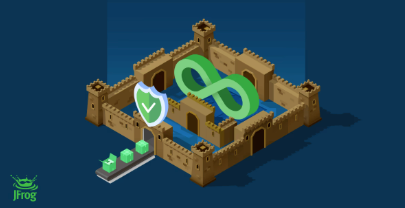
With Artifactory and Xray, organizations can centralize vulnerability scanning, compliance enforcement, and artifact management across AWS, Azure, Google Cloud, and on-premises environments. The platform solves the multicloud challenge technically by utilizing a federated control plane, rather than forcing teams to manage separate, siloed instances. Supported by an active-active High Availability (HA) deployment topology and robust replication architectures, Artifactory and Xray synchronize binaries and security metadata globally, ensuring consistent policy enforcement regardless of where a workload is deployed.
Complementing your existing cloud security stack
Organizations evaluating multicloud security often ask how JFrog integrates alongside existing Cloud-Native Application Protection Platforms (CNAPP) like Prisma Cloud, Wiz, or Lacework. These solutions are complementary layers rather than competing ones. While CNAPP tools focus on monitoring cloud runtime posture and infrastructure configurations, JFrog secures the software supply chain before anything reaches the cloud. For teams already using source-level scanners like Snyk or Mend, JFrog adds a complementary layer, scanning compiled binaries and container images that source scanners never see, and providing artifact lineage across the full supply chain. By focusing on pre-production artifact security, binary-level analysis, and automated promotion gates, JFrog ensures that vulnerabilities are blocked at the build stage, serving as a critical first line of defense.
To deliver a complete multicloud security story, the platform extends beyond basic scanning with additional, deeply integrated modules:
- JFrog Curation: Blocks malicious packages at the proxy level before they ever enter your development environment or cloud infrastructure.
- JFrog Advanced Security: Enhances your posture with contextual analysis, secrets detection, and Infrastructure as Code (IaC) scanning to catch misconfigurations before cloud provisioning.
- JFrog Connect: Provides critical runtime visibility into your cloud and edge deployments, closing the loop between the registry and production.
By embedding this comprehensive security directly into the pipeline, JFrog enables your development and security teams to build once, secure comprehensively, and deploy anywhere with verifiable artifact integrity.
Start a free trial or schedule a demo to see how JFrog federates security across your cloud environments.