NVIDIA
  カーソル
カーソル  GitHub


 Docker
  Maven
Maven  金融サービス
  公共機関
公共機関  テクノロジー
  医療
医療  ゲーミング
ゲーミング  自動車
自動車  Enterprise


Definition
Typosquatting is a cyber attack where malicious actors develop software packages using names that closely mimic legitimate ones to deceive users.
Overview
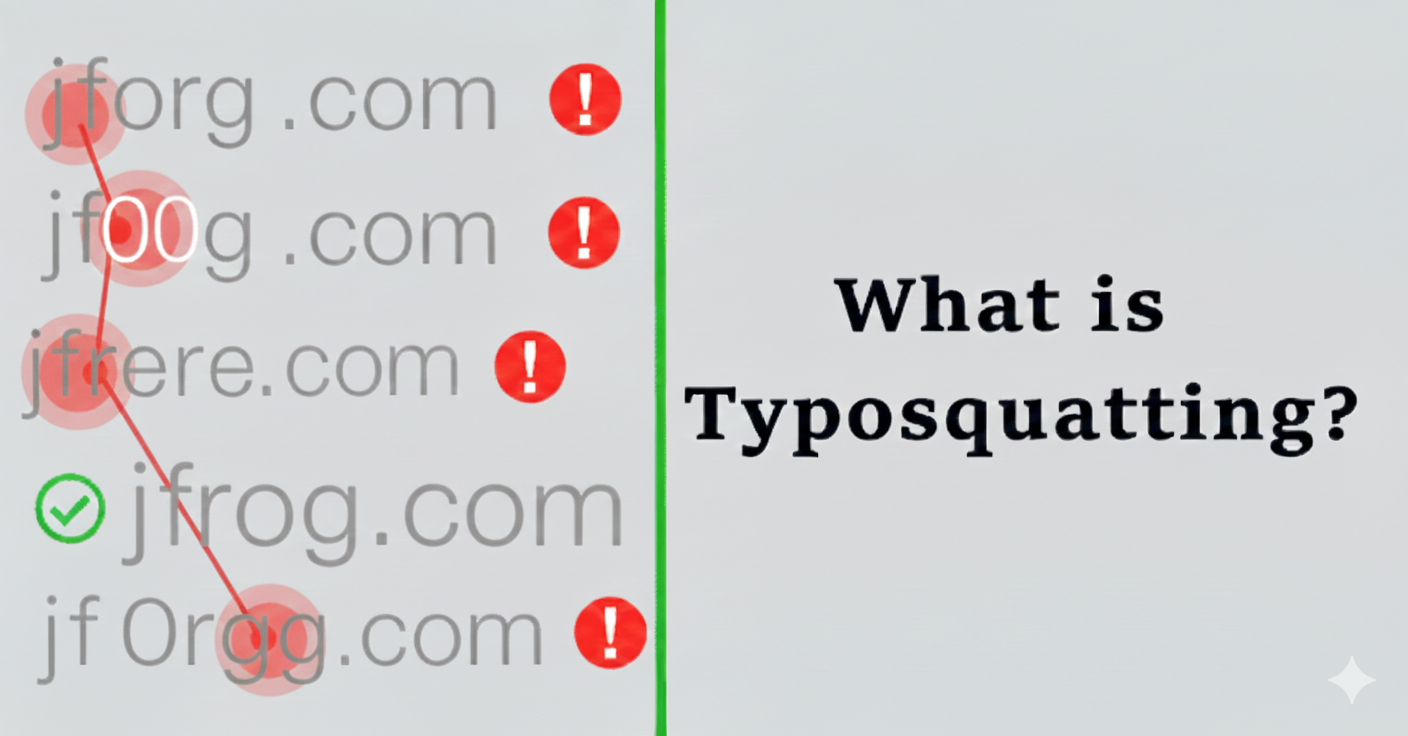
Typosquatting in the software supply chain is a deceptive attack where malicious actors publish packages or artifacts with names resembling legitimate ones. By exploiting common human errors—such as typos, misspellings, or overlooked character swaps—attackers trick developers into downloading and using compromised components. These attacks can have far-reaching consequences, from data theft to full system compromise.
As organizations increasingly rely on third-party and open-source software, typosquatting has become one of the most significant threats to software supply chain security. Understanding how these attacks work, their impact, and how to prevent them is critical to safeguarding development environments and protecting end users.
What is Typosquatting?
Typosquatting is a form of cyber attack in which attackers create malicious software packages with names nearly identical to legitimate ones. For example, a developer intending to install requests might accidentally install requets or reqeusts. These near-identical names can be difficult to detect at a glance, making typosquatting a persistent risk in package ecosystems like npm, PyPI, and Maven.
In the software supply chain context, typosquatting targets developers and organizations who depend on open-source repositories and artifact registries. Unlike traditional phishing or domain typosquatting, which target end users, this variant focuses directly on developers and DevOps pipelines. Once a malicious package is introduced, attackers can exfiltrate data, install backdoors, or disrupt operations.
Understanding Typosquatting in the Software Supply Chain
The main goal of typosquatting is to insert malicious code into trusted environments by preying on human error. Developers often work quickly, relying on command-line interfaces or automation to install dependencies. A small typo, unnoticed, can result in downloading an attacker-controlled package.
Typosquatting is distinct from dependency confusion attacks, where malicious packages use the same name as internal dependencies but appear in public repositories with a higher version number. While both target the supply chain, typosquatting relies on human mistakes rather than version hijacking.
Real-life examples highlight the threat. In 2021, security researchers discovered hundreds of typosquatted packages uploaded to PyPI that attempted to steal credentials or open reverse shells. Similarly, typosquatting has been reported in npm, targeting widely used packages by swapping or omitting single characters. These incidents illustrate how easy it is for attackers to exploit trust in public ecosystems.
The Impact of Typosquatting on Software Supply Chains
Typosquatting attacks can have severe consequences for developers, organizations, and end users. The problems range from direct security breaches to longer-term reputational damage.
For developers, typosquatting undermines productivity and introduces hidden risks into their codebases. Installing even one malicious package can compromise local environments, developer credentials, and connected systems.
For organizations, the consequences are broader. Typosquatting can lead to stolen data, compromised intellectual property, or backdoors embedded in production systems. These risks often translate into regulatory penalties, financial losses, and erosion of customer trust. High-profile incidents show that even one misstep in the supply chain can ripple through entire ecosystems, affecting thousands of downstream users.
Ultimately, typosquatting in the software supply chain demonstrates how fragile modern development pipelines can be if safeguards are not in place.
Identifying Vulnerabilities to Typosquatting
Recognizing typosquatting attempts is a critical defense step. Common indicators include package names that closely resemble legitimate ones, unusual maintainers or versioning patterns, and newly published packages with high download activity.
Organizations can use tools and techniques such as automated repository scanning, digital signatures, and policy enforcement to reduce exposure. Security solutions that integrate with software supply chain security practices help teams detect anomalies across registries and block suspicious packages before they are installed.
Assessing your supply chain for vulnerabilities also means reviewing internal processes. Are developers verifying package sources? Are automated tools flagging inconsistencies? Are third-party dependencies continuously monitored? Addressing these questions strengthens resilience against typosquatting attempts.
Mitigating Typosquatting Risks
Preventing typosquatting requires layered controls: reduce human error, restrict dependency sources, and enforce automated checks in CI/CD. Teams should install dependencies deterministically (lockfiles), consume packages only from approved registries, and treat dependency changes as high-risk changes.
Best practices include:
- Maintaining allowlists (or approved catalogs) for trusted packages and maintainers.
- Requiring review and approval for new dependencies.
- Detecting look-alike names and suspicious metadata automatically.
- Educating developers on naming tricks (swaps, missing characters, Unicode lookalikes).
- Blocking unknown maintainers
- Enforcing provenance policies
- Blocking newly published backages younger than X days (adjust the threshold based on your organization’s risk tolerance)
From a DevSecOps perspective, combine these controls with (Software Component Analysis (SCA) and Software Bill Of Materials (SBOM) generation to improve dependency visibility and governance, and automate enforcement to prevent malicious packages from reaching build and production
The Role of Artifact Repositories in Supply Chain Security
Artifact repositories play a central role in defending against typosquatting. By acting as a controlled gateway for software components, repositories allow organizations to curate and secure the packages used in development.
A secure artifact repository should include features such as:
- Package authenticity verification.
- Built-in scanning for malicious or typosquatted packages.
- Role-based access controls and audit logging.
With these safeguards, organizations can ensure developers consume only validated components. JFrog Xray, when combined with the repository capabilities of the JFrog Platform, extends this protection by continuously scanning binaries and dependencies for risks. Xray correlates typosquatting attempts with metadata, threat intelligence, and usage context, helping teams prioritize remediation.
Future Trends in Typosquatting and Supply Chain Security
Software supply chain security is rapidly evolving as both threats and defensive measures become more sophisticated.
Emerging Threat Vectors
- AI-Driven Campaigns: Attackers are leveraging AI to generate typosquatted packages that mimic legitimate metadata and documentation, making them harder to distinguish from the original.
- Cross-Ecosystem Attacks: New strategies target multiple repositories (e.g., npm and PyPI) simultaneously to increase the surface area for potential infection.
- Social Engineering Integration: Typosquatting is increasingly paired with social engineering, such as fake pull requests or documentation links, to trick developers into manual installations.
Advancements in Defense
- Automated Pattern Recognition: Repository maintainers are using machine learning models to analyze naming patterns and flag suspicious artifacts in real-time.
- Strengthened Governance: Major registries are implementing stricter verification policies and faster takedown procedures for reported malicious packages.
- Proactive Monitoring: Tools are shifting toward continuous scanning of dependency trees to identify “look-alike” packages before they reach production.
Organizational Strategy
To stay ahead of these trends, organizations must shift from reactive fixes to a layered defense model:
- Deep DevSecOps Integration: Embedding security checks directly into the CI/CD pipeline.
- Automation: Using tools that automatically flag mismatched package names against known “gold-standard” libraries.
- Continuous Education: Training developers to recognize common typosquatting patterns during the dependency selection process.
Typosquatting will likely remain a persistent issue, but with layered defenses, organizations can significantly reduce its impact.
Typosquatting and JFrog
While typosquatting is a supply chain-wide problem, it can be mitigated with enterprise-grade solutions that combine prevention, detection, and remediation. The JFrog Platform integrates artifact repositories, automated scanning, and DevSecOps workflows to provide a comprehensive defense.
By leveraging features such as policy enforcement, dependency context analysis, and continuous scanning, JFrog enables teams to detect and block typosquatted packages before they compromise systems. With SCA, SBOM, and Xray vulnerability scanning, organizations gain full visibility into dependencies, ensuring the integrity of their software supply chains. With JFrog, typosquatting prevention becomes part of a secure, automated development workflow—protecting developers, organizations, and end users alike.
For more information, please visit our website, take a virtual tour, or set up a one-on-one demo at your convenience.