Claude
  Cursor
  Codex
Codex  Hugging Face
  NVIDIA
  Visual Studio Code
  Devin
Devin  Kiro
Kiro  Open Code
  NanoClaw
 Docker
  npm
npm  PyPy
PyPy  Wiz
Wiz 
 金融サービス
  ゲーム・エンタメ
  公共部門
公共部門  自動車
自動車  テクノロジー
  ヘルスケア
ヘルスケア 


Definition
The Model Context Protocol is an open, universal standard for connecting AI models to organizational data sources and tools. It enables these integrations through a standardized JSON-RPC communication specification, creating a consistent bridge between AI and real-life systems.
Overview of the Model Context Protocol
MCP serves as a universal bridge between external AI models and your internal systems. It isn’t a database, an execution engine, or a model itself. It’s a standardized communication protocol (built on JSON-RPC), built by Anthropic in 2024, that securely connects AI to the real-time, proprietary tools and information it needs to be useful.
Early AI models had no built-in way to access secure, real-time enterprise data and systems. Getting them connected meant writing custom integration code for every model-and-data-source pairing, a brittle approach that didn’t scale.
MCP solves this with a single, unified layer. Traditional APIs require the model to know the specific details of every endpoint. Software development kits (SDKs) lock integrations to particular programming languages. MCP sidesteps both constraints by providing one universally adaptable layer for moving data and invoking tools. Crucially, this gives AI models the power to change things in the real world. Rather than just generating text inside an isolated chat interface, the model gains the agency to delete data, modify configurations, write files, and change permissions across your systems. This eliminates the need for custom code every time a new integration is needed.
How MCP compares to existing tool frameworks
Technical evaluators already utilizing AI agent frameworks frequently ask how MCP compares to native features like OpenAI function calling, Anthropic tool use, or orchestration libraries like LangChain. The short answer is that MCP does not replace these technologies; rather, it operates at an entirely different infrastructural layer.
OpenAI function calling and Anthropic tool use are request-level APIs that allow a specific model to understand and generate structured data for tool execution. LangChain provides application-level abstractions for orchestrating those agent behaviors. MCP, conversely, is a system-level, vendor-neutral transport protocol.
An AI application built with LangChain can still use native OpenAI function calling to trigger an action, but MCP standardizes how that action is securely routed to the external data source. This decoupling means you can build a tool once as an MCP server and expose it to any model or framework, completely eliminating the need to maintain siloed integration code for every AI provider.
Impact of MCP on development workflows
These technical advantages directly improve how teams manage complex AI integrations. By utilizing a standardized protocol, developers can focus on core logic rather than managing disparate data formats or connection protocols.
The separation of the AI layer from the data source layer creates a more modular environment. This modularity allows organizations to adapt their infrastructure to meet changing requirements without disrupting the existing AI assistant or agent functionality.
What are the Key Components and MCP Architecture?
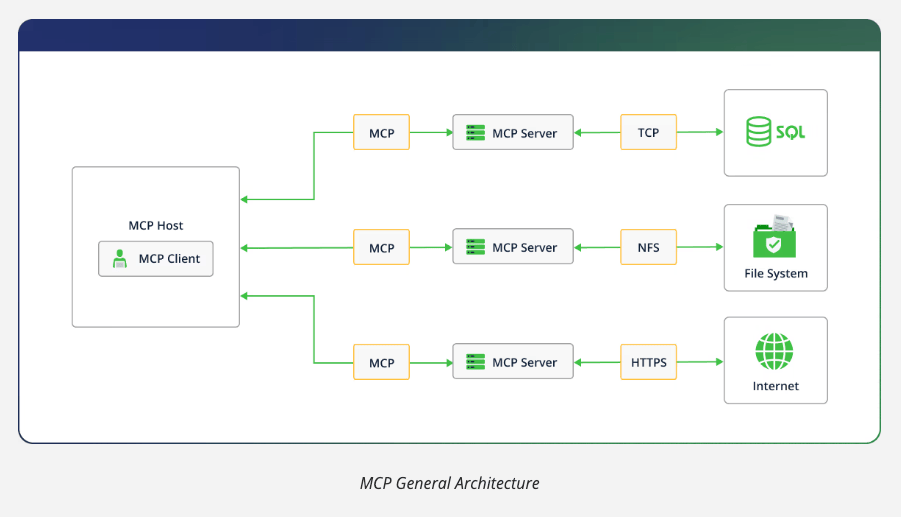
The MCP architecture utilizes a strict client-server model to route context securely. In this framework, MCP clients are typically AI-integrated applications or integrated development environments (IDEs). These clients interface with MCP servers, which function as lightweight proxies to data sources and expose executable functions known as tools.
During a context exchange, the client issues a request that prompts the server to execute a specific tool. The server then retrieves and formats raw data into a standard MCP schema before returning it to the client. This lifecycle begins with a handshake and capability negotiation, followed by structured JSON-RPC requests and deterministic responses.
While the protocol is primarily designed for stateless interactions, stateful sessions can be implemented using session IDs within the transport layer. MCP ensures extensibility by operating over standard transport layers, including standard input/output (Stdio) for local processes and Server-Sent Events (SSE) for remote network connections.
What are MCP tools?
To retrieve data, the protocol relies on precisely defined capabilities known as tools. In the MCP ecosystem, tools are strictly defined as executable functions exposed by an MCP server. They include a JSON schema detailing required input arguments and expected output formats, acting as the precise API endpoints that translate abstract AI intent into concrete infrastructure operations.
Real-world examples of MCP tool names include:
read_local_filefor interacting with a file system.github_create_issuefor interacting with source control.scan_artifact_vulnerabilitiesfor interacting with security platforms.
What are agent skills?
To understand agent skills in practice, it is helpful to look at how they are actually constructed. The native plugins and skills used by modern coding agents are fundamentally composed of MCP servers. These servers bundle specific tools together to give the AI model its capabilities.
Depending on how they are hosted and consumed, these MCP-powered skills generally fall into three categories:
- Remote (URL): These servers are hosted externally and accessed via a web endpoint. Because they are not downloaded or installed locally, they cannot be managed as traditional software artifacts. Instead, governance and security control must be enforced strictly at the runtime and network levels.
- Open-Source Packages: Many MCP servers are distributed through standard open-source ecosystems like npm, PyPI, or as Docker images. These possess all the characteristics of standard OSS packages. They can be easily downloaded from public registries and installed locally, meaning they should be treated and scanned as standard software artifacts.
- Custom: Organizations frequently develop their own proprietary MCP servers for internal use only. These custom servers act as a secure bridge, helping internal coding agents safely access, interact with, and modify private enterprise systems.
Integration with Existing Systems
Integrating MCP means deploying specific servers alongside existing infrastructure. By integrating MCP with CI/CD pipelines, AI agents can query build statuses or retrieve log data to assist in automated debugging. When connecting MCP to developer tools and platforms like IDEs or version control systems, built-in AI assistants can seamlessly request local workspace context.
Using MCP alongside existing APIs and services is straightforward; MCP does not replace representational state transfer (REST) or GraphQL APIs; it simply wraps them, translating standardized model requests into specific legacy API calls. This makes it a crucial asset for platform engineering and internal developer platforms (IDPs), allowing teams to standardize how AI tools access internal components securely.
Getting Started with MCP: Implementation and Setup
When you are ready to implement the protocol, the setup process depends on the type of MCP server you are using.
- For Pre-Built or Remote Servers: The process is highly streamlined. You bypass development entirely and simply obtain the transport uniform resource locator (URI) for the existing server to configure your MCP client.
- For Custom Servers: The process requires a development phase. Begin by identifying your required data sources and selecting an MCP SDK, such as Python or TypeScript. Next, develop a server script that defines your tools and data retrieval logic. You must then deploy this server into a secure environment with authorized access to your target data.
Regardless of which path you take, the final step is identical. You complete the setup by configuring the client, initiating a handshake between the client and the server, and verifying that the tools are successfully discovered.
Common Use Cases for MCP
MCP is highly versatile, granting AI models access to operational reality. The protocol enables a wide array of powerful integrations:
- AI-Assisted DevOps: Agents can query cluster states to suggest operational optimizations.
- Artifact Management: Models can instantly identify dependency trees or binary versions for immediate repository insights.
- CI/CD Troubleshooting: MCP excels in CI/CD pipelines by fetching failure logs and suggesting code remediation.
- DevSecOps Integration: It powers security scanning by correlating vulnerability databases with source code.
- Developer Workflows: MCP powers developer self-service workflows via chatbots that provision staging environments.
The MCP is maintained through open-source collaboration. This ecosystem provides standardized SDKs and pre-configured servers, utilizing open standards to ensure broad compatibility and development consistency. MCP evolves as developers encounter edge cases, propose requests for comments (RFC), and push upstream contributions, all while adhering strictly to vendor-neutral design principles to prevent lock-in.
However, leveraging these open-source MCP servers and external dependencies introduces inherent software supply chain risks. Organizations must apply the same continuous scanning and strict vetting discipline to these ecosystem assets as they do for any other third-party component to prevent malicious packages from compromising their infrastructure.
Security Considerations and Compliance
Successful implementation requires a platform engineering ownership model in which MCP servers are treated as core infrastructure, with governance shared across development, operations, and security. This matters because MCP sits directly in the path of internal data and systems, and as AI shifts from passive interaction to active execution, the credentials and permissions granted to agents carry real operational weight. That access needs to be managed with the same rigor as any other critical piece of the stack.
Best practices for secure implementation mandate:
- Running servers in isolated environments and never as root.
- Requiring robust authentication and authorization models, such as Mutual Transport Layer Security (mTLS) or bearer tokens, for remote transports.
- Enforce strict tool-level access control, ensuring destructive operations are never exposed.
- Adhering to the principle of least privilege for AI interactions, grant the server’s service account only the exact read and write permissions required.
AppSec teams must proactively mitigate common vulnerabilities:
- Over-privileged tools can allow attackers to exfiltrate databases; this is mitigated via parameterized queries.
- Prompt injection and misuse scenarios must be handled by sanitizing all inputs server-side.
- Strict secrets management and credential leakage prevention must be enforced using secure vaults, backed by deep observability and audit logging of every tool invocation.
By aligning MCP usage with DevSecOps practices like SAST and SCA scanning, organizations ensure they are supporting regulatory and industry standards like GDPR or HIPAA. For sensitive actions, strict policy enforcement and approval workflows must be engineered to require a human-in-the-loop.
The Future of the MCP
MCP is on track to become the standard nervous system for AI, with a roadmap that includes native bidirectional streaming, AI-native platforms that ship with server interfaces built in, and continued growth in autonomous workflows. The impact on software development is already tangible. Rather than navigating dashboards and documentation, developers can query live infrastructure directly through conversation. That reduction in friction between humans, models, and systems is why MCP is increasingly regarded as foundational infrastructure glue. Sustained cross-vendor collaboration should solidify its position as a long-term open standard for the industry.
Securing AI Workflows with JFrog
The MCP provides the necessary connectivity for context-aware AI, but it also introduces new software supply chain vectors that require meticulous management. As organizations transition to autonomous AI workflows, ensuring that models and the data they ingest are secure, compliant, and traceable becomes vital for enterprise adoption.
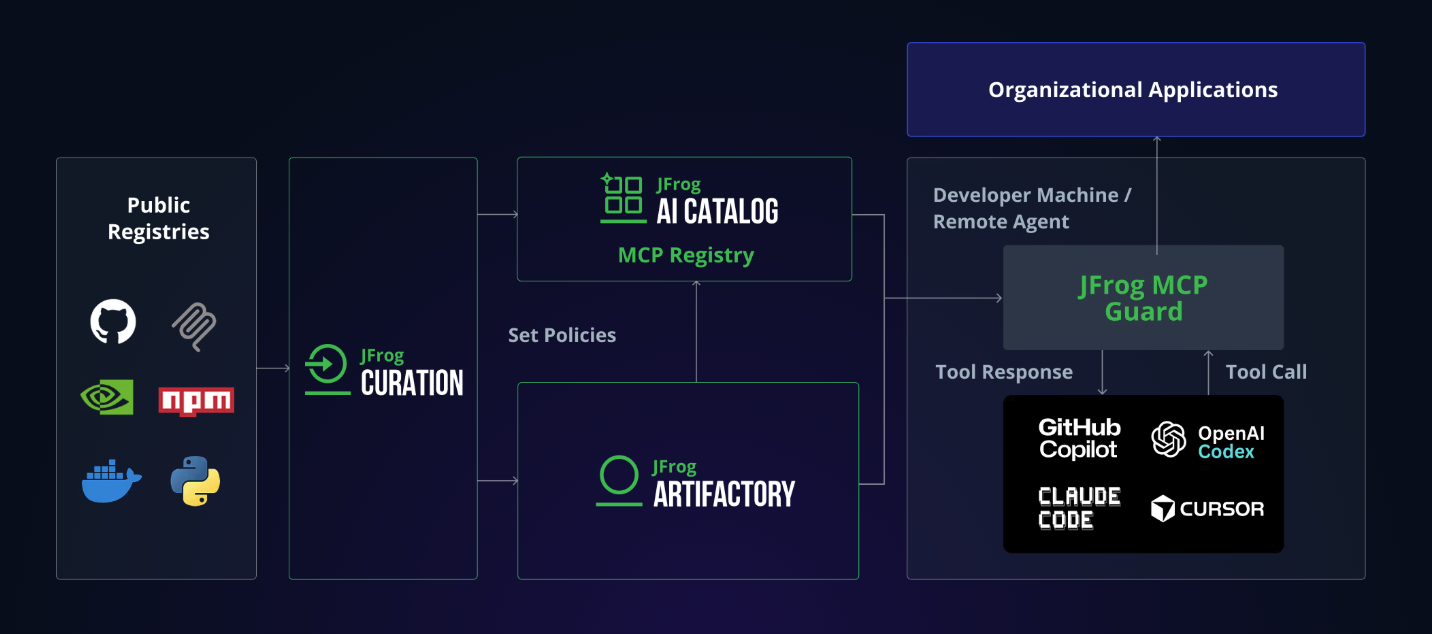
The JFrog Platform empowers you to manage, secure, and deploy the components powering your AI integrations with the same rigor applied to traditional software binaries. Rather than relying on disconnected workflows, organizations can secure their MCP infrastructure using JFrog’s comprehensive suite:
- JFrog AI Security(formerly AI Catalog) and MCP Registry serve as the enterprise-grade control plane and single system of record to discover, manage, and secure all custom and third-party MCP servers, neutralizing threats before execution.
- JFrog MCP Server provides a secure, native bridge that connects your AI coding assistants directly to the JFrog Platform, giving agents real-time context regarding your software supply chain and security posture.
- JFrog Artifactory stores and versions your MCP server packages and model files alongside your application code, providing a single, immutable source of truth.
- JFrog Xray continuously scans your MCP server dependencies, identifying and remediating vulnerabilities before they can be exploited in production.
- JFrog Advanced Security proactively detects exposed secrets, credentials, and tokens hidden within your MCP server code to prevent unauthorized access.
- JFrog Curation stops supply chain attacks early by blocking malicious packages at the proxy level before developers can download them into MCP environments.
With JFrog, you govern every AI model, agent skill, and MCP server in a single source of truth, allowing you to confidently scale AI adoption without sacrificing developer velocity or enterprise trust.
To learn more about securing your AI workflows with JFrog, book a demo or start a free trial.