Claude
  Cursor
  Codex
Codex  Hugging Face
  NVIDIA
  Visual Studio Code
  Devin
Devin  Kiro
Kiro  Open Code
  NanoClaw
 Docker
  npm
npm  PyPy
PyPy  Wiz
Wiz 
 金融サービス
  ゲーム・エンタメ
  公共部門
公共部門  自動車
自動車  テクノロジー
  ヘルスケア
ヘルスケア 


Definition
A folder of notebooks can train a model once. A pipeline retrains, validates, deploys, and monitors it on every trigger without anyone rerunning cells. It makes runs reproducible by pinning versioned data, code, parameters, and stage outputs. "End-to-end" spans the inner experimentation loop and the outer production loop; this page covers the outer loop.
What Is an End-to-End Machine Learning Pipeline?
A machine learning (ML) pipeline is the ML workflow that turns data and code into a deployed, monitored ML model. Unlike a one-time script run, a pipeline reruns the sequence on a trigger. A data pipeline moves raw data through extract, transform, load (ETL) or ELT steps and lands transformed records in a warehouse or data lake. An ML pipeline takes that output and continues through training, evaluation, serving, monitoring, and retraining. It produces a trained, versioned model together with evaluation metrics. It also produces feature definitions.
Data scientists own the inner loop, from wrangling and experimentation through model registration. Infrastructure and ML engineers own the outer loop, where the machine learning operations (MLOps) pipeline runs CI/CD through testing, staging, production, and monitoring.
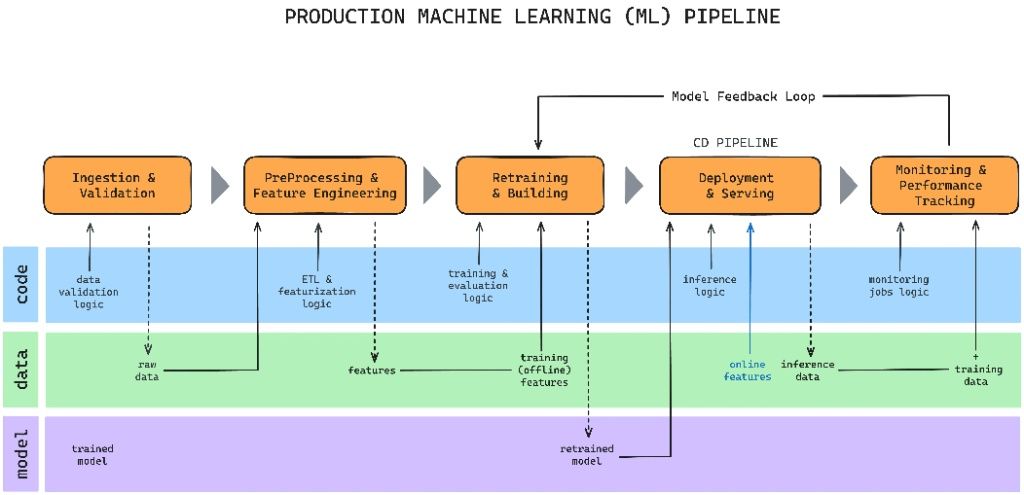
What are the Five Stages of a Production ML Pipeline?
Five stages carry data to a served model: ingestion and validation, preprocessing and feature engineering, training and versioning, deployment and serving, monitoring and retraining. Published frameworks divide the same work into anywhere from three to eleven stages but converge on the same functions.
Stage 1: Data ingestion and validation
Validation catches bad data before it becomes a bad model. Teams commonly use a distributed processing engine to handle batch data and a message broker to transport event streams. Automated data-quality and schema checks run before training so a bad snapshot never reaches the model.
Stage 2: Preprocessing and feature engineering
Engineers transform raw fields through normalization and encoding. They store the results in a feature store. A feature store’s offline store supports point-in-time-correct training sets, while its online store supports inference. Training and serving systems must use the same feature definitions. A feature store removes unintended skew from separate implementations; it does not guarantee identical values. Recomputing features through a second serving-time code path reintroduces that skew.
Stage 3: Model training and versioning
Engineers select an algorithm, split the data, tune hyperparameters, and evaluate on a holdout set. An experiment tracking tool records parameters per run; the model registry stores weights with lineage. Production model training is frequently not reproducible in practice, and a run nobody can reproduce cannot support an incident audit.
Evaluation measures quality on a holdout test set. Validation is a separate gate: the model must beat the current production baseline and clear the business threshold. A lower loss alone does not satisfy this gate. Before promotion, a pipeline runs several checks:
- Schema and data-validation checks confirm the evaluation set matches the expected feature schema.
- Slice-level metrics break aggregate scores by segment so a failing subgroup cannot hide behind a passing average.
- Infrastructure validation confirms the serving stack can load and serve the model without error.
- Training-serving skew checks compare serving logs against training features to catch silent distribution mismatches.
The pipeline must automatically block any model that passes evaluation but fails validation. Human review cannot reliably replace this gate.
Stage 4: Deployment and serving
Machine learning deployment supports batch and endpoint-backed inference.
- Inference modes: Batch jobs need no persistent endpoint. Endpoint-backed inference can use real-time synchronous requests over a REST (representational state transfer) or gRPC (Google remote procedure call) endpoint. It can also queue asynchronous requests.
- Rollout controls: Teams roll out gradually with shadow or canary deployments. A canary typically completes in minutes or hours, while an A/B test can run for days to collect statistically useful business metrics. Blue/green keeps the previous version live for a fast rollback. Sending all traffic to a new deployment without a baking period or automated rollback increases release risk.
Stage 5: Monitoring and retraining
Model monitoring tracks changes in input and prediction distributions, concept drift in the input-to-label relationship, serving latency, and error rates. Continuous training (CT) automates retraining. Five standard triggers drive retraining: on demand, on schedule, on new training data, on performance degradation, and on concept drift. Because labels often arrive long after predictions, teams use label-free proxies such as feature and prediction drift in the interim.
How MLOps and CI/CD Automate the Pipeline
CI and CD each take on a broader meaning in machine learning systems than in conventional software. CT adds a third ML-specific practice.
CI tests and validates code and data. It also checks data schemas and models before anything reaches production. CD ships the training pipeline itself as a versioned artifact. That pipeline in turn deploys the prediction service. CT is a property unique to ML systems: it retrains and re-serves models automatically when a trigger fires.
These three practices map onto a maturity ladder. At the lowest level, every step is manual and a new model version ships only a couple of times a year. At the next level, teams deploy the entire training pipeline and run it recurrently. New data can trigger a run. Performance degradation or concept drift can also trigger one. Teams may add an optional feature store and metadata store. At the highest level, CI/CD builds and tests the pipeline components, then deploys them. A model registry, feature store, ML metadata store, and pipeline orchestrator support this work.
The structural point follows directly: teams deploy the pipeline as the operational unit.
Why Do Pipelines Fail in Production?
Pipelines fail in the plumbing around the model. ML code is only a small fraction of a production ML system. The surrounding infrastructure, including configuration, data validation, serving, and monitoring, carries most of the failure surface.
- Training-serving skew: Different code paths compute features for training and serving, so a feature can be present in training data and silently missing from serving logs. The model degrades without any error surfacing, making the skew invisible until a manual audit catches it.
- Pipeline fragility: Stages without a schema contract fail quietly. Without automated schema generation and example validation as pipeline stages, a renamed upstream column can pass ingestion and leave training on a degraded feature set.
- Silent model degradation: No alert fires while accuracy erodes. A peer-reviewed practitioner survey found that organizations monitor fewer than 40% of production models.
- Unversioned artifacts: During an incident, nobody can name the dataset snapshot or commit behind the live model.
- Manual retraining: The same survey found that 70.9% of surveyed organizations do not automate retraining and redeployment, so a person decides when the model refreshes.
ML Pipeline Artifact Security and the Software Supply Chain
Dataset snapshots, feature definitions, serialized model files, and images can introduce supply chain risk when teams import or promote them without provenance and integrity checks. Inference endpoints create a separate runtime attack surface. PyTorch’s documentation warns that torch.load() implicitly uses the insecure pickle module, and pickle-based serialization remains widespread among popular pretrained Hugging Face models, meaning that importing weights can execute untrusted code unless the team scans the file first.
To mitigate risk, teams must vet third-party base models and open-source ML packages before they enter the training pipeline. The joint UK National Cyber Security Centre (NCSC) and US Cybersecurity and Infrastructure Security Agency (CISA) secure AI guidance tells teams to treat imported third-party weights as untrusted code, scanning and isolating them on the way in.
Current bill-of-materials formats now carry dedicated model card fields for a machine learning bill of materials (ML-BOM), giving teams a structured way to inventory model assets alongside traditional software components. Model signing covers weights, configuration, tokenizers, and datasets as one verifiable unit, so any tampering anywhere in that bundle is detectable before deployment. A practical pattern is to make the registry the trust boundary and promote only scanned, signed builds to serving.
What are Best Practices for Building Reliable ML Pipelines?
These controls make a pipeline auditable and rerunnable:
- Version pipeline configs and feature definitions as code.
- Keep models and datasets with their dependencies in one audited registry.
- Compute features once, in a feature store.
- Trigger retraining automatically on drift thresholds.
- Scan model files and dependencies before promotion; sign what passes.
- Log input distributions and feature values. Record predictions too.
- Keep the previous model deployable for one-config rollback.
Common Questions About End-to-End Machine Learning Pipelines
These answers distinguish production ML pipelines from adjacent MLOps components.
What is a machine learning pipeline?
An ML pipeline is an automated, auditable sequence from raw data to a monitored model. Loose scripts do not provide orchestration or repeatable lineage and promotion controls unless engineers add them.
What is end-to-end learning, and is it the same as an end-to-end pipeline?
End-to-end learning is a modeling technique that trains a single model to map raw input directly to the final output. For example, it can map audio straight to text instead of routing it through a separate phoneme stage. An end-to-end ML pipeline is the operational workflow that carries data through ingestion, training, deployment, and monitoring. The two terms are not interchangeable: an end-to-end learning model still needs an end-to-end pipeline to reach and stay in production.
What are the main stages of an end-to-end ML pipeline?
The stages cover ingestion and validation, feature engineering, training and versioning, deployment and serving, monitoring, and retraining.
What is the difference between a data pipeline and an ML pipeline?
A data pipeline ingests and transforms raw data. It lands records in a warehouse or lake for analysis. An ML pipeline consumes that prepared data and produces a trained model with evaluation metrics. It also produces feature definitions. The artifacts differ: an ML pipeline writes to a model registry and feature store. It also writes to an ML metadata store, none of which a data pipeline requires. Triggers differ too. Data pipelines run on a schedule or on demand. While data pipelines run on a schedule or on demand, ML pipelines introduce dynamic triggers based on new training data, performance degradation, or concept drift. Furthermore, ML pipelines shift the monitoring focus from data freshness and row counts to feature distributions, prediction distributions, and overall predictive quality.
What is model drift and how does a pipeline address it?
Changes in data or input-output relationships can degrade model performance. Teams test input-feature and prediction distributions, then retrain when a threshold trips.
How do ML pipelines relate to MLOps?
MLOps is the discipline for running models in production. The pipeline is its main building block, wrapped in version control and governance, including CI/CD for machine learning.
How does CI/CD for machine learning differ from software CI/CD?
While traditional CI focuses primarily on testing code, continuous integration in ML must also validate data, schemas, and model performance. Continuous delivery (CD) also shifts in scope: instead of deploying a final application, teams deploy the training pipeline as an artifact, which in turn deploys the prediction service. Furthermore, ML introduces continuous training (CT), a unique requirement to automate retraining as conditions change. Ultimately, a passing unit test suite alone does not prove an ML model is fit to promote.
What role does a model registry play in an ML pipeline?
The model registry stores trained model versions and connects each build’s metadata to its metrics. That lineage identifies the data and code behind the live model.
Should you use a managed ML platform or a self-hosted open source stack?
Managed services bundle orchestration, serving endpoints, traffic splitting, and monitoring behind one control plane, which accelerates setup at the cost of ecosystem lock-in and limited portability across clouds. Teams can assemble a self-hosted stack from open-source components: a workflow orchestrator, an experiment tracking and model versioning tool, a feature store, and a model serving runtime. This approach keeps the pipeline portable and fully inspectable, but makes the team responsible for integration and ongoing upkeep. Platform and ML engineering teams should choose based on regulatory or air-gapped deployment constraints. They should also assess existing Kubernetes capacity and the number of clouds they operate on. Either way, no single tool covers the full lifecycle, so multi-tool pipelines are the industry standard.
How JFrog Helps Build Secure ML Pipelines
Reliable ML pipelines version every artifact, validate each promotion, preserve lineage, and keep rollback paths. Those controls make model builds reproducible and prevent unverified artifacts from reaching serving environments.
The JFrog Software Supply Chain Platform provides one system of record for software and AI artifacts from developer to runtime:
- JFrog ML covers model training, deployment, monitoring, fine-tuning, and feature lifecycle management.
- JFrog AI Catalog enforces policy on models and Model Context Protocol (MCP) servers. It requires vetting and signing for all model files behind agent skills. It also requires verification and scanning before execution, and flags shadow AI.
- JFrog Artifactory stores pipeline outputs, including Hugging Face, GGUF, ONNX, and Safetensors models, as versioned binaries with checksum-based deduplication.
- JFrog Curation blocks risky open-source ML packages at ingestion through its Package Traffic Controller.
- JFrog Xray recursively scans ML models and transitive dependencies against a database of 4M+ open-source packages.
For additional security detail, review findings on malicious Hugging Face models, PickleScan vulnerabilities, the 2026 supply chain report, and AI Catalog governance.
Point your training pipeline’s model output at an Artifactory model repository and scan the first artifact before it reaches staging.
Ready to apply these controls to your own ML pipeline? Book a demo to walk through the setup with a JFrog engineer or start a free trial of the JFrog Software Supply Chain Platform to test artifact scanning and policy enforcement against your own models. Either path gives you a concrete starting point rather than a theoretical one.