Claude
  Cursor
  Codex
Codex  Hugging Face
  NVIDIA
  Visual Studio Code
  Devin
Devin  Kiro
Kiro  Open Code
  NanoClaw
 Docker
  npm
npm  PyPy
PyPy  Wiz
Wiz 
 金融サービス
  ゲーム・エンタメ
  公共部門
公共部門  自動車
自動車  テクノロジー
  ヘルスケア
ヘルスケア 


Definition
Exposure management is an integrated security process that continuously evaluates an organization's entire digital attack surface to discover, validate, and prioritize exploitable vulnerabilities. By analyzing business context, network reachability, and control gaps, it extends traditional scanning beyond isolated severity scores. This approach prevents attackers from exploiting chained security flaws, reducing the remediation backlog to actionable risks. Effective programs streamline cross-team workflows to fix high-risk issues before exploitation occurs.
Overview of Exposure Management
Exposure management continuously identifies and prioritizes the weaknesses an attacker could use, including vulnerable software and security-control gaps such as misconfigurations or excessive permissions. A point-in-time vulnerability scan produces a severity-ranked list; exposure management asks whether an attacker can reach the flaw and what it chains with. Google Cloud’s Security Command Center calls those chains “toxic combinations”: “groups of security issues forming a path to high-value resources that an attacker could potentially exploit.”
Teams rank findings by business context that now includes cloud accounts and build systems, including code repositories. The same flaw carries different weight on a payment system than on a test server, so ordering starts from asset ownership and network reachability, then data sensitivity.
Exposure Management vs. Vulnerability Management
A vulnerability is a weakness; an exposure is a vulnerability an attacker can reach and exploit in context. Vulnerability management scores and patches individual CVEs by CVSS severity.
A CVSS 5.3 flaw on an internet-facing service holding customer data can outrank a CVSS 9.8 bug on an isolated internal host. Exposure management extends that judgment to identities, misconfigurations, and the paths between them.
The Exposure Management Lifecycle (CTEM)
Gartner introduced Continuous Threat Exposure Management (CTEM) in July 2022 and defines it as “an integrated, iterative approach to prioritizing and continually refining security posture improvements.” The five stages run as a loop rather than a quarterly audit cycle. Gartner predicts that “By 2026, organizations that embrace CTEM will see two-thirds fewer breaches.”
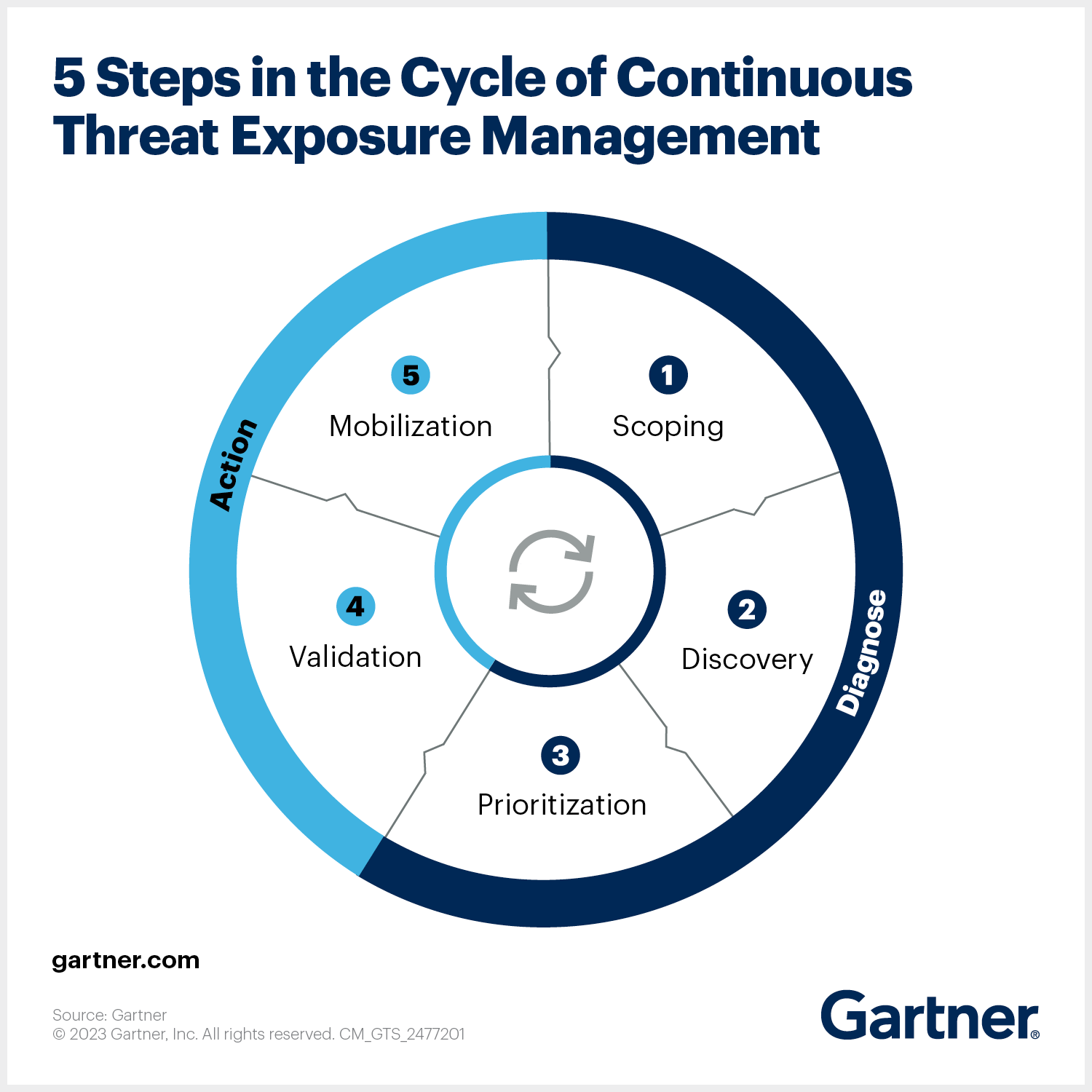
Scoping
Teams define which systems and risk categories fall in scope: external attack surface, SaaS posture, supply chain systems.
Discovery
In discovery, teams inventory in-scope assets and their risk profiles, including CVEs, misconfigurations, identity risks, shadow IT, and excessive permissions.
Prioritization
Teams rank exposures by urgency, severity, ability to remediate, and level of risk, so vulnerability prioritization stops running on raw CVSS score alone.
Validation
Confirm exploitability with red teaming or penetration testing; breach and attack simulation (BAS) can provide automated validation. Then verify the fix closed the path.
Mobilization
Teams route validated exposures to the asset owner and track vulnerability remediation against approval workflows and service-level agreements (SLAs). Gartner notes that teams cannot automate every remediation decision.
Core Components of an Exposure Management Program
Discovery and cloud posture tools cover part of the program. Most teams also consolidate validation feeds in an exposure management platform so security teams rank findings against one asset inventory rather than five.
EASM and CAASM
External attack surface management (EASM) discovers internet-facing assets, including shadow IT. Cyber asset attack surface management (CAASM) aggregates known-asset data through API integrations. Gartner describes EASM as “a source of record and feeds into CAASM for added visibility.”
CSPM and CIEM
Cloud security posture management (CSPM) detects cloud misconfigurations and drift. Cloud infrastructure entitlement management (CIEM) finds excessive entitlements that traditional IAM cannot analyze.
Threat Intelligence and BAS
CISA’s Known Exploited Vulnerabilities (KEV) catalog, with more than 1,600 entries, confirms exploitation in the wild. The Exploit Prediction Scoring System (EPSS) estimates exploitation probability within 30 days. BAS tools run safe simulations mapped to MITRE ATT&CK to test control coverage.
Benefits of Exposure Management
Exposure management changes what the remediation team works on and what leadership sees:
- A smaller queue: Veracode’s 2026 State of Software Security found 82% of organizations carry security debt; reachability analysis lets teams cut that backlog to the exploitable subset.
- Faster remediation of what matters: Edgescan’s 2026 report puts average time to remediate at 54.8 days; ranking by reachability moves the breach-likely exposures to the front of that queue.
- Board-ready risk reporting: Report risk to executives by business system instead of CVE count.
- Compliance evidence: GDPR Article 32 requires regular testing, and PCI DSS external scans are required every three months. HIPAA’s §164.308 requires risk analysis and risk management. A continuous program keeps evidence current for each framework.
Exposure Management and the Software Supply Chain
Exposures originate upstream in source code, dependencies, container images, and build artifacts. Sonatype counted 454,600 new malicious packages in 2025, up 75% year over year. The build pipeline is an exposure surface as well. In March 2025, the tj-actions/changed-files compromise reached more than 23,000 repositories.
A software bill of materials (SBOM) is the discovery inventory for this surface: CISA recommends feeding it into vulnerability and asset management tools; VEX (Vulnerability Exploitability eXchange) records whether a specific vulnerability affects each component. NIST SP 800-218 (SSDF) requires collecting and sharing provenance data for each release, and frameworks such as the SLSA framework give teams a way to record it. Artifact promotion gates block any component with a validated exposure before it reaches production.
Best Practices for Implementing Exposure Management
Programs that stall usually started ranking findings before they finished discovery:
- Start with asset discovery: Establish EASM and CAASM coverage before ranking anything.
- Add business context before ranking: Map assets to the systems and data they touch.
- Validate before spending: Confirm exploitability with attack path analysis or BAS.
- Extend upstream: Cover build pipelines and artifact registries, including dependency ingestion points, as part of the same program.
- Track lifecycle metrics: Measure time-to-detect and time-to-remediate. Track recurrence rate too.
- Automate the low-risk fixes: Mondoo’s 2025 data shows 62% of remediation workflows are still manual; send high-confidence fixes to automation and keep human review for the rest.
FAQ
Exposure management, vulnerability management, and attack surface management address distinct stages of risk identification and remediation across the software delivery lifecycle.
What Is the Difference Between ASM and Exposure Management?
ASM feeds exposure management as a data source rather than replacing it. Exposure management adds ranking, validation, and the routing of fixes to owners.
Is Exposure Management the Same as Vulnerability Management?
No, vulnerability management scores and patches individual CVEs, while exposure management also weighs lower-severity issues that combine into an attack path.
How Does Attack Surface Management Relate to Exposure Management?
You cannot prioritize what you cannot see, so mature programs treat ASM as the discovery foundation. Gartner describes EASM as a source of record that feeds CAASM, and exposure management layers prioritization and remediation on top of both.
What Tools Are Commonly Used for Exposure Management?
Programs typically combine EASM, CAASM, CSPM, CIEM, vulnerability scanners, and BAS. Teams consolidate that output in one exposure management platform so ranking runs against a single inventory.
What Is CTEM (Continuous Threat Exposure Management)?
Gartner introduced CTEM in 2022 as a program model rather than a product category. It runs scoping, discovery, prioritization, validation, and mobilization as one continuous loop using tools teams already own.
What Is the Difference Between CAASM and EASM?
EASM looks from the outside in and discovers unknown internet-facing assets. CAASM looks from the inside out, aggregating records from tools already deployed via API.
How JFrog Helps With Exposure Management
Exposure management works when discovery, business context, validation, and routing run as one continuous loop. The JFrog Software Supply Chain Platform extends the CTEM cycle upstream to where exposures first enter the pipeline, so fewer of them reach production, and the downstream queue stays smaller.
- JFrog Xray: Software composition analysis covers software and AI artifacts while generating SBOM data for exposure inventories.
- JFrog Advanced Security: Contextual analysis determines whether CVEs are exploitable in your codebase, ensuring teams prioritize the findings an attacker can reach.
- JFrog Curation: Policies block vulnerable and malicious open-source packages and ML models at ingestion, before an exposure ever enters the pipeline.
- JFrog Connect: Runtime monitoring delivers real-time visibility into vulnerabilities across running workloads.
See how the JFrog Platform handles security across the software supply chain with by starting a free trial or scheduling a demo today.