NVIDIA
  カーソル
カーソル  GitHub


 Docker
  Maven
Maven  金融サービス
  公共機関
公共機関  テクノロジー
  医療
医療  ゲーミング
ゲーミング  自動車
自動車  Enterprise


Definition
The principle of least privilege is an operating paradigm where every subject in a system, whether a user or application component, can access only the information and resources that are strictly necessary for their requirements.
Overview of the Principle of Least Privilege
The Principle of Least Privilege (PoLP) is a foundational concept and core security practice in computing and information technology.It asserts that any user, program, or process should be given only the minimum access rights or permissions necessary to perform its intended job or function, and for no longer than required.
In today’ enterprise environments, especially those utilizing DevOps and cloud-native architectures, the principle applies not just to human users but, critically, to non-human entities such as automated scripts, microservices, containers, CI/CD pipeline agents, and serverless functions.
Historical Context and Evolution
Initially, PoLP was primarily applied to traditional operating system roles, such as Unix user groups and file system permissions. With the rise of the internet, distributed systems, and modern DevSecOps practices, the scope of the principle of least privilege has dramatically expanded:
- 1970s–1990s: Primarily focused on operating system security and kernel integrity.
- 2000s (Enterprise): Applied to network segmentation and database access control.
- 2010s–Present (Cloud & DevOps): Extended to encompass cloud Identity and Access Management (IAM) for services, secrets management, CI/CD pipeline agents, Infrastructure as Code (IaC) tools, and automated security scanning tools.
Key Terms Related to Least Privilege
Understanding the principle of least privilege requires familiarity with related terminology, especially in a security context:
| Term | Definition in a PoLP Context |
|---|---|
| Privilege Creep | The gradual accumulation of unnecessary access rights over time, often because a user changes roles but retains old permissions. |
| Just-in-Time (JIT) Access | A modern approach to least privilege where access rights are granted automatically only when requested, and only for a specific, limited duration (e.g., 30 minutes), and then immediately revoked. |
| Zero Trust | A security model built on the foundational concept of “never trust, always verify.” |
| Separation of Duties (SoD) | A concept that prevents any single individual from executing a complete high-risk task. This is achieved by distributing the required privileges across multiple users or processes, each operating under least privilege. |
| Non-Human Identity | Any software entity (service account, API key, container, pipeline agent) that requires permissions to execute a task. |
How Does the Principle of Least Privilege Work?
Implementing the principle of least privilege is an ongoing strategy enforced through rigid, systematic controls rather than a single technical solution. The enforcement relies on three core mechanisms. First is the necessity of Granting Minimum Rights by following a “deny by default” model: the system starts with no rights and only grants specific, minimal permissions absolutely required for a specific task.
At the operational level, PoLP is enforced by carefully modeling User Roles and Permissions. Every entity is assigned a specific identity, which is then mapped to a defined role based on its job function (e.g., “Deployment Engineer,” “Security Auditor”). These roles, in turn, are granted only the granular permissions—the specific actions an identity can take on a resource—needed to function. The best practice here, especially in automated environments, is creating fine-grained roles for service accounts, ensuring they are siloed to only what they need; for example, a service account might only have the permission to read one specific repository and write to a different, designated log stream.
Importance of the Principle of Least Privilege
The integration of least privilege is key in application security because it directly tackles the most significant risks in software delivery and system integrity. It fundamentally limits the damage an attacker can inflict. If a CI pipeline agent’s credentials are compromised—a primary vector in software supply chain attacks—the attacker’s movements are immediately contained because the stolen credentials only have minimal, scoped access. They cannot leverage this breach to deploy malware to unrelated production environments, exfiltrate customer data, or delete infrastructure, simply because the agent was never granted those high-level permissions. Furthermore, PoLP is the single most effective control against both human error and malicious insider threats, ensuring that a small mistake in a non-production environment cannot accidentally escalate into a catastrophic production failure.
Least privilege also works by significantly Reducing Attack Surfaces. Every unnecessary permission granted to an application or user is a potential vulnerability and an entry point for compromise. PoLP mandates that the application itself must be restricted in its communication—for example, a container running a transactional database should not have external internet egress access. By confining the scope of every system component, the impact of a breach is contained; a failure or exploit in one microservice will not cascade and take down the entire application stack because its permissions are isolated to its own data and internal APIs.
Finally, regulatory pressure makes the adoption of the principle of least privilege an essential requirement for compliance. Major security frameworks and data regulations—including GDPR, HIPAA, PCI DSS, SOC 2, and ISO 27001—explicitly require that access to sensitive personal data and cardholder information be strictly limited to only those individuals and processes whose job function absolutely necessitates it.
What are the Best Practices for Implementing the Principle of Least Privilege?
Achieving a comprehensive least privilege posture requires a mature strategy that blends security governance with automation and developer enablement. One of the most critical practices is consistently conducting access reviews and audits to proactively fight privilege creep.
When designing the foundational structure, optimizing Role-Based Access Control Strategies is key. This means avoiding unnecessary role overlap and designing smaller, more granular roles; instead of a single broad “Developer” role, create highly focused roles like “Feature-A-Deployment-Agent” and “Feature-B-Tester.” Crucially, Non-Human Identities, or service accounts, must be treated with the highest scrutiny. Every distinct task or service should use a unique, non-reusable service account with permissions scoped only to the single resource it needs to interact with.
Because manual privilege management is impractical at DevOps scale, organizations must prioritize Utilizing Automation Tools for Management. Modern Identity and Access Management (IAM) systems, whether cloud-native (like AWS IAM) or specialized platforms, enforce granular RBAC and JIT access rules automatically.
Secrets Management tools, such as HashiCorp Vault, are also vital for PoLP, dynamically generating credentials, encrypting them at rest, and injecting them into processes (like a CI/CD pipeline step) only microseconds before they are needed, after which they are instantly revoked.
Finally, using Infrastructure as Code (IaC) tools like Terraform allows security teams to review and enforce least privilege policies as code before the infrastructure—and its associated role is even deployed, effectively taking this crucial security control and shifting-left to the very beginning of the software development lifecycle (SDLC).
JFrog and the Principle of Least Privilege
JFrog applies the principle of least privilege by granting users and services only the minimal access necessary for their roles, primarily through strict role-based access control (RBAC) and granular permissions.
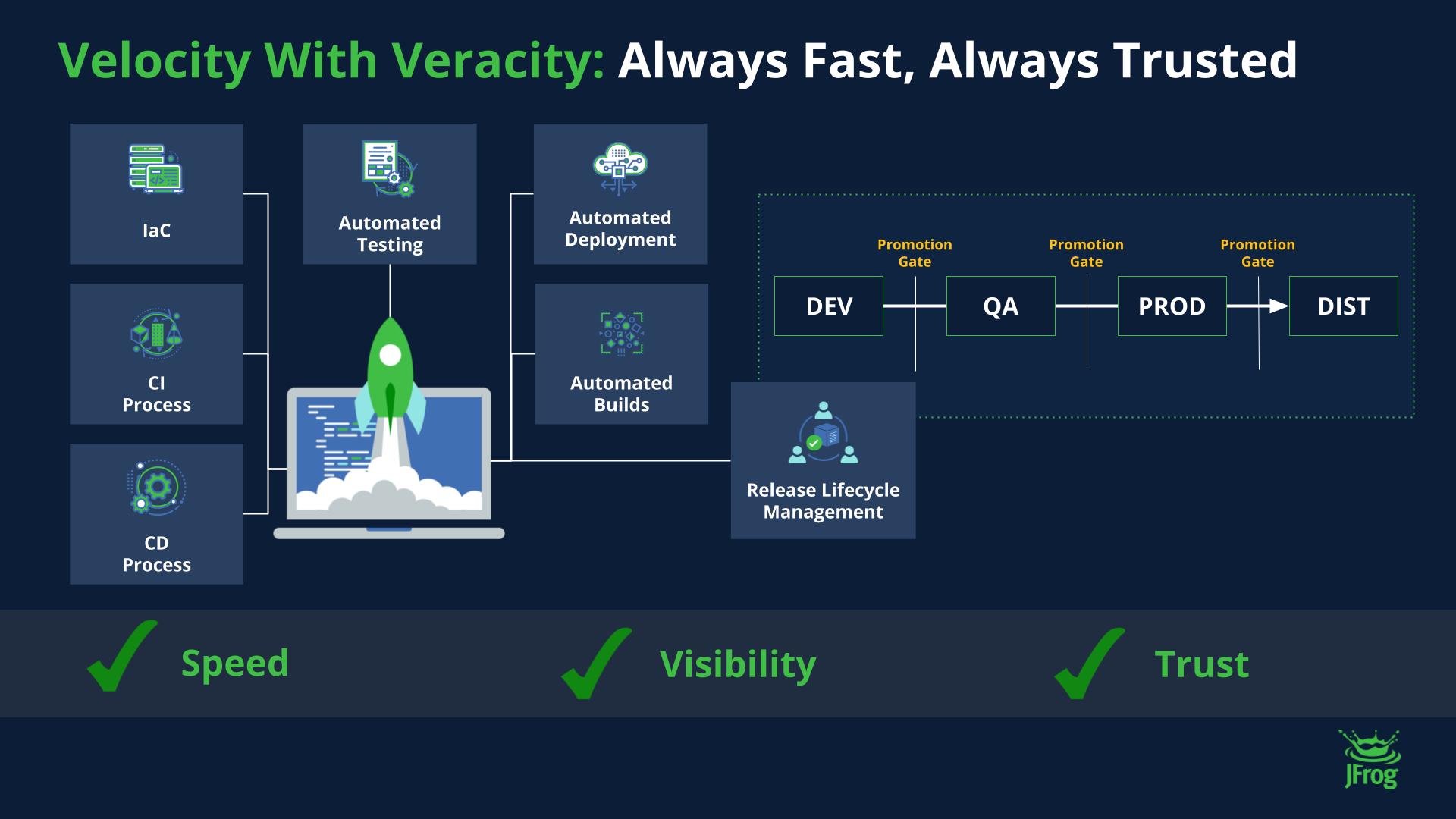
This approach is fundamental to security posture, minimizing the risk of unauthorized access, data breaches, and privilege escalation, especially in environments like those involving Infrastructure as Code (IaC) and containers. JFrog also reinforces this principle with regular access reviews, multi-factor authentication, and comprehensive logging and monitoring.
For more information on how the JFrog Platform can help implement the principles of least privilege in your organization and enhance the security posture of your software development environment, please take a virtual tour, set up a one-on-one demo or start a free trial at your convenience.