Claude
 Cursor
 Codex
 Hugging Face
 NVIDIA
 Visual Studio Code
 Devin
 Kiro
 Open Code
 NanoClaw

 Docker
 npm
 PyPy
 Wiz

 Financial Services
 Gaming
 Public Sector
 Automotive
 Technology
 Healthcare


Impact of AI on CVEs : PROTECTION STRATEGIES

For enterprise software development operations, AI now handles work that was once too hard or too costly to justify, from reverse engineering and debugging to building fuzzing harnesses. Recent high profile security incidents shows how far this goes:
- AI agents escaping ChatGPT sandboxes through zero-day logic flaws
- Claude models breaking out of test environments while surfacing critical zero-days.
- Independent researchers using LLMs to find dozens of vulnerabilities in heavily audited codebases.
Higher Volume and Lower Quality CVEs
In the first blog of this series, we explained how AI is a multiplier for security research experts, resulting in faster bug discovery and PoC development, which leaves more time for deep architectural analysis. For novices, however, it means the ability to create a large volume of low-quality CVEs that increase response time and amplify triage noise.
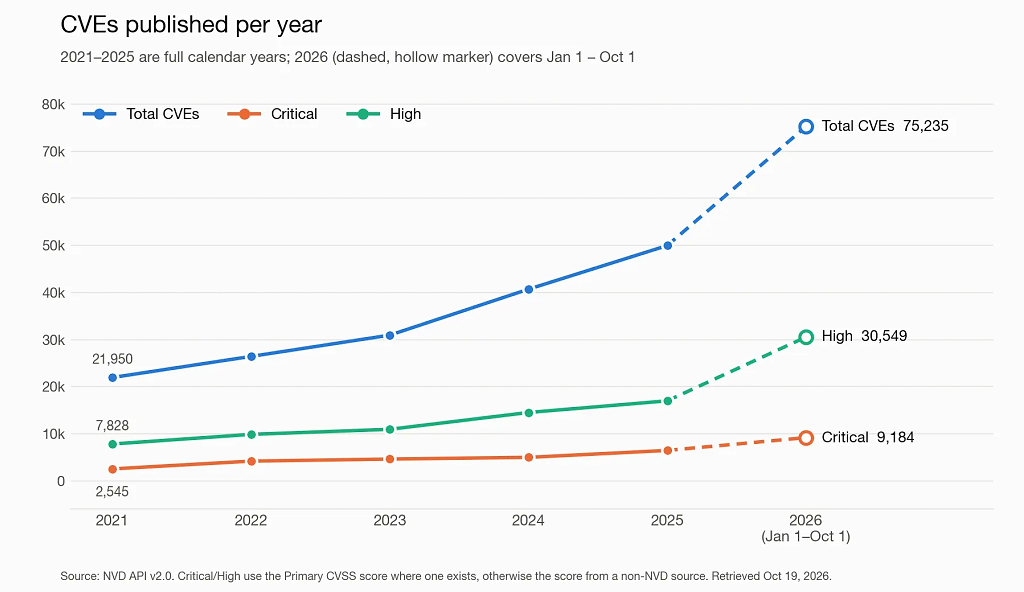 Published CVEs are accelerating sharply reaching 75,000 in just the first nine months of 2026
Perhaps a more serious consequence of vulnerability research with AI is “democratization” of nation state capabilities. It used to take the resources of a nation state to launch sophisticated hacks such as 0-click smartphone attacks and unauthenticated RCEs (Remote Code Execution) on enterprise servers. Using AI, these and other attacks can be launched by smaller groups such as ransomware gangs and even individual malicious actors.
Real World Evidence
This year alone, we have had more than 10+ Linux LPE (Local Privilege Escalation) vulnerabilities and have also seen multiple RCEs in popular open-source packages that power the internet, such as PHP, Chrome and Redis.
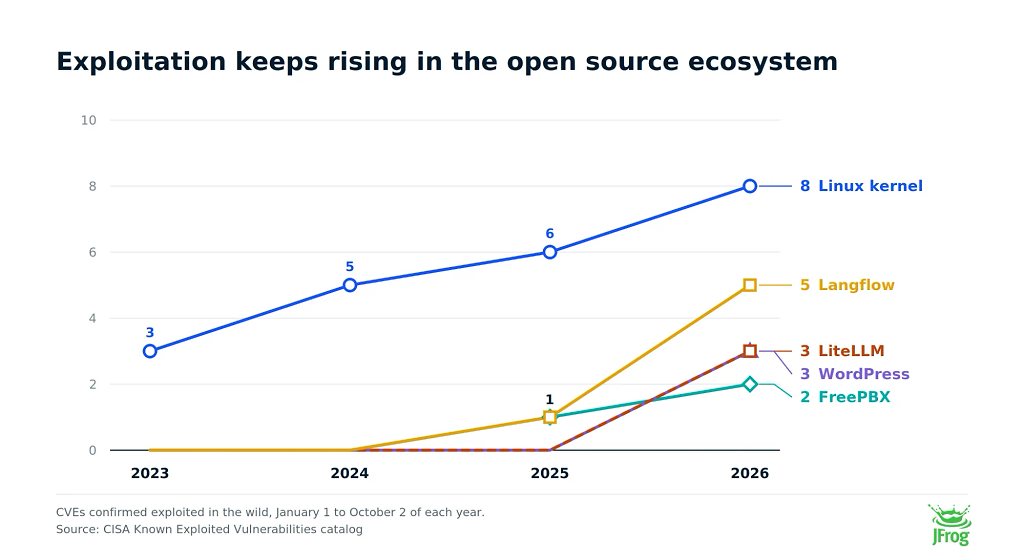
Confirmed in-the-wild exploits across major open-source projects from 2023 to October 2026
The trajectory is clear: CISOs and security teams should prepare themselves for disclosure of high severity vulnerabilities in well-known industry components by professional and amateur security researchers on a monthly basis.
Example: JFrog’s Zero-Click Chain

Exploiting a malformed image tile to achieve zero-click remote code execution
To demonstrate how AI compresses weeks of advanced exploit development into a matter of hours, our research team built a full zero-click attack chain targeting everyday desktop software. By combining an AI-discovered vulnerability in the libheif image-parsing library (CVE-2026-47178) with a Linux kernel privilege escalation exploit, we turned a single malformed image file into complete root-level system takeover without a single click from the user.
Libheif – Malicious images as an infection vector
The danger of parser vulnerabilities are well documented, , especially those that parse untrusted input sent from an attacker without user interaction. Vulnerabilities like these have been used extensively by nation-states and PSOAs (private-sector offensive actors), as well as cybercriminals, to deploy malware on systems with minimal, and in some cases, no human interaction whatsoever.
CVE-2026-47178 – Heap out-of-bounds write to popping calc
Feeling inspired by how nation-state-grade spyware infects devices, often using format parsing as the initial access vector, we started researching libheif, which is a library implementing the parsing of the HEIF image format.
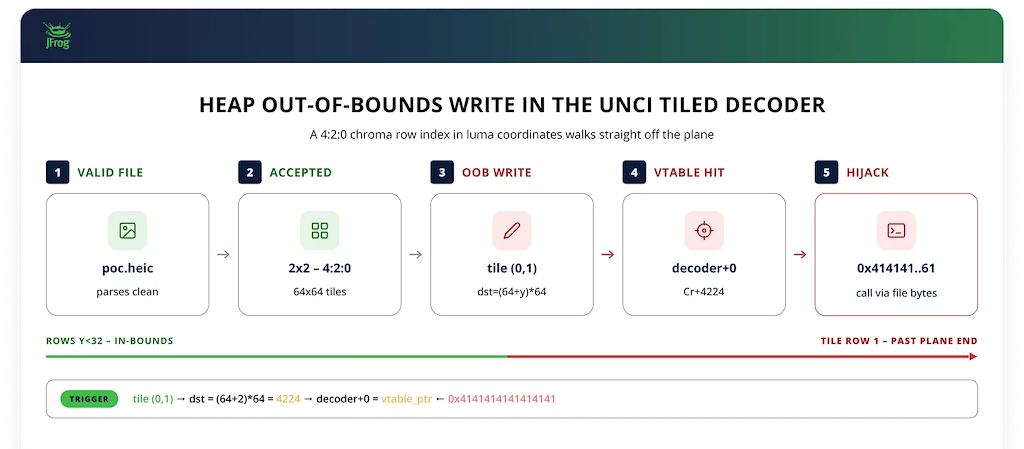
Exploit flow from a malformed image tile to heap corruption and control-flow hijack
CVE-2026-47178 is a heap out-of-bounds write in the UNCI decoder in libheif that allows an attacker to overwrite virtual function pointers on the heap, thus leading to remote code execution. Leveraging AI, we discovered the vulnerability within 2 hours, as opposed to the weeks of research it would take a professional using conventional methods.
It took us another 5 hours to turn it into a reliable exploit against Debian’s File Explorer, without user interaction.
Researching & Confirming our Findings
The research environment was quite straightforward: We compiled heif-dec, the library-bundled C++ binary for parsing HEIF images using libheif with AddressSanitizer, and instructed the AI to find a heap out-of-bounds write using static analysis only and confirm its hypothesis dynamically via a crash under ASAN.
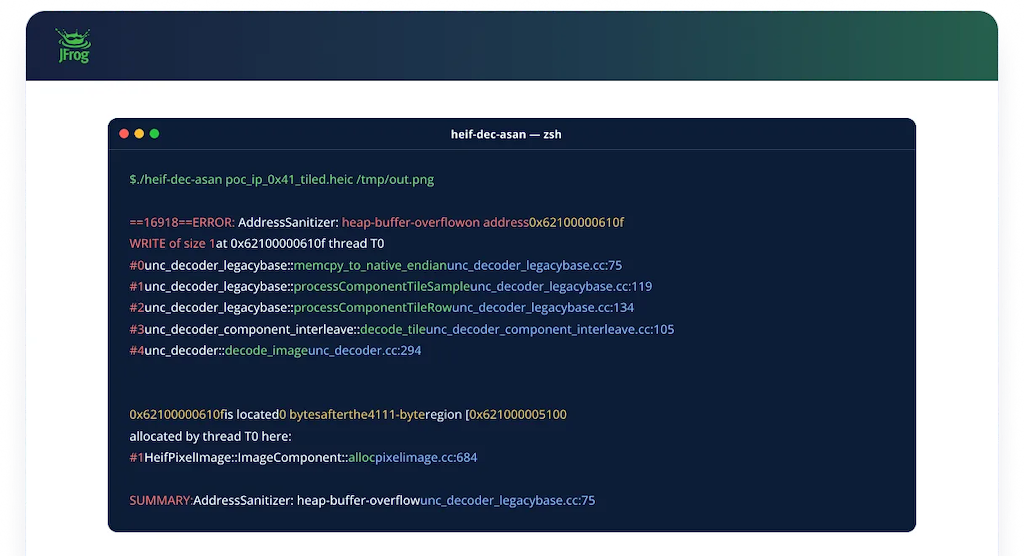 AddressSanitizer crash report confirming a heap-buffer-overflow during image decoding
The ASAN essentially acts as a truth indicator (oracle). This result tells us immediately that the LLM did not hallucinate its finding, and the finding is an actionable, real vulnerability.
We may now proceed to developing the actual exploit:
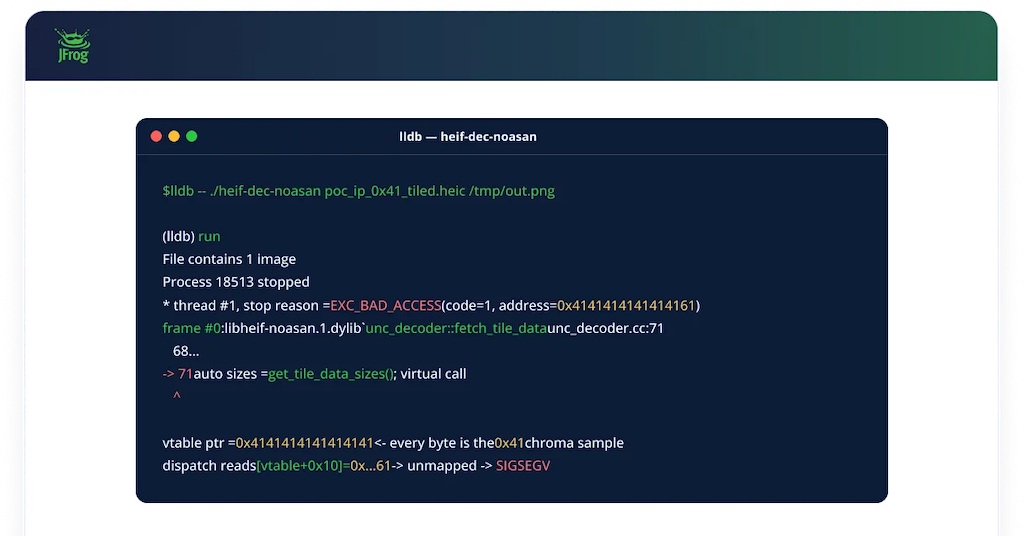 Debugger output showing a crash due to an overwritten vtable pointer from a virtual function call
Through specific heap manipulation, a technique known as heap feng shui, we successfully overwrote a virtual function pointer, a C++ object data structure, granting us direct control over the instruction pointer and completing another critical milestone. The classic convention is to set the instruction pointer to 0x41414141, to demonstrate instruction pointer control.
The final stage is to turn our control flow hijack into code execution. By default the stack is non executable, so we must utilize gadgets, or useful pieces of code that already exist in the executable’s memory space, for our needs.
Since our target was the gnome file explorer, nautilus, we decided to take a look as to how it decodes these heif images, and noticed that it uses a binary called `libheif-thumbnailer`, a binary that’s similar to libheif-dec, which uses the libheif library, alongside other libraries.
The library that’s particularly important this time is libdav1d, which is another codec. The library provided a useful gadget, akin to a one_gadget, that allows us to run `system()` with our own string specified in the `rdi` register, which is just perfect.
Now, we can run any code that we want, but not as root, and that’s the next stage.
DirtyClone – Elevating Linux LPE privileges
Now that we have remote code execution, we can begin elevating our privileges. We previously disclosed an LPE in the Linux kernel as a result of an incomplete patch of the dirtyfrag vulnerability. We won’t go in depth into the details of how the exploit works, but you can more info our previous blog post.
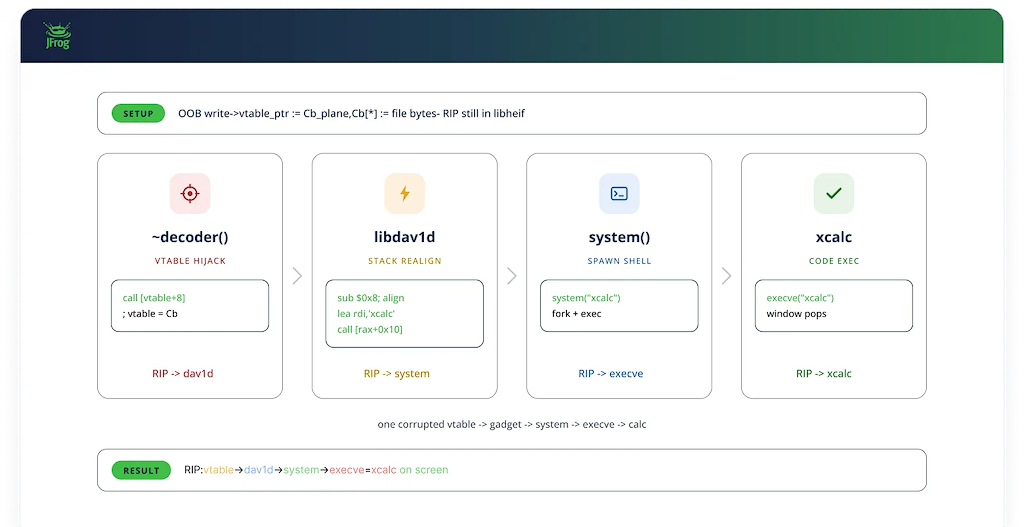 Exploit chain turning a corrupted vtable pointer into arbitrary code execution
The following is a summary of the attack scenario:
An attacker, using a delivery mechanism such as a messaging app (different delivery mechanism than what we outlined here), or even just downloading the file unwittingly and just navigating to the directory where the file is stored via file manager, will cause remote code execution as root.
How Can JFrog Help?
SCA scanning often begins by matching component versions against public CVE records. While this identifies potentially vulnerable dependencies, it may also report issues that are not applicable to the way a specific application uses them.
JFrog Advanced Security’s Contextual Analysis goes beyond version matching. It examines source code, binaries, configurations, and dependency paths to decide whether the vulnerable conditions are actually present, and only then reports a CVE as Applicable.
Take CVE-2026-47178 in libheif. A version match would flag every artifact that contains an affected libheif. Contextual Analysis marks it Applicable only when both conditions are met:
- libheif was compiled with
-DWITH_UNCOMPRESSED_CODEC=ON - the application calls the vulnerable function heif_decode_image
In the scan below, JFrog Xray found both: libheif.so.1.19.8 built with the flag, and a reference to heif_decode_image in /app/heif_app. Each piece of evidence comes with its path, offset, and symbol, so teams can verify the verdict instead of trusting it blindly. When the evidence is incomplete, Xray returns Undetermined rather than a false positive.
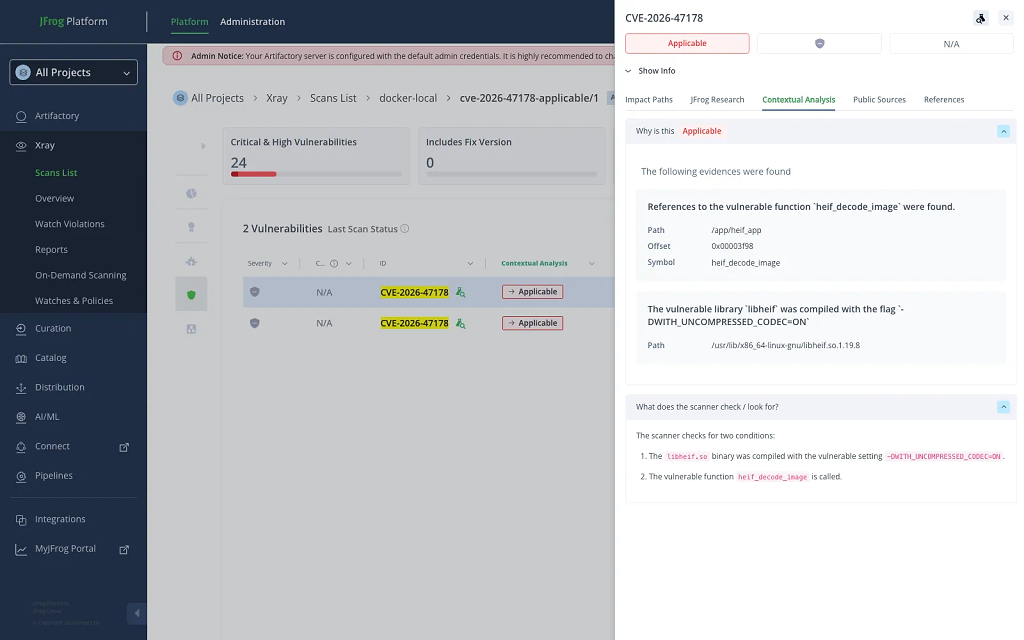
Validating CVE applicability through binary, function-level, and configuration evidence.
JFrog Security Research and Severity Assessment
JFrog Xray is strengthened by CVE research and enrichment from the JFrog Security Research team. Rather than treating every CVE equally, the team focuses mainly on High and Critical CVEs. For these, researchers analyze real-world exploitability, assign a JFrog Severity Score, document the conditions that determine applicability, and provide actionable remediation or mitigation guidance.
When JFrog’s analysis differs from a public CVSS rating, Xray can present a separate JFrog Severity analysis based on technical evidence and likelihood of exploitation. This gives teams another signal for prioritization instead of requiring them to rely on a single external base score.
JFrog Advanced Security complements Xray’s research-backed enrichment with Contextual Analysis. According to JFrog’s internal statistics, Contextual Analysis covered an average of 80% of High and Critical CVEs in customer scans. The same data found that an average of 85% of High and Critical findings were marked as not applicable, helping teams focus remediation on a smaller set of relevant issues. Among the NVD CVEs reassessed by JFrog researchers in 2025, JFrog’s severity assessment was lower for 96% of those rated Critical and 65% of those rated High. Together, JFrog Advanced Security’s Contextual Analysis and Xray’s research-backed severity reassessment help teams reduce CVE noise and direct remediation toward vulnerabilities that represent the greatest threat to their applications.
Take Aways
AI is uncovering real vulnerabilities faster, but also increasing false reports, inflated scores, and pressure on already overloaded maintainers and security teams. As discovery outpaces validation and patching, CVE volume and severity alone are no longer enough to guide remediation. In the AI era, the challenge is not simply finding more vulnerabilities, but identifying which findings are real, reachable, and urgent. Combining vendor guidance with contextual analysis and research-backed severity helps teams focus their limited time on the vulnerabilities that pose genuine risk.
Speak to a JFrog security expert to find out how we can help you effectively manage CVEs in today’s challenging environment.
 New insights from +1,400 security & DevOps leaders. Get the Full Report.