Claude
  Cursor
  Codex
Codex  Hugging Face
  NVIDIA
  Visual Studio Code
  Devin
Devin  Kiro
Kiro  Open Code
  NanoClaw
 Docker
  npm
npm  PyPy
PyPy  Wiz
Wiz 
 Financial Services
  Gaming
  Public Sector
  Automotive
  Technology
  Healthcare


How to Validate Policy-as-Code Without Breaking Builds (Even When AI Writes the Code)


By
6 min read
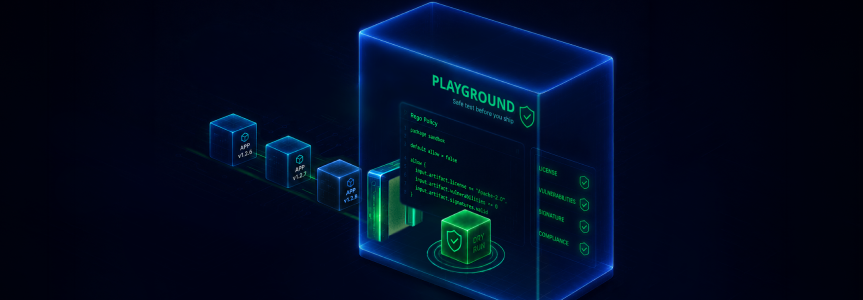
Picture two realities for the same compliance control reaching production.
Reality One: Your AppSec team writes a new rule. An engineer uses Claude Code or Cursor to generate the OPA (Open Policy Agent) Rego policy in minutes. They deploy it. It blocks a legitimate release on a missing context variable, and the on-call engineer routes around the gate to ship the code. The AI gave them fast code — but not code they could trust.
Reality Two: Your AppSec lead opens a sandbox. They describe the rule in natural language, and an AI assistant drafts the Rego. They run it against a real application version pulled from their System of Record. It evaluates exactly as intended. Saved as a template, it becomes an automated release gate. The release goes out without anyone routing around it.
The friction has never been writing the rules. It is the risk of trusting them in production.
In our first two Policy-as-Code posts, we covered the foundation (governance lives in an immutable System of Record) and the use cases (turning NIST SSDF controls into evidence-based release gates). This third and final post in our series removes the last friction by giving security teams a safe, AI-assisted way to enforce governance without breaking builds.
The Core Problem: Why Policy-as-Code Programs Stall
A January 2026 study from researchers at Polytechnique Montréal confirmed what security leaders already knew: OPA dominates Policy-as-Code, accounting for 62% of all policy files, with 86.7% of that activity dedicated to security and compliance governance.
The industry has standardized on OPA. The question is no longer if you should use it, but how to scale it.
The pressure is real: AI-generated code is arriving 10x faster than human code, supply chain attacks have risen 300%, and 48% of CISOs cite evidence collection as their top regulatory challenge.
But here is the shift most security leaders have not fully internalized yet. AI tools like Claude Code and Cursor can generate Rego in seconds. That eliminated one bottleneck and exposed another: the validation gap.
There is no way to test it against the real artifacts it is meant to govern before it ships. A single missing context variable can block legitimate releases. Engineering teams bypass the rules. The governance program erodes.
Generic sandboxes only validate syntax, not reality
Many teams try to solve the testing problem with generic Rego sandboxes. These validate syntax but they do not tell you how a policy will behave in the real world.
To know if a policy works, you need context: your application’s business criticality, its software bill of materials (SBOM), the evidence collected across your SDLC. A generic sandbox knows none of this.
Without context, you deploy blindly, hoping policies catch the bad releases without stopping the good ones. But hope is not a viable security strategy.
Enter the Policy-as-Code Playground in JFrog AppTrust
JFrog AppTrust now includes a hosted playground for Policy-as-Code. Unlike generic sandboxes, it’s directly integrated into the JFrog Software Supply Chain Platform as your System of Record and provides three capabilities that change how AppSec teams build and deploy policies.
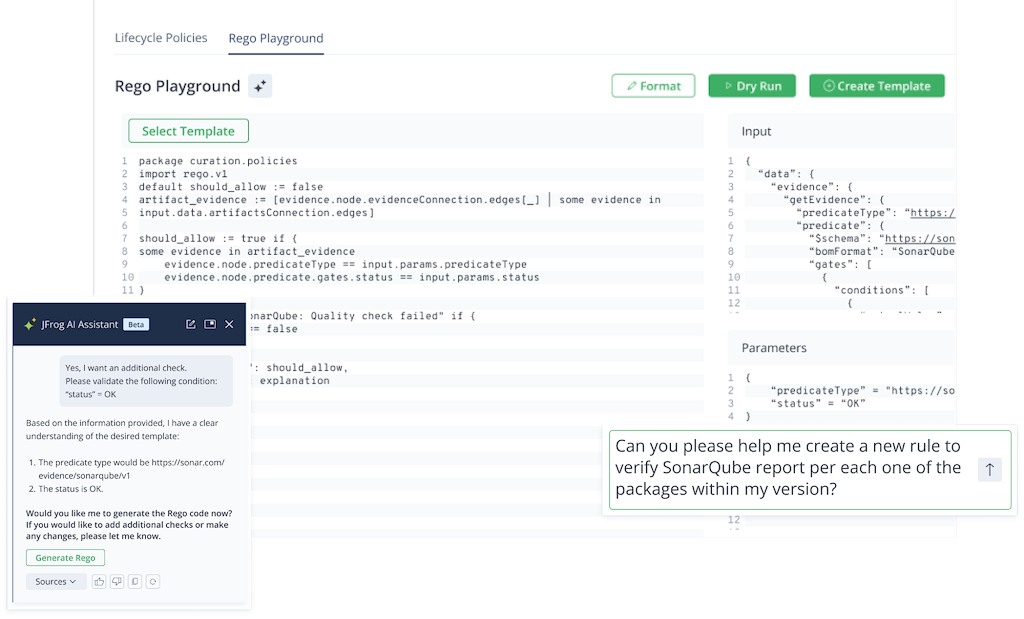
Here’s a short video to show you how it works:
Evidence-based validation: test against real artifacts
Because JFrog stores evidence alongside your binaries, you don’t test new policies on hypothetical data. You test them against the real ones.
- Load real history: Pull actual Application Versions from JFrog Artifactory directly into the playground.
- Execute dry runs: Run your drafted policy against these historical binaries.
- Instant visibility: Review the evaluation output and debug logs immediately.
You prove the policy behaves correctly on a real application before it touches CI/CD. Governance ships with the same cryptographic proof engineers expect from their own code.
Reusable templates: turn one rule into an organizational control
Once the Rego is validated, you save it as a template. Teams then turn the template into a rule, attach the rule to a policy, and bind that policy to any release lifecycle gate.
- Parameterize the rule: Adjust variables so the policy applies to different risk levels.
- Save as a template: Store the validated rule in a centralized library.
- Apply universally: Any team across any business unit can adopt this evidence-based release gate.
A project that once took an AppSec engineer’s entire afternoon is now a standardized organizational control protecting hundreds of pipelines. 57% of government-affiliated organizations and 35% of enterprises now audit specifically to win new business, and a library of evidence-based controls is the asset that can get them there.
AI-assisted authoring: skip the manual work
You no longer need a Rego specialist to create effective security gates.
- Natural language inputs: Describe the rule you want to enforce in your own words.
- Instant translation: The AI assistant asks clarifying questions and returns valid OPA Rego code in seconds.
- Accessible governance: Any AppSec engineer can draft advanced compliance controls without specialized syntax knowledge.
The AI is the on-ramp. The playground works whether you have a Rego expert on the team or not.
Stop Wrestling with Syntax. Start Governing Your Releases.
The PaC playground in JFrog AppTrust turns continuous governance from a bottleneck into a business enabler. Anchor policies to an immutable System of Record. Automate regulatory controls like NIST SSDF. Empower any security engineer to author rules without fear of breaking builds.
The blame game between security and engineering is now irrelevant: engineering trusts gates tested against reality, and security knows automated controls are blocking the right releases based on immutable evidence.
Ready to test policies against real artifacts before they ever block a build? Schedule a demo of JFrog AppTrust, take an online tour of the JFrog Platform, or start a free trial to put continuous governance to work.
For more on this topic, be sure to check out the other blogs in this series:
 New insights from +1,400 security & DevOps leaders. Get the Full Report.