Claude
 Cursor
 Codex
 Hugging Face
 NVIDIA
 Visual Studio Code
 Devin
 Kiro
 Open Code
 NanoClaw

 Docker
 npm
 PyPy
 Wiz

 Financial Services
 Gaming
 Public Sector
 Automotive
 Technology
 Healthcare


Continuous NIST SSDF Evidence, Built Into Each Release
The NIST Secure Software Development Framework (NIST SP 800-218) recommends a core set of secure software development practices. As enterprise customers tighten vendor security, your next security review may ask one question: can you show it? With JFrog, you put controls in your pipeline, capture signed evidence with each release, and show it when asked.

Why Your Customers Demand NIST SSDF Evidence
NIST SSDF gives software buyers a common language for secure development practices. Whether facing agency scrutiny or enterprise due diligence, buyers want evidence (like PRs, Jira tickets, security tests, and gate decisions) ready before they sign.
The Federal Playbook Changed
Federal agencies now set their own risk-based software security policies and may request SBOMs and evidence of secure development practices. Having that evidence ready can help you respond to procurement reviews.
Security Reviews Expect Enforcement
In vendor onboarding, saying you apply SSDF practices may not be enough. A documented policy lacking active pipeline enforcement may not hold up in modern security reviews, forcing your teams into manual compliance fire drills.

Buyer Trust Requires Constant Proof
Following NIST in full is a business advantage, not just a compliance exercise: it gives you a defensible security posture, ready evidence, and credibility with customers. Cutting corners does the opposite, leaving blind spots that increase risk and can cost you the very contracts you were trying to win.
Three Common NIST SSDF Gaps a Customer Security Review Can Expose
Your pipeline does not enforce what your policy documents.
NIST SSDF recommends secure development practices across the SDLC. Many teams write policies and rely on manual processes to follow them. A policy that lives in a document and not in your pipeline can fall short at audit time.
You assemble evidence after the fact, not continuously.
Customers and auditors may ask for proof that your SSDF practices run consistently across releases. Reconstructing that evidence from tickets, emails, and scan exports at audit time can turn a routine review into a fire drill.
Your third-party components enter builds without systematic vetting.
NIST SSDF recommends vetting the open-source and commercial components you use. A one-time review at ingestion can miss vulnerabilities disclosed after that moment.
Apply NIST SSDF Practices Across Your Software Supply Chain
Find the SSDF practice area your team owns. See what JFrog supports and what evidence backs it.
Prepare the Organization (PO)
Document security requirements, define roles, integrate your toolchain, and track security check criteria across your SDLC.
SDLC Policy Evidence and Toolchain Integrity
JFrog can check that your versioned SDLC policy, roles and responsibilities, and training records are attached as evidence. It helps verify toolchain integrity via SLSA attestations, checks for CI/CD pipeline documentation, and can gate releases on independent code review, security approvals, and risk assessment criteria.
Produce Well-Secured Software (PW): Secure Design and Risk Management
Model risks before development. Track security requirements and get an independent design review before release.
Risk Assessment and Design Review Records
JFrog can require vulnerability analysis before production and check that your risk assessment, data classification, and independent design review records are attached to each release as signed evidence.
Produce Well-Secured Software (PW): Secure Build, Testing, and Component Vetting
Vet components before they enter a build. Review code independently, test it, and verify secure defaults.
Component Vetting and Approved Provenance
JFrog can evaluate third-party components against policy before build entry. It can enforce approved component lists using provenance data and digital signatures. For each release, JFrog can require independent pull request approvals and bind scan logs, VEX records, and Jira tracking as signed evidence.
Protect the Software (PS)
Sign commits, maintain provenance attestations on internal packages, and archive release files securely.
Cryptographic Signatures and Release Binding
JFrog verifies cryptographic signatures on commits and packages and can enforce SLSA provenance attestations across your internal packages. It can check that your cryptographic key management policy documentation is attached, and binds SBOMs, signatures, and build provenance directly to each release artifact.
Respond to Vulnerabilities (RV)
Gather vulnerability information continuously, maintain a response policy, and feed root causes back into your SDLC.
Continuous Monitoring and Vulnerability Tracking
JFrog continuously monitors active production releases against newly disclosed CVEs and can require vulnerability analysis before production promotion. Through its Jira integration, JFrog can bind your vulnerability impact analyses, VEX records, and tracking for root causes, remediations, and lessons learned to the release. JFrog can also check that records of your PSIRT charter, response playbook, vulnerability disclosure program, and incident response exercises are attached as signed evidence.
From NIST SSDF Practice to Traceable Evidence in JFrog AppTrust
Activate Pre-Mapped NIST SSDF Controls from Day One
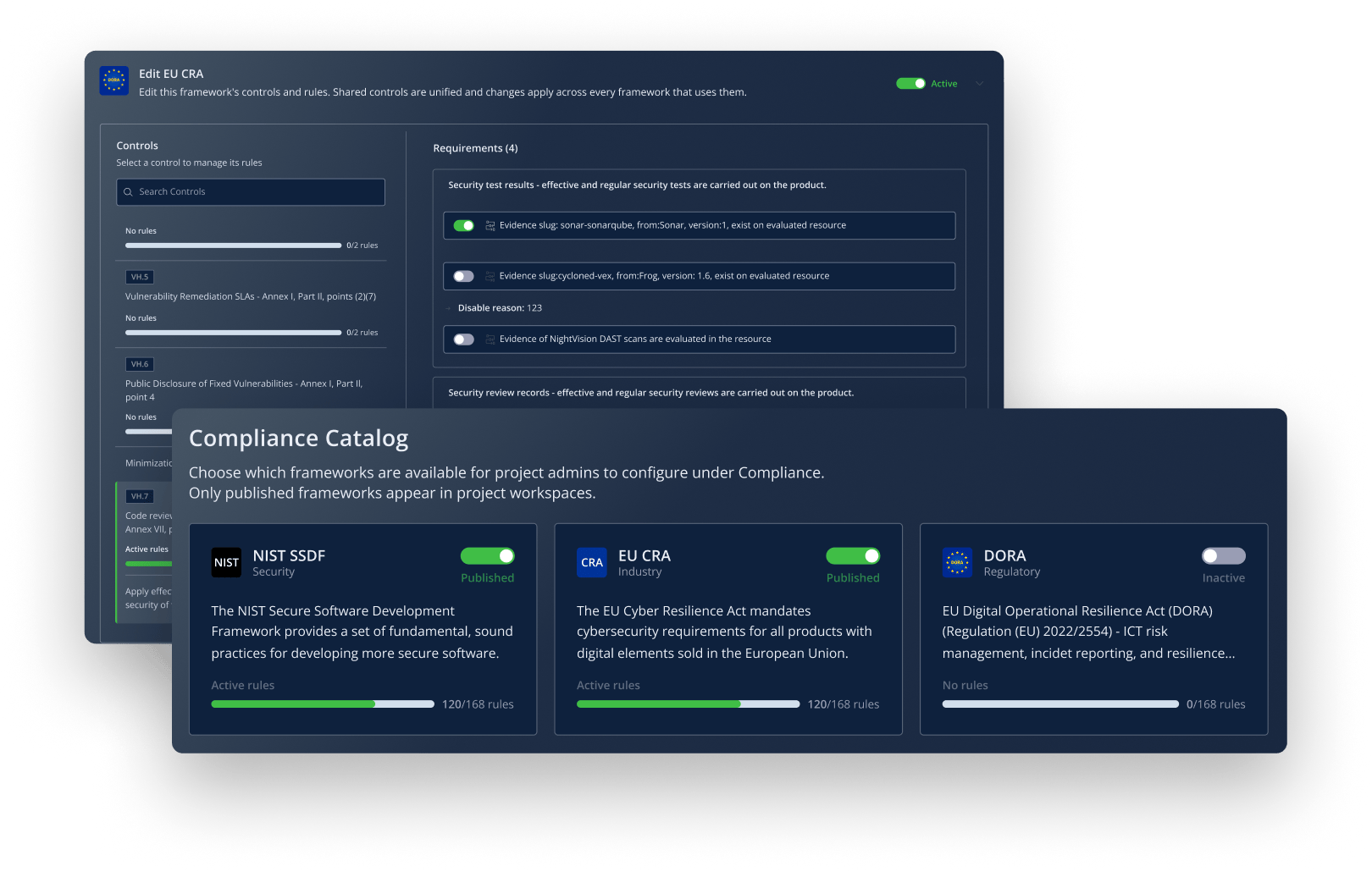
Controls arrive pre-mapped to NIST SSDF practices as Policy-as-Code, so your team switches on the controls that apply instead of translating a framework into pipeline rules. Each control maps to an SSDF practice, and coverage scoring shows how many of those controls are active across your releases.
Block Releases That Fail Your Policies Before They Ship
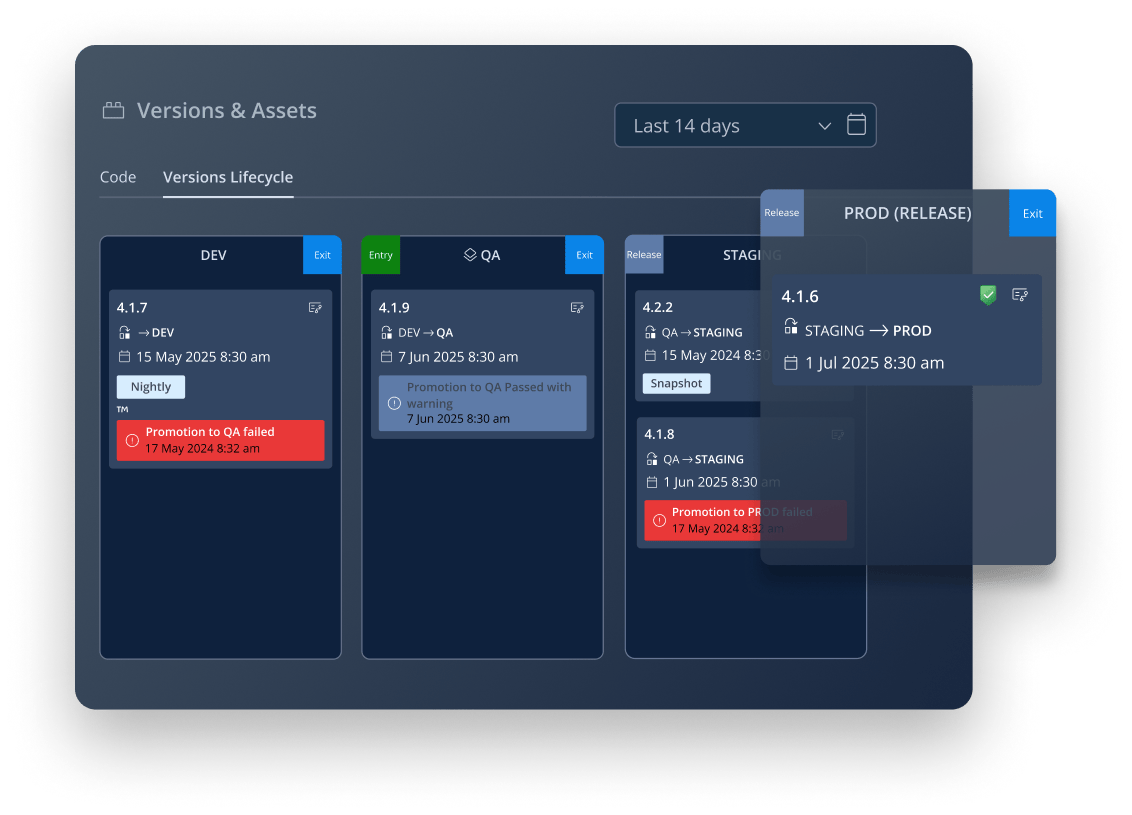
Out-of-the-box and customizable SSDF-mapped policy gates can evaluate each promotion. When a rule is set to block, releases that fail it are held back from production, whether the issue is an unresolved CVE, a missing approval, or a failed test.
Evidence That Travels With the Release
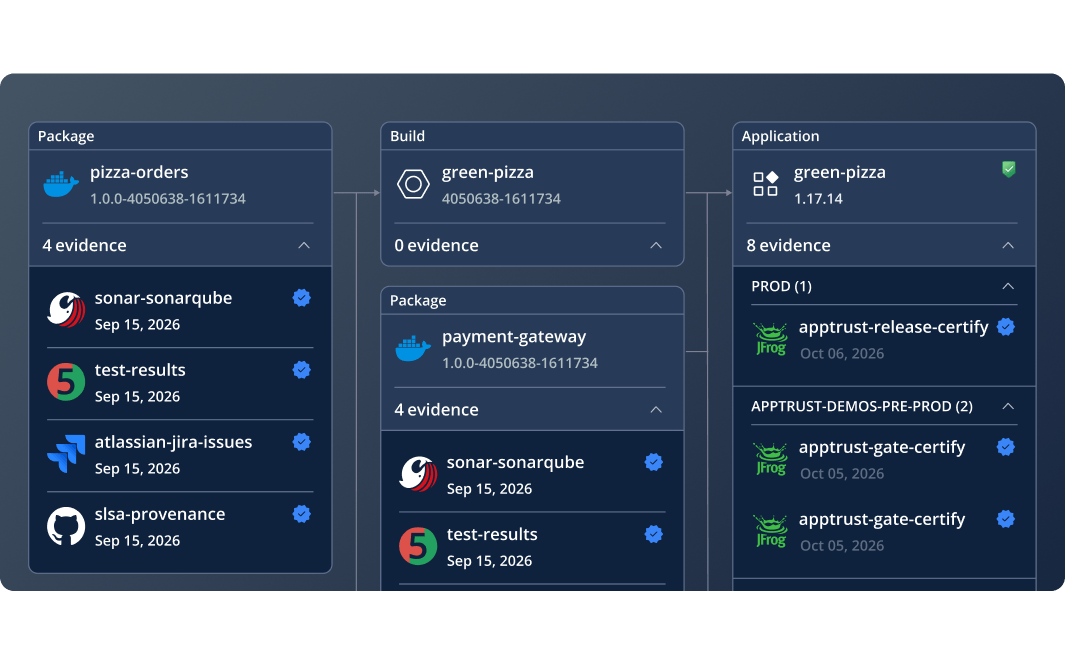
AppTrust collects signed evidence from your connected tools, including SBOMs, test results, Jira tickets, code review records, and provenance attestations, and binds it to one application version. Pull the evidence for that version when a customer, federal agency, or auditor asks.
Go Deeper on NIST SSDF Practices
Every New Compliance Framework Restarts the Same Fire Drill. It Doesn't Have To.
What is the Secure Software Development Framework (SSDF)?
Automate NIST SSDF Compliance: A Technical Guide to Policy as Code in JFrog AppTrust
Frequently Asked Questions
NIST SSDF (SP 800-218) is a framework of secure software development practices published by NIST. Federal agencies and commercial buyers may use it as a reference when they evaluate software producers. Some may ask for evidence of SSDF alignment before purchasing third-party software.
No. SSDF does not set up a third-party certification program, although a buyer may ask for an independent assessment. Some customers and agencies may ask for an attestation: a documented, evidenced demonstration that your organization follows the practices it describes. JFrog can help with the evidence collection and policy enforcement that support that attestation. The attestation itself is your organization’s responsibility.
JFrog supports practices in all four SSDF practice groups: Prepare the Organization (PO), Produce Well-Secured Software (PW), Protect the Software (PS), and Respond to Vulnerabilities (RV). The mapping above shows the JFrog controls currently mapped to SSDF practices. Practices outside the software supply chain layer, including endpoint hardening, network architecture, and zero-trust access, sit in a different stack and need complementary tooling.
JFrog can collect, sign, and attach concrete evidence to each release. When an enterprise buyer or federal agency asks about your SSDF practices, your team can pull verifiable evidence. Instead of scrambling to assemble data, your team can respond to procurement reviews with evidence already in place.
NIST SSDF is a set of recommended practices, not a law, though customers and agencies may reference it in procurement and contract requirements. Organizations choose to adopt SSDF to satisfy customer security reviews, meet contractual requirements, and standardize secure pipeline controls.
NIST CSF (Cybersecurity Framework) covers organization-wide cybersecurity posture across six core functions. NIST SSDF focuses specifically on the software development lifecycle (SDLC) and supply chain security practices.