Claude
  Cursor
  Codex
Codex  Hugging Face
  NVIDIA
  Visual Studio Code
  Devin
Devin  Kiro
Kiro  Open Code
  NanoClaw
 Docker
  npm
npm  PyPy
PyPy  Wiz
Wiz 
 Financial Services
  Gaming
  Public Sector
  Automotive
  Technology
  Healthcare


Definition
The National Institute of Standards and Technology Cybersecurity Framework (NIST CSF) 2.0 is a voluntary guidance framework designed to help organizations manage and reduce cybersecurity risk. It expands upon earlier iterations by applying to all sectors and introducing a sixth core function, Govern, to align security strategy with business objectives. Implementing CSF 2.0 provides a structured, common language that strengthens operational resilience, mitigates supply chain threats, and satisfies regulatory oversight.
Overview
NIST CSF 2.0 is a voluntary cybersecurity framework published by the National Institute of Standards and Technology in February 2024 to provide a structured, risk-based approach to managing security posture. It establishes a common language for organizations of any size or sector to identify, protect against, and respond to cyber threats.
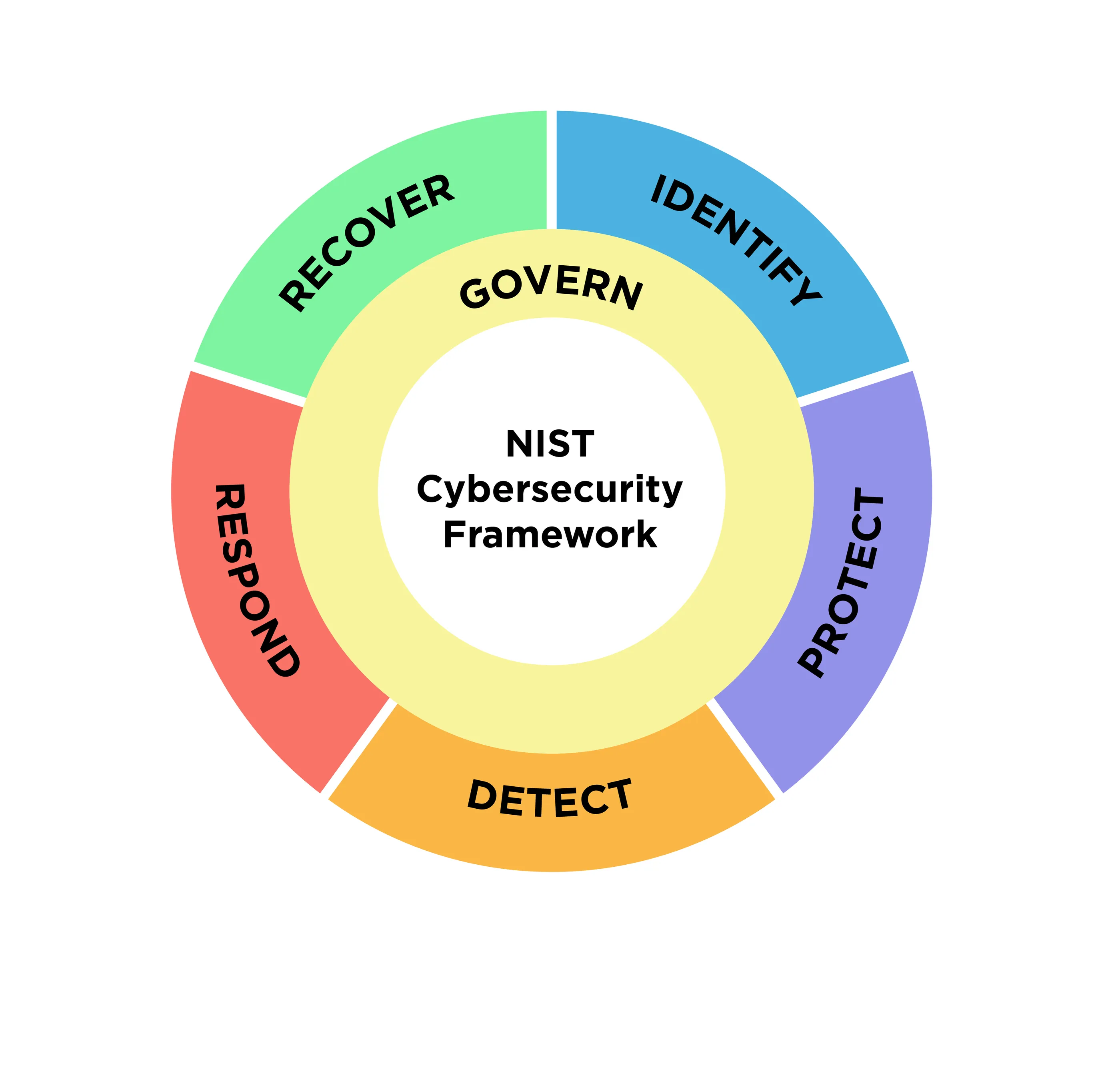 To the five main pillars of a successful cybersecurity program, NIST now has added a sixth, the “govern” function, which emphasizes that cybersecurity is a major source of enterprise risk and a consideration for senior leadership.
Credit: N. Hanacek/NIST
Understanding NIST CSF 2.0
To understand NIST CSF 2.0, organizations must view it as a flexible communication tool rather than a rigid set of compliance checkboxes. Originally designed for critical infrastructure, the NIST cybersecurity framework 2.0 has been expanded to address all organizations, including small businesses, non-profits, and government agencies. This universal scope ensures that any entity can use the NIST framework to improve its application security and operational resilience.
The CSF 2.0 update represents the first major overhaul since version 1.1 in 2018, reflecting a more complex threat landscape where cybersecurity risk management must be an enterprise-wide responsibility. A defining feature of the new version is its emphasis on the “Govern” function, which sits at the center of the framework to oversee the other five functions: Identify, Protect, Detect, Respond, and Recover. This structural change highlights that security is not just a technical challenge but a foundational business requirement.
While the NIST cybersecurity framework remains voluntary for the private sector, it is increasingly becoming the de facto standard for global commerce. It is frequently referenced in government procurement requirements, cyber insurance underwriting, and regulatory alignment for high-assurance standards like PCI DSS and CMMC. Organizations that adopt the framework often find it easier to demonstrate security maturity to stakeholders and board members.
Beyond US-focused standards like PCI DSS and CMMC, CSF 2.0 aligns directly with international regulatory mandates. Organizations operating globally use the framework to establish the risk governance required under NIS2 enforcement and to prepare for upcoming regulations like the EU Cyber Resilience Act (CRA) September 2026 vulnerability reporting deadline.
What are the Benefits of NIST CSF 2.0?
Implementing the NIST framework provides a standardized methodology for communicating risk across technical and non-technical teams. By using a shared vocabulary, DevOps engineers and executive leadership can align on investment priorities and risk tolerance. This alignment is essential for modern cybersecurity risk management, where security decisions directly impact business velocity.
The framework is designed to interoperate with other established standards. Organizations can map their NIST CSF 2.0 activities to NIST 800-53 controls or the NIST risk management framework without starting from scratch. This interoperability reduces the burden of multi-compliance and helps organizations prepare for more rigorous assessments. Additionally, reaching higher NIST CSF tiers (ranging from Partial to Adaptive) can lead to more favorable cyber insurance premiums, as insurers use these tiers to measure an organization’s defensive maturity.
What are Best Practices of NIST CSF 2.0?
Successful implementation of NIST CSF 2.0 relies on the use of NIST CSF profiles, which help organizations transition from their current state to a desired target state. Organizations should start by creating an “Organizational Profile” to identify which subcategories are most relevant to their specific business needs. This allows teams to focus resources on the gaps that pose the highest risk to their operations. By tailoring these profiles, stakeholders can align cybersecurity efforts with overall mission requirements and risk tolerance.
A key best practice in the new framework is the formalization of supply chain security. Organizations must prioritize suppliers based on criticality and perform continuous vulnerability scanning of all third-party components. Maintaining a verifiable software provenance for every artifact in the pipeline ensures that the organization remains compliant with the new GV.SC categories within the Govern function. This proactive approach prevents “compliance drift” and ensures that security is baked into the entire lifecycle.
Organizations should utilize “Community Profiles” to benefit from sector-specific guidance and shared best practices. This collaborative approach helps teams stay informed about emerging threats and industry-wide security standards. To maintain resilience, it is also essential to integrate secure software development practices into all phases of the Secure SDLC. By combining automated tools with strategic governance, organizations can achieve a higher level of maturity within their cybersecurity risk management programs.
NIST CSF 2.0 and the Software Supply Chain
While NIST CSF 2.0 applies across the entire enterprise, its expanded scope places direct emphasis on software supply chain security. Modern application delivery relies heavily on open-source packages, third-party containers, and automated build pipelines. To meet CSF 2.0 requirements, engineering and security teams must map specific framework subcategories directly to automated controls within their software delivery pipelines.
| NIST CSF 2.0 Subcategory | Supply Chain Control Focus | Implementation Guidance |
| GV.SC-04 | Supplier & Dependency Identification | Maintain complete visibility into open-source components and transitive dependencies through a dynamic Software Bill of Materials (SBOM) and dependency graph analysis. |
| GV.SC-06 | Pre-Ingestion Due Diligence | Establish automated curation policies and pre-ingestion package scanning to evaluate open-source library health and licensing before components enter developer environments. |
| GV.SC-09 | Program Integration & Provenance | Enforce quality gates within CI/CD pipelines and verify verifiable software provenance to align supply chain risk with organizational policies. |
| PR.PS-05 | Unauthorized Software Prevention | Enforce repository allowlists and build-time component controls to prevent execution or deployment of unapproved software artifacts. |
| PR.PS-06 | Secure SDLC Integration | Operationalize secure coding practices throughout the pipeline by aligning controls with the NIST SSDF (SP 800-218) framework. |
| DE.CM-06 | Third-Party & External Monitoring | Perform continuous vulnerability scanning across active runtime environments and third-party container images to catch emerging threats. |
Mapping subcategories to pipeline controls
- Supplier Prioritization (GV.SC-04): Organizations must identify and evaluate open-source dependencies with the same rigor as commercial vendors. Generating granular SBOMs ensures visibility into hidden transitive risks across complex dependency trees.
- Third-Party Due Diligence (GV.SC-06): Risk management begins before code hits production. Blocking malicious or non-compliant packages at the ingestion gate prevents vulnerabilities from entering the Secure SDLC.
- Policy Governance & Provenance (GV.SC-09): Integrating governance into build systems ensures that every compiled artifact has an auditable, cryptographic chain of custody verifying its origin.
- Software Integrity (PR.PS-05 & PR.PS-06): Preventing unauthorized binaries from running requires enforcing strict artifact management controls. Integrating NIST SSDF practices ensures security controls are automated rather than treated as manual audit hurdles.
- Continuous Monitoring (DE.CM-06): Because new vulnerabilities are disclosed daily, external dependencies and base images require continuous scanning even after deployment.
Challenges
Adopting an enterprise-wide framework like CSF 2.0 presents cultural and technical hurdles. One of the primary challenges is the shift from viewing security as a technical silo to a governance-led initiative. This requires significant buy-in from leadership and a change in how performance is measured across the organization.
Technically, the volume of data and artifacts in a modern environment makes manual tracking of framework subcategories impossible. Organizations often struggle with the “Identify” and “Protect” functions when they lack visibility into their SBOM or deep-layer transitive dependencies. Without automation, identifying which third-party libraries require remediation becomes a bottleneck that can stall development and leave the organization exposed to a software vulnerability.
Supporting NIST CSF 2.0 with the JFrog Platform
The JFrog Platform provides the automation and governance necessary to operationalize the supply chain and protection controls required by NIST CSF 2.0. By managing every artifact that flows through the development pipeline, JFrog helps organizations implement the framework’s core functions from the inside out.
JFrog Xray supports the “Detect” and “Protect” functions by performing continuous vulnerability scanning across all binary artifacts and container images. This ensures that any identified software vulnerability is remediated early in the lifecycle. To assist with the “Govern” function, JFrog Advanced Security generates detailed SBOM reports and provides the software provenance needed for supply chain due diligence.
The platform’s alignment with the SSDF (NIST SP 800-218) directly satisfies subcategory PR.PS-06, which requires secure development practices to be integrated into the SDLC. By centralizing artifact management in Artifactory, teams maintain the audit trails and configuration controls needed to verify implementation of the SLSA Framework, providing a direct path from framework requirement to working control.
For more information, start a free trial or set up a demo of the JFrog Platform.