Claude
  Cursor
  Codex
Codex  Hugging Face
  NVIDIA
  Visual Studio Code
  Devin
Devin  Kiro
Kiro  Open Code
  NanoClaw
 Docker
  npm
npm  PyPy
PyPy  Wiz
Wiz 
 Financial Services
  Gaming
  Public Sector
  Automotive
  Technology
  Healthcare


Definition
Payment Card Industry Data Security Standard (PCI DSS) is a worldwide technical and operational framework built to safeguard credit card transactions. This mandate applies to any organization that stores, processes, or transmits cardholder data to protect financial ecosystems from catastrophic breaches. By implementing strict network segmentation and secure software development lifecycle practices, companies systematically eliminate security vulnerabilities across their digital transaction environments. Contractual compliance prevents severe operational impacts, including costly monthly penalties and the potential loss of corporate processing privileges.
What is PCI DSS?
Enforced by the PCI Security Standards Council (PCI SSC), PCI DSS (Payment Card Industry Data Security Standard) is a worldwide security standard built to protect cardholder data systems and stop payment fraud. It applies to any organization that stores, processes, or transmits payment card information. By mandating strict technical and operational requirements, the standard ensures a secure software supply chain for financial transactions. Compliance is a contractual obligation enforced by the card brands. Non-compliance carries fines from $5,000 to $100,000 per month and potential loss of processing privileges.
Understanding PCI DSS
To understand PCI DSS, one must look at it as a baseline for Application Security rather than a legal statute. It applies to all entities involved in payment processing, including merchants, processors, and third-party service providers. The standard focuses on securing the environment where card data lives, often referred to as the cardholder data environment. While many refer to becoming PCI DSS certified, the standard is technically a framework rather than an official government certification. Validation is achieved through a Self-Assessment Questionnaire (SAQ) or an intensive Report on Compliance (ROC) conducted by a Qualified Security Assessor (QSA).
With the release of PCI DSS 4.0, which became the mandatory standard in March 2024, organizations now benefit from more flexible, risk-based approaches to security. Compliance obligations are divided into four levels based on annual transaction volume:
- Level 1: Organizations process over 6 million transactions annually and must undergo an internal PCI DSS audit and receive a formal ROC.
- Level 2: Organizations with 1 to 6 million transactions require an annual SAQ and quarterly network scans.
- Level 3: E-commerce merchants with 20,000 to 1 million transactions.
- Level 4: Small merchants with fewer than 20,000 transactions follow simpler validation paths through annual SAQs and quarterly scans.
The shift from version 3.2.1 to 4.0 mirrors the ever-changing cybersecurity landscape. Version 4.0 champions continuous security and gives organizations two distinct validation paths: the traditional, prescriptive Defined Approach, and the more flexible Customized Approach. The Customized Approach allows organizations to implement innovative security controls that meet the requirements’ objective even if they do not fit legacy security models, which is essential for organizations using cloud-native architectures or automated deployment pipelines.
What are the 12 Specific PCI DSS Requirements?
The PCI DSS framework operates through 12 specific requirements organized into six logical goals. These logical goals ensure security is baked into the entire infrastructure, from the network layer to the Secure Software Development Life Cycle (SDLC), mitigating software vulnerabilities.
Goal 1: Build and Maintain a Secure Network and Systems
- Requirement 1: Implement network security controls to protect the environment.
- Requirement 2: Maintain secure system configurations rather than relying on default settings.
Goal 2: Protect Cardholder Data
- Requirement 3: Secure stored account data to prevent unauthorized access.
- Requirement 4: Encrypt data when it is being transmitted across public networks.
Goal 3: Maintain a Vulnerability Management Program
- Requirement 5: Protect systems against malware using updated anti-virus software.
- Requirement 6 (Critical for Developers): Develop and maintain secure systems and software. Focus on implementing a Secure SDLC and conducting regular software composition analysis (SCA) to identify risks in third-party libraries and mitigate software vulnerabilities.
Goal 4: Implement Strong Access Controls
- Requirement 7: Restrict system access strictly by a business “need-to-know” basis.
- Requirement 8: Identify users securely by enforcing mandatory multi-factor authentication (MFA), a key requirement in PCI DSS 4.0.
- Requirement 9: Restrict physical access to systems containing cardholder data.
Goal 5: Regularly Monitor and Test Networks
- Requirement 10: Log and monitor all access to system components and data.
- Requirement 11: Test security systems regularly, which includes performing formal PCI DSS penetration testing.
Goal 6: Maintain an Information Security Policy
- Requirement 12: Enforce a formal policy that governs the entire information security program across the business.
What are the technical nuances of requirement 6?
Requirement 6 is particularly vital for technical teams as it governs the development and maintenance of secure systems and applications. In version 4.0, this requirement has been strengthened to ensure that all software is protected against the OWASP Top 10 web vulnerabilities. This necessitates that security is integrated into every stage of the software delivery lifecycle, including the vetting of open-source dependencies and the hardening of CI/CD build environments. Organizations must establish a risk-ranking process for vulnerabilities, ensuring that critical flaws are remediated before code reaches the cardholder data environment.
This requirement essentially mandates that developers treat their software supply chain with the same scrutiny as their own source code. This involves scanning every binary, container image, and third-party library for a software vulnerability. By shifting security left, teams can identify issues during the build phase rather than discovering them during a production PCI DSS audit. This proactive approach satisfies auditors and reduces the technical debt associated with emergency patching in sensitive production environments.
What are the Benefits of PCI DSS?
Achieving PCI DSS compliance provides significant advantages that extend beyond simply avoiding contractual penalties. PCI DSS controls overlap with SOC 2, ISO 27001, and the SSDF, so achieving this reduces effort for those audits as well. The controls found in PCI DSS overlap heavily with other frameworks like SOC 2, ISO 27001, and the SSDF (Secure Software Development Framework), making multi-compliance easier to manage.
Beyond technical security, it also builds long-term trust with consumers, acquiring banks, and payment ecosystem partners. It demonstrates security maturity to enterprise buyers and procurement teams during the vendor selection process. Maintaining a detailed SBOM and Software Provenance as part of a compliance program ensures that organizations are always prepared for a PCI DSS audit. This proactive stance helps organizations avoid monthly fines that typically range from $5,000 to $100,000.
The standard also encourages the adoption of current security technologies. For example, the move toward mandatory MFA and the update from legacy firewall rules to “network security controls” reflects a perimeter-less approach to security. By aligning with these standards, organizations naturally harden their infrastructure against a wider variety of cyber threats, effectively using PCI DSS as a catalyst for organizational-wide security improvement.
Best Practices
A successful PCI DSS checklist focuses on continuous monitoring and scope reduction rather than a once-a-year preparation. One of the most effective strategies is using network segmentation to isolate the cardholder data environment, which reduces the number of systems that must meet strict PCI DSS requirements. Organizations should also automate software composition analysis to scan for every software vulnerability in open-source dependencies, as manual reviews cannot keep pace with release cadences.
Maintaining an accurate SBOM provides the visibility needed to track every component in payment applications, facilitating faster incident response. Adhering to the SLSA Framework helps ensure the integrity of build artifacts and provides the software provenance required for high-assurance environments. Teams must also prioritize license compliance for third-party software and apply the principle of least privilege rigorously to restrict data access. Continuous patching is vital, as Requirement 6 ties compliance to active patch management.
Security teams should treat this as an ongoing operational process. This includes performing quarterly Approved Scanning Vendor (ASV) scans and conducting annual penetration tests as floor requirements, not ceilings. Integrating these security checks directly into the CI/CD pipeline ensures that any deviation from the baseline is detected immediately, preventing the “compliance drift” that often leads to audit failures and data breaches.
Challenges
Compliance is hard to maintain when software changes daily and new threats are always around the corner. A significant challenge involves transitive dependencies, where a vulnerability hidden deep within an open-source library can put the entire environment at risk. Many organizations lack the visibility to see multiple layers deep into their software supply chain, leaving them exposed to risks they are not even aware of.
Transitions between versions, such as moving from v3.2.1 to PCI DSS 4.0, also require significant updates to authentication methods and risk analysis documentation. Furthermore, relying on manual spreadsheets for asset inventory or patch management is prone to error and often leads to audit failures. In modern environments, the scale of containers and microservices makes manual tracking nearly impossible, necessitating automated governance across the entire artifact lifecycle.
Supporting PCI DSS with the JFrog Platform
Meeting the rigorous demands of PCI DSS requirements 6 and 11 requires specialized tooling for the software supply chain. The JFrog Platform provides the necessary governance to manage and secure artifacts before they ever reach the cardholder data environment. By governing every artifact that flows through the development pipeline, organizations can reduce compliance risk upstream.
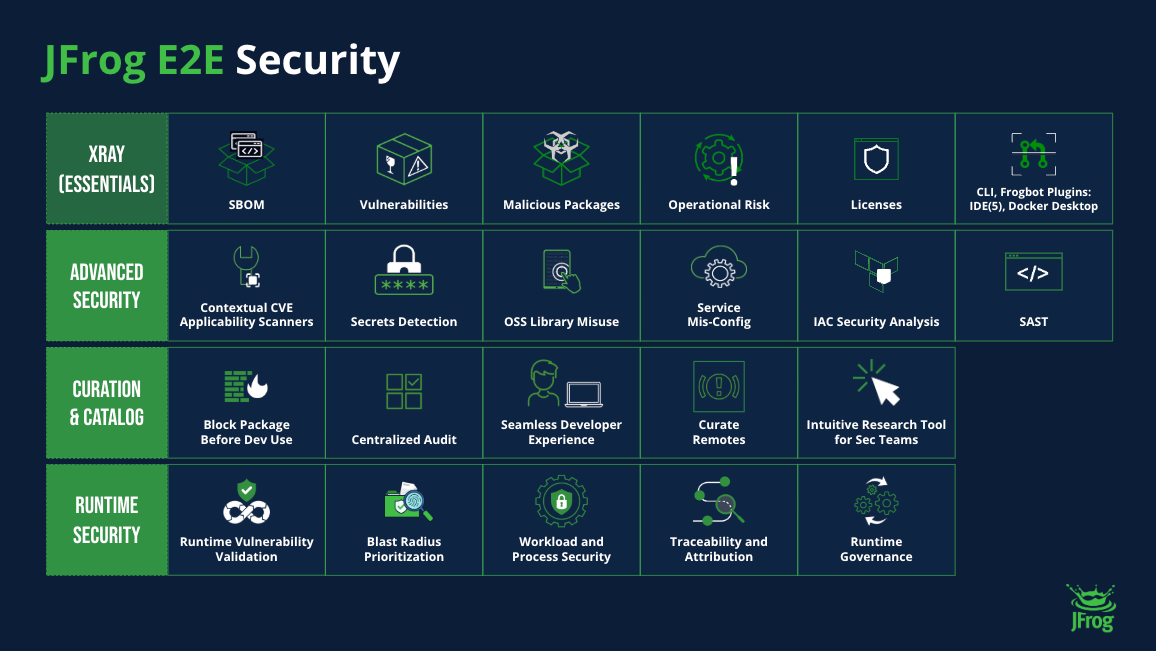
JFrog Xray provides continuous vulnerability scanning for all binary artifacts and container images, identifying every software vulnerability early in the lifecycle. This continuous scanning directly supports Requirement 6 by surfacing vulnerable components before they can reach the cardholder data environment. To support the secure SDLC, JFrog Curation automatically blocks non-compliant or risky open-source packages from entering the pipeline. By enforcing package approval policies at ingestion, Curation fulfills Requirement 6’s mandate to protect systems against risky or malicious components before they enter the development pipeline.
Furthermore, the platform helps organizations maintain compliance through SBOM generation in SPDX and CycloneDX formats, and automated policy enforcement, providing the transparency required for Application Security audits. By centralizing artifact management in JFrog Artifactory, teams create a tamper-evident record of all software components, which serves as essential evidence for ROC and AOC documentation. This immutable audit trail directly addresses Requirements 10 and 11 by providing the verifiable access logs and artifact integrity records that auditors require to confirm ongoing monitoring and testing controls are in place.
Start a free trial or schedule a demo to see how JFrog supports your PCI DSS compliance workflow.