Claude
  Cursor
  Codex
Codex  Hugging Face
  NVIDIA
  Visual Studio Code
  Devin
Devin  Kiro
Kiro  Open Code
  NanoClaw
 Docker
  npm
npm  PyPy
PyPy  Wiz
Wiz 
 Financial Services
  Gaming
  Public Sector
  Automotive
  Technology
  Healthcare


Definition
Cybersecurity Maturity Model Certification (CMMC) is a mandatory Department of Defense framework designed to protect sensitive unclassified data throughout the defense industrial base. By replacing inconsistent self-attestation with verifiable tiered standards, it ensures all contractors and subcontractors maintain a resilient security posture. Compliance is now a critical prerequisite for bidding on and securing new federal defense contracts.
Overview
CMMC (Cybersecurity Maturity Model Certification) is a U.S. Department of Defense (DoD) framework designed to verify the protection of sensitive federal information within the Defense Industrial Base (DIB). It establishes a tiered certification program requiring contractors to demonstrate they safeguard Federal Contract Information (FCI) and Controlled Unclassified Information (CUI) to a verifiable standard. The current CMMC 2.0 framework became enforceable in November 2025 via the 48 CFR final rule, making it a mandatory requirement for maintaining contract eligibility in new DoD solicitations.
Understanding CMMC
To understand what CMMC is, organizations must view it as a shift from self-reporting to a verifiable framework for application security. Created to close security gaps across the supply chain, the framework requires contractors to meet an independently assessed baseline when handling sensitive data. It is built on 14 domains mapping to 110 NIST 800-171 practices, and under 48 CFR enforcement, compliance is now a mandatory prerequisite for all new DoD contracts.
The framework manages compliance through a tiered system where requirements align with data sensitivity:
- Level 1 (Foundational): Requires annual self-assessments for contractors handling Federal Contract Information (FCI).
- Level 2 (Advanced): The primary target for most contractors handling Controlled Unclassified Information (CUI); requires a third-party assessment every three years.
- Level 3 (Expert): Reserved for high-priority programs and involves direct DoD oversight alongside additional NIST SP 800-172 controls.
Does CMMC apply to software build tools or just IT infrastructure?
CMMC compliance is not limited to traditional IT infrastructure. Any CI/CD pipeline, artifact repository, or build node that processes software intended for CUI environments falls directly within the CMMC compliance boundary.
How Does CMMC Work?
The CMMC framework functions by requiring organizations to implement specific cybersecurity practices and then verify that implementation through either annual self-attestation or a formal third-party CMMC assessment. The process is designed to harden the defense supply chain from the inside out, starting with the identification of a software vulnerability and extending to the physical security and monitoring of the facility. For contractors pursuing Level 2 CMMC certification, they must implement and document 110 security practices across the 14 mandatory domains.
This process begins with the establishment of a Secure SDLC where all development tools, build environments, and CI/CD pipelines are considered part of the compliance boundary. Organizations must perform regular vulnerability scanning of all components and maintain strict configuration management to prevent the use of unauthorized or malicious software. Once these practices are established and operationalized, a Certified Third-Party Assessment Organization (C3PAO) evaluates the gathered evidence to confirm that the security controls are sufficiently mature and consistently applied.
A critical component of how the framework works is the specific relationship between CMMC and NIST 800-171. While NIST defines the “what” (the 110 technical controls required) CMMC provides the “how,” establishing the rigorous certification process that verifies those controls are active. This structural change ensures that defense contractors do not just have a security plan on paper but are actively maintaining an operational security posture that is independently verifiable.
What are the Benefits of CMMC?
Achieving CMMC compliance delivers measurable business value that extends far beyond federal contract eligibility. Key benefits include:
- Standardized Security Baseline: Aligns with the SSDF Secure Software Development Framework (SSDF) to reduce the risk of data breaches and intellectual property theft, protecting both proprietary data and national security information.
- Competitive Advantage: Demonstrates a high level of security maturity to the DoD and prime contractors in the Defense Industrial Base.
- Regulatory Simplification: Streamlines compliance by contributing evidence to other high-assurance frameworks like PCI DSS and SOC 2.
- Supply Chain Transparency: Utilizes accurate SBOMs and verifiable software provenance to build a more transparent, resilient, and easily audited supply chain.
What are Best Practices with CMMC?
A successful CMMC checklist starts with clearly defining the boundary of the Controlled Unclassified Information environment and reducing the scope of the assessment wherever possible. Organizations should strive to isolate systems that handle CUI to minimize the number of assets subject to the 110 NISTt 800-171 practices. This strategic scope reduction significantly lowers the overall cost and complexity of the certification process, as it prevents the need to apply rigorous federal standards to non-essential business infrastructure. Effective segmentation ensures that security resources are concentrated where they are needed most, creating a more defensible and manageable compliance posture.
Maintaining continuous visibility across all software assets is also essential for long-term compliance, as point-in-time snapshots are insufficient for the dynamic nature of modern development. Organizations should automate their vulnerability scanning and implement the SLSA Framework to ensure build integrity throughout the pipeline. Using a software bill of materials (SBOM) provides assessors with the precise component-level inventory required to evaluate configuration management and system integrity controls effectively. This level of transparency is critical for proving that no unauthorized or malicious open-source packages have entered the environment.
Organizations must formalize their documentation by updating their System Security Plan (SSP) and establishing a clear Plan of Action and Milestones (POA&M) for any outstanding remediation tasks. Adhering to the SSDF can further assist in codifying these secure processes into daily developer workflows. Additionally, early engagement with a Certified Third-Party Assessment Organization (C3PAO) is highly recommended; the limited number of accredited assessors for nearly 80,000 organizations has created significant scheduling waitlists that can delay CMMC certification.
To avoid C3PAO audit delays and navigate assessor backlogs, organizations should automate SBOM creation and software composition analysis. This drastically cuts assessment preparation time and streamlines evidence collection, positioning proactive organizations to meet assessment timelines and secure future defense contracts.
What are the Challenges of CMMC?
The primary challenge for defense contractors today is the abrupt transition from a self-attestation model to a mandatory, third-party verified framework. Implementing and documenting all 110 practices of NIST 800-171 requires significant and ongoing investment in both technical infrastructure and security personnel. Many organizations find that their existing software supply chain is a primary weak point; open-source dependencies and third-party libraries can introduce a software vulnerability that is difficult to track and remediate without advanced automation.
Another hurdle is the significant “waitlist management” risk caused by the small number of currently accredited C3PAOs. Organizations that delay their preparation until a contract award is imminent may find themselves unable to schedule an assessment before their current contracts expire or new solicitations are released. Furthermore, the 48 CFR enforcement date has created a firm deadline for compliance; any organization not yet certified risks being immediately excluded from the defense marketplace.
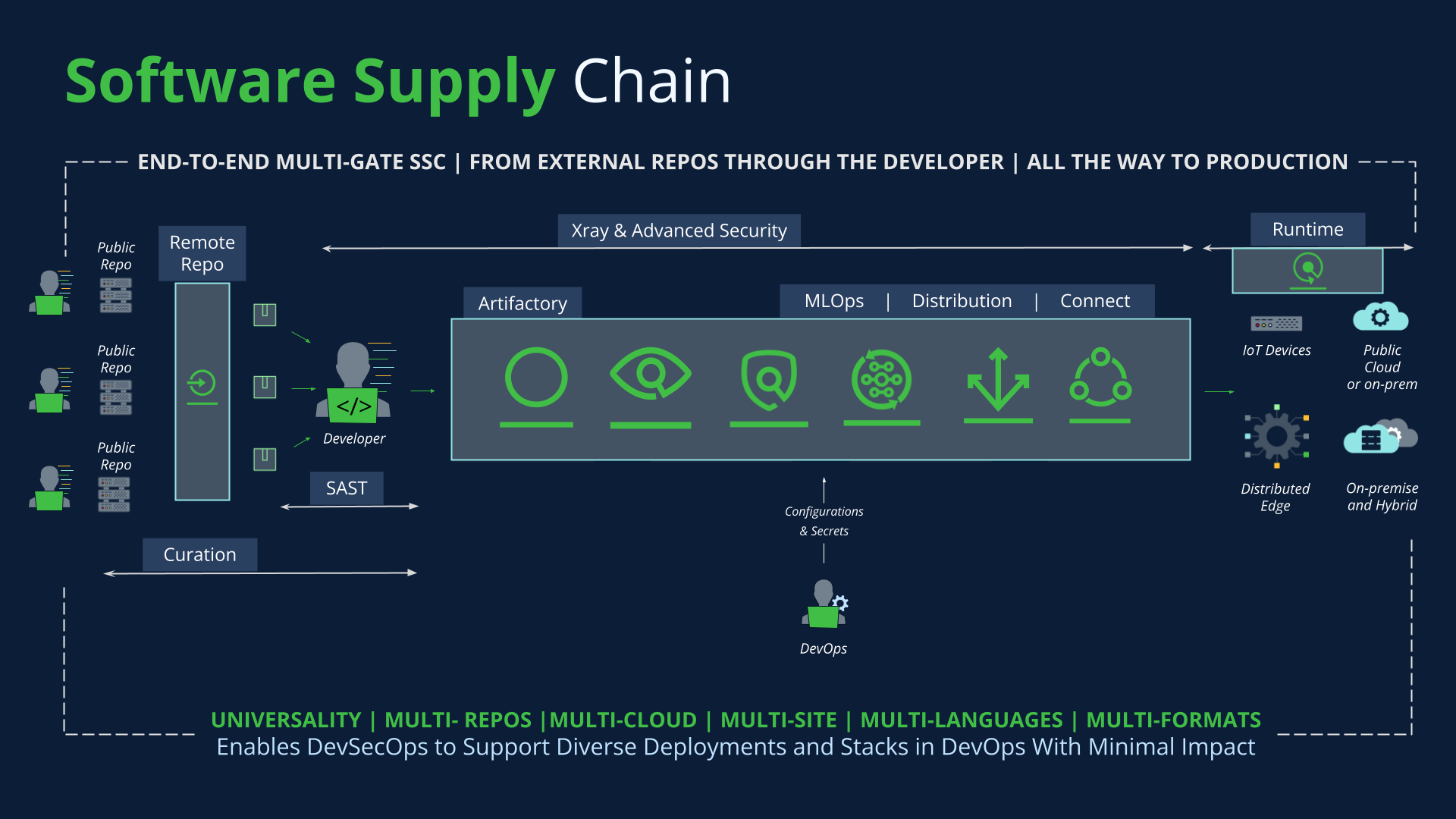
Visual chart of how JFrog helps enable a secure software development lifecycle.
Supporting CMMC with the JFrog Platform
Meeting the rigorous demands of CMMC domains like System and Information Integrity (SI) and Configuration Management (CM) requires a dedicated platform layer designed for the software supply chain. The JFrog Platform provides the governance and security tooling necessary to manage artifacts and protect CUI environments from the inside out.
- JFrog Artifactory provides the immutable repository audit trail essential for satisfying CMMC Domain AU (audit & accountability) requirements.
- JFrog Security Essentials (Xray) performs continuous vulnerability scanning on open source components, container images, and binary artifacts, directly supporting the requirement to identify and manage software flaws.
- JFrog Curation automatically blocks non-compliant open-source packages at ingestion, demonstrating proactive risk management.
- JFrog Advanced Security generates detailed SBOMs in standard SPDX and CycloneDX formats while establishing software provenance required for third-party audits, ensuring full traceability from initial build to deployment.
Ready to simplify your CMMC assessment? Request a demo or start a free trial of the JFrog Platform.