Claude
  Cursor
  Codex
Codex  Hugging Face
  NVIDIA
  Visual Studio Code
  Devin
Devin  Kiro
Kiro  Open Code
  NanoClaw
 Docker
  npm
npm  PyPy
PyPy  Wiz
Wiz 
 金融サービス
  ゲーム・エンタメ
  公共部門
公共部門  自動車
自動車  テクノロジー
  ヘルスケア
ヘルスケア 


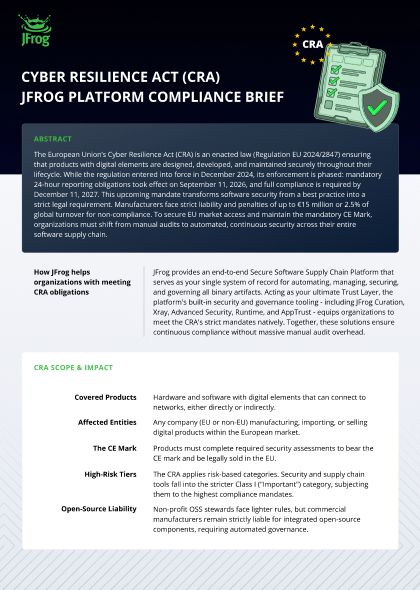
Cyber Resilience Act (CRA) JFrog Platform Compliance Brief
Abstract
The European Union’s Cyber Resilience Act (CRA) is an enacted law (Regulation EU 2024/2847) ensuring that products with digital elements are designed, developed, and maintained securely throughout their lifecycle. While the regulation entered into force in December 2024, its enforcement is phased: mandatory 24-hour reporting obligations took effect on September 11, 2026, and full compliance is required by December 11, 2027. This upcoming mandate transforms software security from a best practice into a strict legal requirement. Manufacturers face strict liability and penalties of up to €15 million or 2.5% of global turnover for non-compliance. To secure EU market access and maintain the mandatory CE Mark, organizations must shift from manual audits to automated, continuous security across their entire software supply chain.
How JFrog helps organizations with meeting CRA obligations
JFrog provides an end-to-end Secure Software Supply Chain Platform that serves as your single system of record for automating, managing, securing, and governing all binary artifacts. Acting as your ultimate Trust Layer, the platform’s built-in security and governance tooling – including JFrog Curation, Xray, Advanced Security, Runtime, and AppTrust – equips organizations to meet the CRA’s strict mandates natively. Together, these solutions ensure continuous compliance without massive manual audit overhead.
CRA Scope & Impact
- Covered Products: Hardware and software with digital elements that can connect to networks, either directly or indirectly.
- Affected Entities: Any company (EU or non-EU) manufacturing, importing, or selling digital products within the European market.
- The CE Mark: Products must complete required security assessments to bear the CE mark and be legally sold in the EU.
- High-Risk Tiers: The CRA applies risk-based categories. Security and supply chain tools fall into the stricter Class I (“Important”) category, subjecting them to the highest compliance mandates.
- Open-Source Liability: Non-profit OSS stewards face lighter rules, but commercial manufacturers remain strictly liable for integrated open-source components, requiring automated governance.
Platform Compliance Mapping
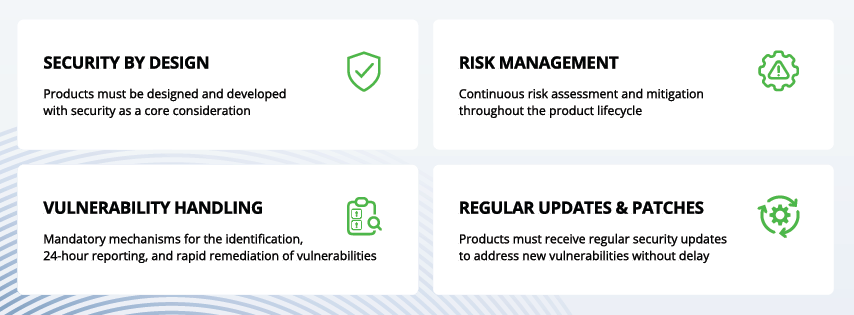
The CRA requires companies to adopt secure development practices, proactively manage vulnerabilities, and maintain comprehensive auditability. Compliance is a non-negotiable prerequisite for EU market access, ensuring products are secure and trusted.
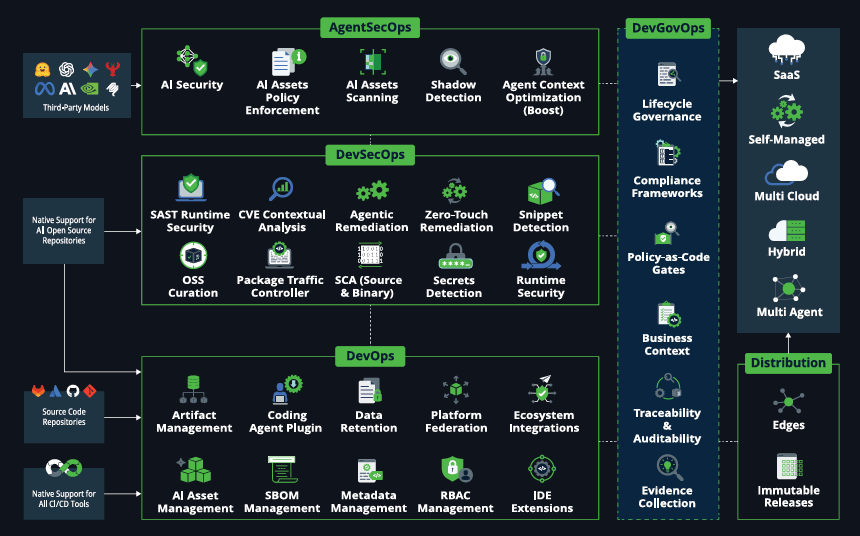
The JFrog Platform is a unified solution that ensures secure and controlled software delivery from code to runtime. Scanners check code, but the CRA regulates the product you ship – the binary. JFrog acts as your ultimate Trust Layer, securing the binary artifacts to provide an immutable single source of truth. This bridges the gap between developers, operations, and security teams, scaling trust at the speed of modern development.
The JFrog Software Supply Chain Platform
JFrog Curation, Catalog, and IDE Plugins
Establish a secured environment to satisfy the CRA’s Strict Liability mandates and a Secure-by-Design foundation.
- Secure-by-Design Enforcement: Automatically block unsafe or highly vulnerable open-source packages at the front door before they enter your software supply chain.
- Third-Party Due Diligence: Mitigate strict liability risks by establishing a “clean pipe” environment that ensures third-party components do not compromise product cybersecurity.
- Shift-Left Resolution: Utilize IDE plugins to empower developers to identify and resolve vulnerabilities directly at their desks, maintaining continuous compliance without slowing down delivery velocity.
JFrog Xray, Advanced Security, and Runtime
Detect and remediate vulnerabilities early to meet the CRA’s strict incident reporting and tracking SLAs.
- Automated SBOMs & VEX: Generate mandatory machine-readable SBOMs enriched with VEX (Vulnerability Exploitability eXchange) data to fulfill the CRA’s strict product documentation requirement and its minimum 5-year vulnerability tracking mandate per release.
- Contextual Analysis: Solves the prioritization paradox by identifying genuinely exploitable CVEs, empowering your team to hit CRA’s strict ENISA reporting deadlines: 24-hour early warnings, 72-hour detailed notifications, and 1-month final reports.
- Secure-by-Default Infrastructure: Ensure your deployments meet the CRA’s ‘Secure-by-Default’ configuration mandates by continuously scanning Infrastructure-as-Code (IaC).
JFrog AppTrust
Automate CRA compliance and continuous governance by eliminating manual bottlenecks with a legally defensible system of record.
- Lifecycle Governance: Provides a structured promotion flow that physically moves immutable application bundles through defined stages, so you can prove to auditors that only verified releases reached production.
- Automated Evidence Collection: Automatically consolidates security, quality, performance and releasing evidence into a single source of truth, cryptographically binding it to your binaries for a tamper-proof chain of custody.
- Policy as Code (PaC): Translates complex CRA regulations into executable Open Policy Agent (OPA) code to enforce automated release gates that proactively block non-compliant software.
- Pre-Mapped Policy as Code (PaC): Enforce CRA compliance without manual policy writing. AppTrust applies pre-mapped CRA frameworks directly to Open Policy Agent (OPA) release gates out of the box, delivering real-time compliance coverage scoring while proactively blocking non-compliant software across the SDLC.
CRA Compliance Starts Here
JFrog’s integrated platform provides comprehensive risk assessments, eliminates vulnerability noise, and maintains immutable audit trails. By leveraging the platform’s integrated security capabilities and embracing a DevGovOps approach – embedding governance, risk, and compliance (GRC) directly into development workflows – businesses can replace massive manual audit overhead with automated evidence-based gates using JFrog AppTrust. This guarantees continuous compliance with the Cyber Resilience Act while safely accelerating software delivery.
Request a demo to learn more about how the JFrog platform can help you meet these critical requirements.