Claude
  Cursor
  Codex
Codex  Hugging Face
  NVIDIA
  Visual Studio Code
  Devin
Devin  Kiro
Kiro  Open Code
  NanoClaw
 Docker
  npm
npm  PyPy
PyPy  Wiz
Wiz 
 Financial Services
  Gaming
  Public Sector
  Automotive
  Technology
  Healthcare


Why Self-Healing Is the Only Way to Secure at Frontier AI Speed

By
4 min read
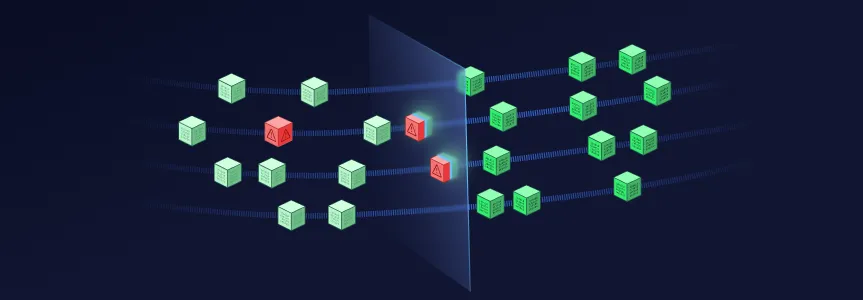
For twenty years, the software security playbook has worked the same way. You find the vulnerability, score it, open a ticket, assign it to a human, wait for the fix, ship the patch, and prove it happened. Every step in that sequence assumes humans can review each fix individually and still keep up.
Frontier AI broke that assumption. The exploit window has collapsed from weeks to hours. Attackers reason across your codebase, chain their findings, and ship exploits before a CVE is even published. Your review queue has become a liability.
Frontier AI Has Changed Both the Exploit Window and the Exploits Themselves
When the industry built modern AppSec, disclosure was slow. Exploit development took weeks. A vulnerability that required deep expertise or specialized tooling to weaponize was often safe to deprioritize, because few attackers had the skill or the patience to build the exploit and reach a payoff. This complexity itself was a form of defense.
Frontier AI has collapsed that timeline. The exposure window is now measured in hours. Vulnerabilities that were once too hard to exploit are now within reach of a far broader attacker pool. A flaw that sat at the bottom of your triage queue because no one would realistically build the exploit is now something an AI model can produce in an afternoon. This does not mean every dormant CVE is suddenly a live threat. It does mean the assumptions underneath your prioritization need to be revisited.
Meanwhile, the defensive side has not moved. Security teams still triage, score, ticket, and wait for human approval on each fix. That workflow was built for weekly exposure windows that have since collapsed to hours. CISOs are expected to deliver remediation at machine speed using a process designed for manual approval.
AI Assistants Cannot Restructure the Workflow
The industry’s instinct has been to add more AI to the same process. AI assistants for developers. AI assistants for security analysts. AI assistants for triage. These are genuinely useful, and in the right hands they meaningfully reduce toil. But they leave the shape of the work untouched. The human still reviews every fix, and the queue still forms.
The Frontier AI era demands something different. It needs a Self-Healing Software Supply Chain, one that runs at machine speed and stays trustworthy without human sign-off on every fix.
A Self-Healing Software Supply Chain keeps your software lifecycle secure, compliant, and provable by default. And a critical piece of this Self-Healing Software Supply Chain is the ability to automatically remediate risks.
Automated Remediation Requires Both Speed and Trust
Speed without trust breaks things faster. Trust without speed loses to the attacker. Automated vulnerability remediation, and thereby self-healing, only works when both hold together.
To be trusted, automated vulnerability remediation has to meet four conditions.
- Build-Safe Fixes: Remediation must preserve build integrity, or automation gets killed.
- Ecosystem-Wide Reach: Fixes must resolve exposure everywhere, not just in isolated repos.
- Context-Aware Relevance: Automation must focus strictly on reachable, exploitable code.
- Verifiable Governance: Machines must leave signed, cryptographic evidence of every change.
And this is precisely the challenge. It has been hard to deliver trusted, automated remediation so far because most tools are able to meet one or two of the above conditions, but not all four.
Self-Healing Cannot Be Bolted On and Stitched Together
Even meeting all four conditions is not enough if they live in separate tools. One tool scans, another prioritizes, a third remediates, and a fourth records evidence. Each runs on its own schedule, and risk slips through the gaps between them.
A Self-Healing Software Supply Chain has to work as one system. Prevention, detection, prioritization, remediation, and evidence have to run together, from the same place your artifacts already flow through. It operates at machine speed, holds a secure and compliant state on its own, and delivers automated vulnerability remediation without human approval for every fix.
That is what JFrog is unveiling at swampUP this September: a software supply chain that protects, heals, and governs itself.
Reserve your seat now to see how you can secure your software supply chain at Frontier AI speed.
 New insights from +1,400 security & DevOps leaders. Get the Full Report.