Claude
  Cursor
  Codex
Codex  Hugging Face
  NVIDIA
  Visual Studio Code
  Devin
Devin  Kiro
Kiro  Open Code
  NanoClaw
 Docker
  npm
npm  PyPy
PyPy  Wiz
Wiz 
 Financial Services
  Gaming
  Public Sector
  Automotive
  Technology
  Healthcare


DevGovOps: How the AI Era Dictates That Governance Lives Inside the Pipeline

By
6 min read
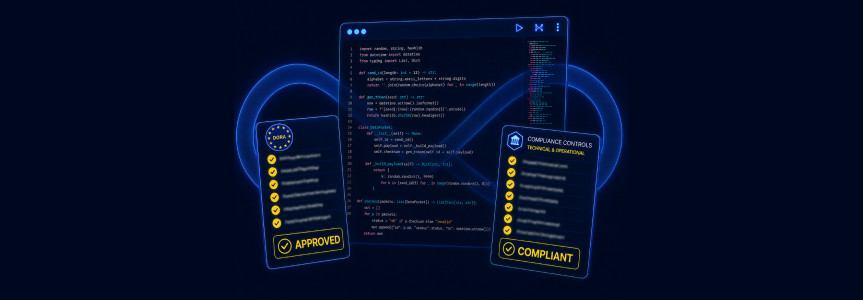
For decades, proving compliance meant having a person behind every decision – an engineer who remembered the approval, an auditor who could call someone and get an answer. That model worked because humans wrote, reviewed, and shipped every line of code. When agents do it instead, that dependency breaks. And so does your ability to prove you were in control.
Compliance Was Built Around a Human in the Loop
Your governance model rested on a premise that held for two decades: a human touched every decision. They wrote the code, reviewed the pull request, and approved the release. You knew every contributor, controlled the pace, and could trace any decision back to a name. Compliance was a burden – but it worked because a person stood behind every step.
AI coding agents remove that person from the loop. They plan features, write code, review pull requests, and deploy to production without waiting for human approval at each step. Security and governance teams now find out what shipped only after it is already in production, at a volume no manual process can track.
Frontier AI has collapsed the window between a vulnerability entering your supply chain and an attacker weaponizing it – from weeks to hours. In August 2026, the Shai-Hulud worm compromised more than 1,300 versions of widely used npm packages, reaching an estimated 2 billion monthly installs before defenders could fully contain it. Your governance process was not built for that speed.
When a board member or auditor asks who approved a change, what is inside a release, or why an agent merged code at 3 a.m., there is often no one to ask.
Regulators Are Not Waiting for Your Governance to Catch Up
CRA, NIST SSDF, DORA, and FedRAMP demand the same thing from different angles: prove you govern your software supply chain at any given moment, not just at audit time. The EU CRA alone carries fines up to 2.5% of global annual revenue and shifts personal legal liability directly onto CISOs and executive leadership.
In July 2026, the European Central Bank directed the CEOs of every major European bank to submit a concrete action plan by October 31st – with named controls and named owners – for protecting against Frontier AI-accelerated threats. The ECB will not be the last regulator to move this way. The requirement is the same everywhere it lands: prove you govern your supply chain, continuously, on demand.
Bolted-On Governance Breaks at Agent Speed
Governance has always been the last gate: it signs off after development ships and security reviews. That worked when there was time between each step. Agentic pipelines remove that time. By the time a security team reviews what an agent already shipped, the window to act has often closed. Adding more reviewers to that sequence does not fix it – it only adds another person trying to catch up with a machine. A policy review that used to take a day now needs an answer in the time it takes an agent to open a pull request.
The model that worked for human-paced development cannot survive agent-speed delivery. Something has to change structurally – not just get faster.
DevGovOps Makes Governance a Natural Output of the Pipeline
DevOps merged development and operations. DevSecOps moved security into every stage of delivery instead of leaving it at the end. DevGovOps shifts compliance down to the platform layer itself, making governance a continuous output of the pipeline rather than a function any team runs manually.
DevGovOps runs on four continuous dimensions:
- Codify: Turn governance rules into machine-readable policy that tests, validates, and applies across every release – whether code is written by a human or an agent.
- Attest: Capture and cryptographically sign evidence automatically at every stage, so proof already exists before anyone asks for it. This includes agent interactions: every autonomous action an agent takes is captured and attached to the release it produced. The evidence chain runs from the first prompt to the final artifact, all in a single system of record.
- Enforce: Apply policy automatically at each stage, so nothing ships that fails it – regardless of whether a human or an agent triggered the release. When a policy exception is genuinely necessary, waivers require a cryptographic signature – so bypasses are accountable, not invisible.
- Monitor: Keep watching production continuously after release. The release gate is never the last checkpoint.
Together, these four dimensions turn governance into something your pipeline produces continuously – instead of something your team scrambles to reconstruct once a year.
How JFrog AppTrust Runs DevGovOps Today
JFrog AppTrust is uniquely positioned to deliver this because every artifact – whether first-party, AI-generated, or open source – already flows through JFrog Artifactory before it ships. Context, lineage, and attestations attach to the artifact the moment it enters the pipeline. Evidence is not a separate collection step; it is a byproduct of where the artifact already lives. That also means ownership, risk, and business impact are instantly available for every artifact – so when a new vulnerability surfaces, you know immediately which application it affects, who owns it, and what the blast radius is. Developers never feel it. Auditors can always see it.
AppTrust brings DevGovOps to your pipelines through four capabilities introduced at swampUP 2026:
- AI-powered Policy-as-Code Playground: Validates policies against real evidence inside your System of Record, before they ever enforce.
- Prompt-to-Release Traceability: Captures the full provenance trail behind every agent action, from the original prompt through the artifact that ships.
- Out-of-the-Box Compliance Frameworks: Arrive pre-mapped to CRA and NIST SSDF, so you start from a working baseline instead of a blank policy document.
- Post-Release Governance: Keeps watching production after the release gate closes, extending the Monitor dimension past the moment of deployment.
Together, these capabilities give your team a way to run DevGovOps as part of their pipelines instead of treating it as a framework on a slide.
Closing The Governance Gap
The pressure on security leaders has never been greater – more agents, more velocity, more regulation, more personal liability. But the answer is not more process – It is better infrastructure. When governance is engineered into the pipeline, it stops being something you manage and starts being something you have. That shift – from governance as a burden to governance as a property of every release – is what DevGovOps delivers. And it changes what it means to be in control.
To explore how JFrog AppTrust can close your own compliance gap sooner, schedule a demo or start a free trial.
 New insights from +1,400 security & DevOps leaders. Get the Full Report.