Claude
  Cursor
  Codex
Codex  Hugging Face
  NVIDIA
  Visual Studio Code
  Devin
Devin  Kiro
Kiro  Open Code
  NanoClaw
 Docker
  npm
npm  PyPy
PyPy  Wiz
Wiz 
 Financial Services
  Gaming
  Public Sector
  Automotive
  Technology
  Healthcare


Frontier AI Application Security: Every Second Counts
A look at how AppSec processes must change to manage the ever increasing volume of CVEs resulting from today's cyber-capable AI models

By
9 min read
Somewhere in the last few months, the math of application security quietly broke.
Anthropic’s Claude Mythos Preview didn’t just analyze code, it found a 27-year-old vulnerability in OpenBSD, a 16-year-old bug in FFmpeg, and a 17-year-old remote code execution flaw in FreeBSD, entirely on its own. Then it went further: it built working exploits for them. No human guidance. No months of manual research. And by Anthropic’s own account, this is only a preview of what’s coming.
Comparable capabilities are already proliferating to other frontier models, and it’s only a matter of time before it reaches open-weight models that anyone can run, with none of the coordinated-disclosure norms that responsible actors follow.
That’s the shift. It isn’t that AI is creating new categories of security issues out of thin air, – it’s that the gap between “a vulnerability exists” and “a vulnerability is a working exploit in an attacker’s hands” has gone from weeks to hours, sometimes less.
The CVE tsunami security teams have been bracing for isn’t just going to be bigger. It’s going to be faster, and every second sitting between disclosure and remediation is a second an attacker can gain access to your development environment.
Legacy AppSec stacks were built for a slower world, where a handful of critical CVEs took a month, with days or weeks to triage, correlate across tools, and patch. That world is gone and the uncomfortable truth is that this cannot be fixed by attempting to run the old, fragmented process faster. Accelerating a manual, siloed security workflow doesn’t close the gap between disclosure and exploitation – it just means you work even harder only to fall in the end.
The Advantage Isn’t a Feature – It’s Architecture
Most AppSec vendors’ offerings have security added on top of the underlying infrastructure, where; a scanner is bolted onto a Git repo, an ASPM tool orchestrated on top of a cloud account, and a CNAPP dashboard is sitting on top of workloads it assumes are valid.
JFrog takes a dramatically different approach by building security directly into the SDLC. It’s also the same platform that already manages every binary, dependency, build, container, and release moving through the organization.
JFrog believes that security, governance, and control of AI Agents need to be integrated into a single platform , connected at every stage of the development lifecycle. We provide a single cohesive trust layer that can tie binaries back to code repositories, and specific developers. It’s also where vulnerability detection, prioritization and remediation, as well as continuous governance happen in parallel, not handed off between stakeholders and siloed tools sequentially..
That architectural choice isn’t a matter of taste. In an era where exploitation windows are measured in hours, it produces three concrete time advantages that a bolted-on stack cannot structurally replicate, because time saved is time that can be put towards a better defense.
1. Time Not Spent Tending the Stack
Every hour an AppSec engineer spends reconciling conflicting findings between a SAST tool, an SCA tool, a secrets scanner, and a separate CNAPP dashboard is an hour not spent evaluating actual threats. Point solution stacks create their own tax: each tool owns its own silo, catches issues only within its own slice of the SDLC, and none of them are built to trace a finding beyond the phase where it was discovered. That reconciliation work is manual and expensive. Some waste a significant share of their security budget on redundant tooling that largely overlaps in coverage.
JFrog Advanced Security runs binary-level SCA, SAST, secrets detection, container and IaC scanning, detailed CVE contextual analysis, and runtime verification from the same UI. This is in addition to the artifact metadata already stored in JFrog Artifactory. There’s no correlation step because there’s nothing to correlate. A package, its build, its scan results, and its production footprint were never split across five systems in the first place. Security teams get one console, one policy engine, one audit trail, instead of a rotating shift spent keeping integrations alive.
2. Time Not Spent Hunting Down Impact
When a CVE lands, the first question every security leader asks is the one that historically took the longest to answer:Where are we exposed? In a fragmented AppSec stack, that means manually correlating SBOMs, build logs, and deployment records across tools that were never designed to communicate with each other. This often takes days, while the exploitation window keeps compressing at the hands of evolving frontier AI models.
JFrog Xray’s Impact Search answers that question in seconds, not days. Because JFrog Artifactory manages the binary as the single source of truth, Xray can trace every artifact across every repository containing an affected package: its location, its last scan, and its path through the supply chain.
This happens across millions of artifacts and full transitive dependency trees, at a scale point tools built for a single ecosystem simply cannot match. Contextual Analysis then determines whether the vulnerability is actually reachable in how the first-party code uses the library, typically suppressing around 90% of flagged CVEs as non-applicable, so teams triage a ranked queue of real risk instead of a raw alert firehose.
For the growing category of AI-generated code that copies snippets directly into a codebase rather than declaring them as dependencies, JFrog Snippet Detection catches what manifest-based scanners miss entirely, matching reused and altered code fragments against known vulnerabilities and license obligations. Because JFrog Runtime continuously verifies what’s actually running in production matches the single source of truth in Artifactory, blast-radius mapping doesn’t stop at the build, but extends into every running application.
3. Time Not Spent Figuring Out How to Fix It
Knowing you’re exposed to a security vulnerability is only half the problem. The other half is figuring out the right fix for your specific requirements without breaking something else. That is precisely where a lot of remediation time quietly disappears.
Since the JFrog Platform already knows the customer’s builds, lineage, and policy posture, the remediation guidance is tailored to your specific release rather than generic security advice.
JFrog Xray’s smart remediation engine, backed by the JFrog Security Research team, returns a machine-readable fix recommendation and correlates the vulnerable artifact back to its source repository through irrefutable build Info. JFrog Frogbot then opens a pull request with the validated fix applied and automatically scanned for new policy violations, closing the loop from detection to a mergeable change.
For teams pushing further into agentic workflows, JFrog’s agentic remediation plugs directly into the coding agent the organization already trusts via JFrog’s MCP server. Rather than asking teams to trust a new autonomous agent from scratch, it hands the customer’s chosen agent the system-of-record context it needs in order to act. Every step of that chain, spanning detection, applicability, fix, evidence, approval, is bound into an immutable, cryptographically signed audit trail through JFrog AppTrust, so speed and compliance are no longer a trade-off.
Prevention Still Beats Fast Response
Speed of response matters, but the fastest fix is the one you never had to make in the first place. JFrog Curation sits upstream of all of this, blocking malicious, critical-vulnerability, or policy-violating packages and increasingly, models and AI components via JFrog AI Catalog, before a developer or an agent ever pulls them into the build.
When a blocked version is requested, Curation automatically serves the highest policy-compliant alternative, so security stops being the thing that slows down a pipeline. Frogbot extends that same enforcement into the pull request itself, catching new vulnerabilities and license or policy gaps at the first possible opportunity to fix them, before they ever reach a build.
Seconds Are the New Scoreboard
As cyber-capable AI models continue to compress the distance between “vulnerability disclosed” and “vulnerability weaponized,” the security advantage stops being about how many scanners a platform bundles or how many CVEs a feed covers. It comes down to something much simpler: How many manual engineering hours it takes between a disclosure and a validated, governed fix.
The diagram below shows the JFrog killchain, the systematic process for accelerating vulnerability remediation times:
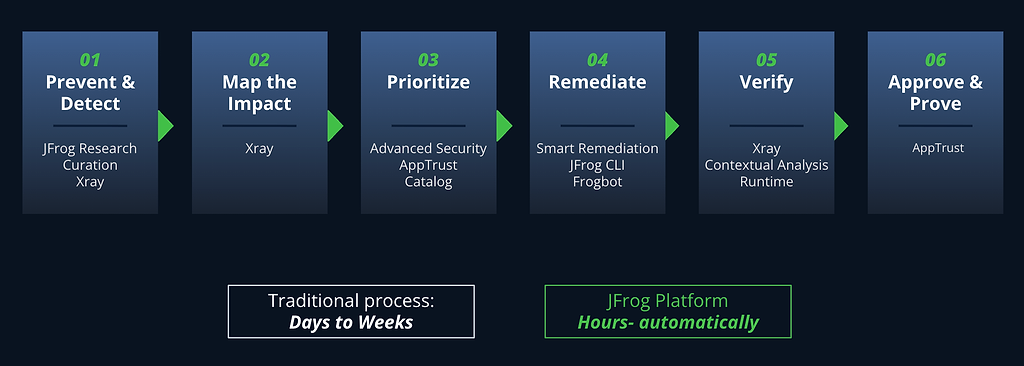
The organizations best prepared for what Mythos-class models represent aren’t the ones racing to bolt on the newest AI-security point solution. They’re the ones who already made their software system of record the place where security, governance, and speed all work together. In the end, when the next wave of cyber-capable models arrives– every minute we save, is another minute we can use for remediation .
See JFrog AI Era Security In Action
In the fast-moving era of frontier models, managed cloud platforms allow for instant, universal remediation of evolving vulnerabilities. Whether hybrid or migrating your existing infrastructure, the JFrog Cloud Platform is built to provide the automated protection and continuous governance you need to master the AI surge.
Want to see how JFrog gives your security team back the precious time that matters? Schedule a demo with a JFrog AppSec expert and get a personalized walkthrough of JFrog Xray, Advanced Security, Contextual Analysis, and end-to-end remediation mapped to your workflow.
 New insights from +1,400 security & DevOps leaders. Get the Full Report.