Claude
  Cursor
  Codex
Codex  Hugging Face
  NVIDIA
  Visual Studio Code
  Devin
Devin  Kiro
Kiro  Open Code
  NanoClaw
 Docker
  npm
npm  PyPy
PyPy  Wiz
Wiz 
 Financial Services
  Gaming
  Public Sector
  Automotive
  Technology
  Healthcare


The System of Record for Every AI Asset in Your Dell AI Factory

By
5 min read
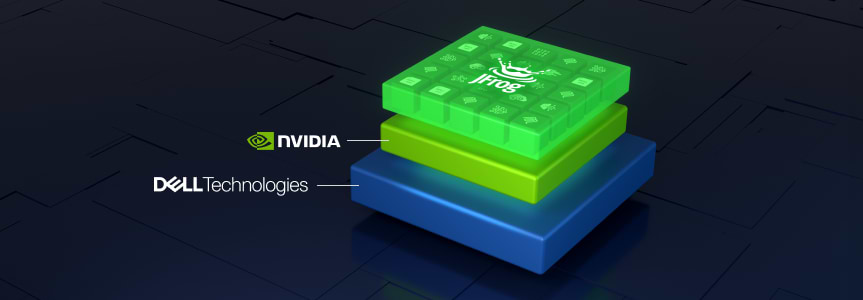
Building an AI-powered software stack means working with more asset types than ever – NVIDIA NIM, models from Hugging Face, agent skills, MCP servers, container images, packages, and fine-tuned variants – each sourced from different registries and used by different teams. That fragmentation is where governance breaks down and velocity stalls. The JFrog Platform is the universal repository that the world’s largest enterprises use as a system of record to manage AI models and software artifacts at scale. Delivered as a validated Dell Automation Platform blueprint, it’s a one-click deploy on the Dell AI Factory.
The Asset Layer of an AI Factory
Enterprise AI Factories are built in layers. Dell provides the validated infrastructure and services. NVIDIA provides the GPU-accelerated software stack and models. Kubernetes orchestrates the workloads. Above all of that sits an asset layer that tracks every model, container, and package the factory consumes and produces.
Producing an AI-powered application means orchestrating those assets: pulling the right model version, pairing it with the right container image, resolving the right package dependencies, and doing it consistently across teams and environments. Without a system of record at this layer, that orchestration breaks down, and governance teams lose visibility into provenance, version history, and access records for everything running in production. Without a way to manage these assets at scale, the problem compounds as teams, models, and applications multiply.
This is the layer JFrog was built for, and what the Dell Automation Platform blueprint deploys.
What does a single source of truth give you?
A few capabilities matter most when the JFrog Platform takes on this role on a Dell AI Factory:
- One place to find every AI and software asset: Regardless of source or format.
- Consistent delivery across teams and environments: The same model, container, or package version available wherever it’s needed in the factory.
- Controlled proxying of public sources (NVIDIA NGC, Hugging Face, Docker Hub): External assets enter the factory through a single, reliable path.
- Full version history, provenance, and access control: Every asset tracked from the moment it enters the factory through to production, with a clear audit trail of who pulled what and when.
- Air-gapped operation for regulated and disconnected environments: Financial services, healthcare, and federal sectors keep the same capabilities intact.
What JFrog can manage in a Dell AI Factory?
The asset list that a Dell AI Factory will recognize from day one:
- NVIDIA NIM: Proxied and cached from NGC, with version control and a local distribution path for inference workloads.
- Hugging Face models: Proxied through a controlled mirror, giving teams access to the catalog without uncontrolled outbound pulls.
- Agent Skills: The JFrog Agent Skills Registry ensures agents, developers, and AI users only pull verified, secured, and governed skills.
- MCP Servers: A centralized MCP Registry that ensures developers and agents only use pre-vetted MCP servers.
- Container images: Docker and OCI-compliant registry for inference, serving, and runtime images
- Packages and dependencies: Over 60 package technologies covering Python and the supporting dependency sprawl that AI workloads bring with them.
- Proprietary and fine-tuned models: Versioned alongside third-party assets, in the same repository.
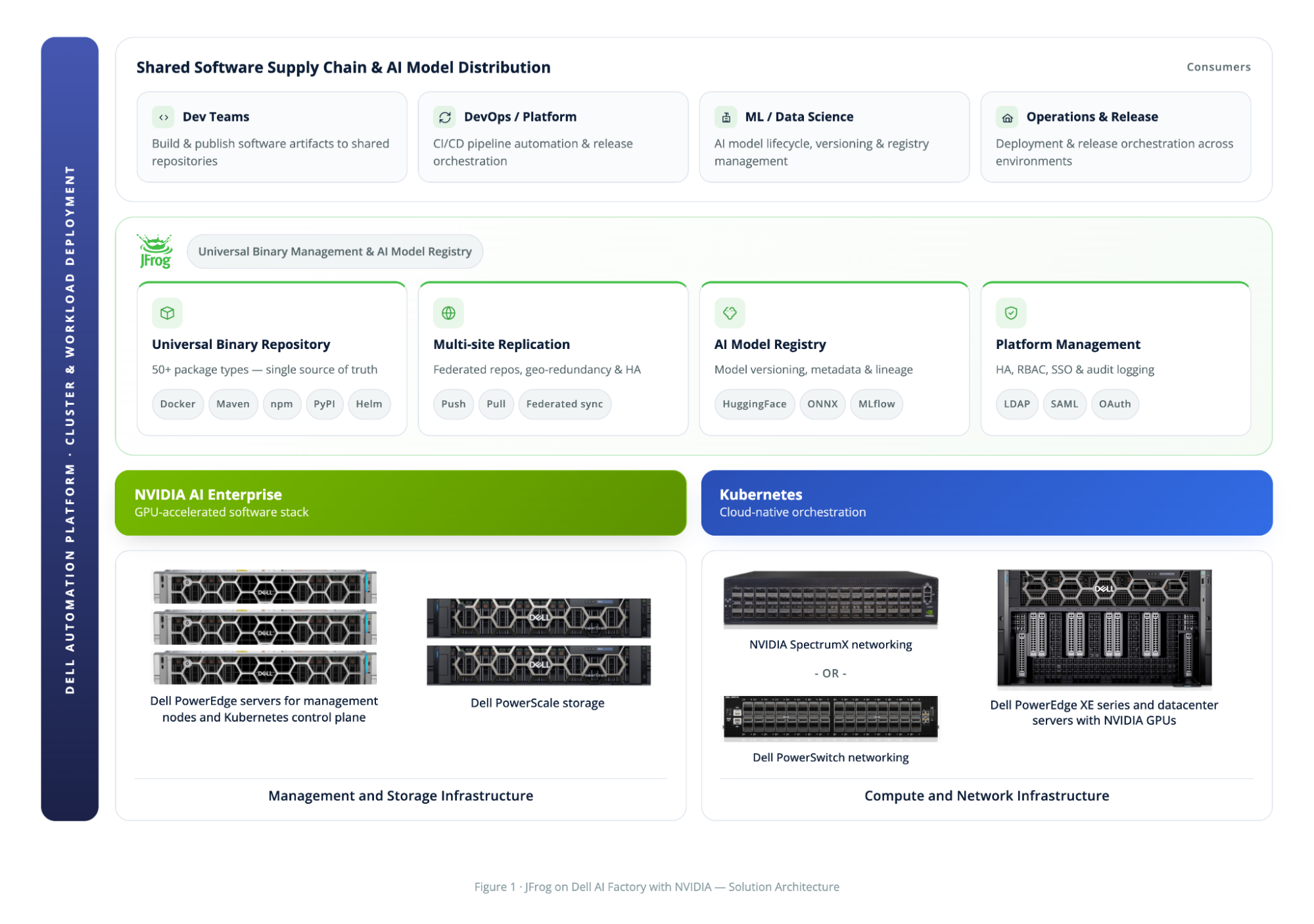
Figure 1. The JFrog Platform on the Dell AI Factory with NVIDIA – Solution Architecture
In practice, a team building a RAG application can pull a NIM through JFrog, pair it with a container image stored in the same repository, and resolve their Python dependencies from the same source, without any of those assets ever leaving the factory perimeter.
Why the blueprint matters
The JFrog Blueprint is a Dell-validated, one-click deployment designed to simplify and accelerate enterprise rollouts. Built as an orchestration layer on top of JFrog Helm charts that manage the application-level deployment of Artifactory, the Blueprint extends them with Dell-validated infrastructure configuration, including secret handling, storage class setup, and end-to-end lifecycle management through the Dell Automation Platform.
The practical result: what used to be a multi-week integration is now a marketplace deployment from the Dell Automation Platform catalog. Together, Dell and JFrog deliver a central hub for managing AI models and software artifacts at scale, installed and lifecycle-managed on Dell-certified infrastructure.
Where to go next:
Resources to get you started with JFrog on the Dell AI Factory.
- Get started with a JFrog Trial
- Take a tour of the JFrog Platform (step-by-step walkthrough)
- Book a 1:1 demo of The Jfrog Platform
- Read about JFrog in Dell’s announcement
- JFrog’s catalog listing for the blueprint itself on the Dell Automation Platform
- The JFrog Solutions Guide for architecture, sizing, and deployment details
Experience
JFrog Today
Discover how the JFrog Platform unites DevOps, DevSecOps and MLOps for secure, rapid software delivery.