Claude
 Cursor
 Codex
 Hugging Face
 NVIDIA
 Visual Studio Code
 Devin
 Kiro
 Open Code
 NanoClaw

 Docker
 npm
 PyPy
 Wiz

 Financial Services
 Gaming
 Public Sector
 Automotive
 Technology
 Healthcare


The New Rules of Patching: When a Fix Becomes a Blueprint for Attackers

By
8 min read

TL;DR: Frontier AI has collapsed the vulnerability exploit window from weeks to mere hours. Attackers now use advanced AI models to reverse-engineer published fixes and generate working exploits faster than human security teams can deploy updates. In the AI era, publishing a patch creates a blueprint for attackers. Surviving this threat requires vendors to tier sensitive disclosures and customers to treat patch application speed as a critical security metric.
While software supply chain security has mainly been thought about in terms of dependencies and plugins, the era of AI models has brought new risk to our systems through any software you host yourself.
When a customer self-manages a vendor’s product, keeping the product secure depends equally on the vendor’s ability to release timely patches and the customer’s ability to quickly deploy these patches or version updates. The very same remediation pipeline – the patch, its distribution channel, and the vendor’s accompanying instructions – becomes part of the security boundary, and in turn a potential target for the attacker.
Frontier AI models are increasing the number of critical zero-days discovered in vendor software which demand urgent patching. That means more opportunities for attackers to exploit the patching process itself, and the imperative for rethinking that process.
How a Published Patch Becomes an Exploit Within Hours
Here’s the standard practice today: When a vendor identifies a zero-day vulnerability, they build a fix, publish the CVE, publish detailed release notes, and ship the patched binary so every customer can upgrade urgently. That transparent disclosure was how users and defenders learned what they had to fix and how urgently it required updating.
Fast forward and times have changed. While attackers have always leveraged this transparency to diff the fixed version against a vulnerable one and generate a working exploit, their access to advanced AI models now allows them to generate the exploit in inhuman speed, before customers have a chance to update.
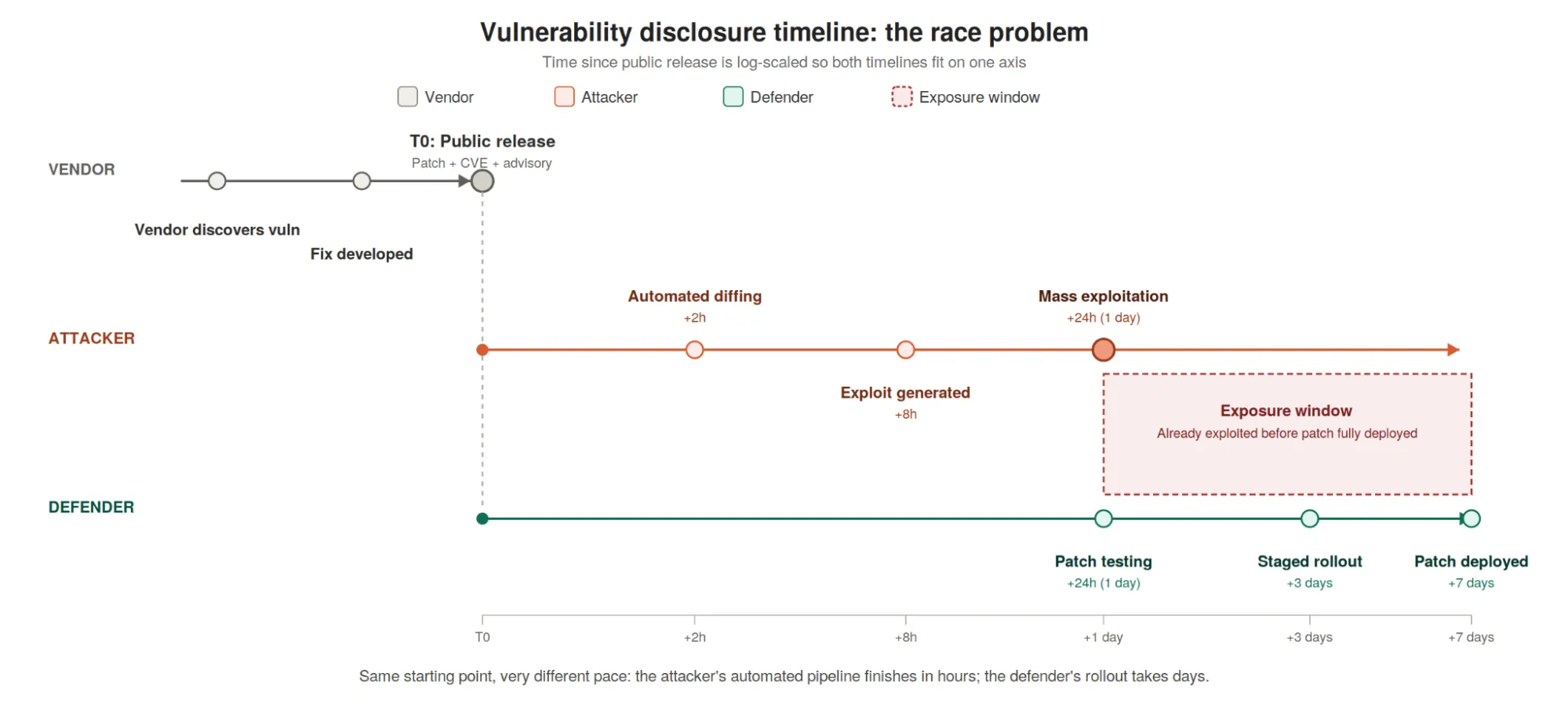
In practice, a conservative timeline can look like this: automated diffing within about 2 hours, a working exploit within 8, and mass scanning and exploitation by hour 24. For simpler vulnerabilities and binaries, that time could easily be cut down to single hours. Many enterprise patch pipelines are still in testing at that point. The only safe operating assumption today is this:
The exposure window starts when a patch is published and stays open until the moment it is applied.
Why Is Self-Managed Software More Exposed Than Cloud SaaS Software?
For SaaS-delivered software, there’s no patch exposure window. The vendor updates the service immediately once the fix is available and every customer is protected at the same moment, so there’s nothing for an attacker to reverse-engineer. And responsible SaaS vendors apply robust protection layers to the services they are delivering, from hardened configuration to advanced monitoring to ongoing testing – taking that burden off the customer.
Self-managed software works differently. A lag exists between the vendor publishing a fix for a zero-day vulnerability and the customer applying it, sometimes hours, often days or weeks. That lag used to be manageable: some customers upgrade fast, some slow, and waiting a few extra weeks just meant accepting a certain level of risk before the zero-day details were publicly disclosed. That risk used to be acceptable. Now, it’s not.
How Responsible Disclosure Changes in the AI Era
For decades, the security community treated maximum transparency as unambiguously positive when making patches publicly available. That standard assumed defenders and attackers moved at roughly the same speed, so fast disclosure served defenders more than attackers.
That assumption no longer holds. Today’s responsible disclosure now functions as a head start for the wrong side.
That doesn’t mean the answer is secrecy. Withholding fixes or slow-walking patches would only trade fast exploitation for zero protection. The answer is new private disclosure methods that maintain trust, without arming attackers. An anonymous reader of a changelog shouldn’t get the same information as a customer ready to patch today.
Fix Speed Is the Other Half of the Vendor’s Job
All critical business infrastructure is now a target for bad actors. It’s a question of when, not if, it will be attacked. Disclosure discipline is only half the battle, the other is delivering patches that keep infrastructure secure.
That timeline used to be measured against a slower threat. Batching fixes into a scheduled release or spending weeks validating a patch across every supported version, made sense when attackers moved at a similar pace. Now, critical fixes must be delivered almost immediately. And to counter the growing risk of chained vulnerabilities, even the non-critical patch cadence must accelerate.
This isn’t a case for rushing untested patches; a broken fix creates its own risk. It’s a case for treating speed-to-fix with the same urgency as speed-to-disclosure. Self-managed customers already carry a structural disadvantage in deployment time. Vendors owe them a fix that arrives as fast as it can safely be applied.
What Vendors Need to Change About Patch Delivery and Disclosure
This is still an evolving threat model. However, a few principles are coming into focus for anyone shipping self-managed software in the AI era.
- Treat fix development speed as a security metric. Track time-to-patch against strict SLAs. Establish a new release cadence mapped and measured against how fast attackers can act today.
- Deliver sensitive disclosures and patches via a trusted channel. Establish a secure hub for both the patch and sensitive disclosure details. This gives customers a head start before any sensitive detail goes public.
- Tiered disclosure timing and details. Customers ready to act on a fix immediately need a different information flow than the public reading a changelog. Limiting who receives information and when can help keep attackers at a disadvantage.
What You Should Do Now If You’re Self-Hosting Software
None of this works unless customers move too, regardless of what software they’re running.
If you run self-hosted or hybrid infrastructure, the operating assumption has to change. The moment a vendor makes a fix available, treat the clock as already running against an adversary who may be working on it too:
- Get onto authenticated access channels fast. While it may take some adjusting, this approach creates a faster, more secure patch path.
- Automate and compress your patch timeline. Batching upgrades into a quarterly or monthly window worked when threats moved on a similar timescale, and they no longer do.
- Keep your platforms current, not just the components on it. Outdated tooling caps your speed at whatever that version supports, no matter how urgently you need to move.
- Harden your environments. Maintain high AppSec hygiene with both internal tools (e.g., network, infra) and your vendor’s built-in tools – secure configuration, permissions (especially removing anonymous ones) and roles.
Patch application speed has become a security metric, not just an IT hygiene one, and boards and regulators are starting to treat it that way. If all this seems like too much to handle with current resources, it may be time to consider employing more automation (AI or other) in your patching pipeline or whether migrating to SaaS is the right move.
The New Rule for Patching Self-Hosted Software in the AI Era
The old model assumed disclosure protected the defender. In the AI era, that’s no longer guaranteed; the most transparent move can also be the one that arms the attacker first.
Vendors need to rethink which details get published, in order to give the head start to the defender and not the attacker. Traditional SLAs must be accelerated. Simultaneously, customers need to rethink how fast applying security patches must become. Waiting days to weeks is no longer acceptable as responsible security practices evolve. The net-net: neither side gets to sit this one out. Protecting against frontier-level threats is an all-hands partnership.
For more information on how to protect your software development ecosystem in the AI era, reach out to your JFrog Account Manager or schedule a meeting with a JFrog Security Expert.
 New insights from +1,400 security & DevOps leaders. Get the Full Report.