Claude
  Cursor
  Codex
Codex  Hugging Face
  NVIDIA
  Visual Studio Code
  Devin
Devin  Kiro
Kiro  Open Code
  NanoClaw
 Docker
  npm
npm  PyPy
PyPy  Wiz
Wiz 
 Financial Services
  Gaming
  Public Sector
  Automotive
  Technology
  Healthcare


Introducing JFrog Platform Federation: One Control Plane for Synchronizing Every Site in Your Software Supply Chain


By
9 min read
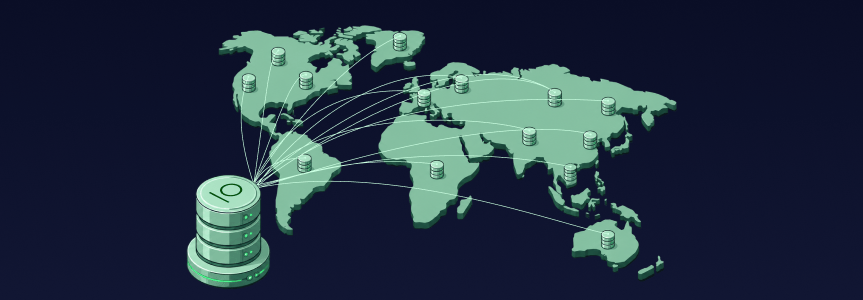
It’s 2 p.m. on a Tuesday. Your primary region goes down. Your software artifacts have been syncing to your Disaster Recovery site the way they were designed to, but your projects, permissions, and security policies were never part of the package. Instead of flipping the lights back on, your platform team is scrambling to manually reconstruct governance while builds grind to a halt across every other region.
That’s the reality of multi-site software delivery today. Enterprises run distributed topologies for good reasons: Fast local access to artifacts, lower cross-region egress bills, and ensuring continuous software delivery in a world where AI coding agents generate builds around the clock. However, manually stitching sites together, locking into a single ecosystem, or federating artifacts without the governance around them doesn’t scale anymore.
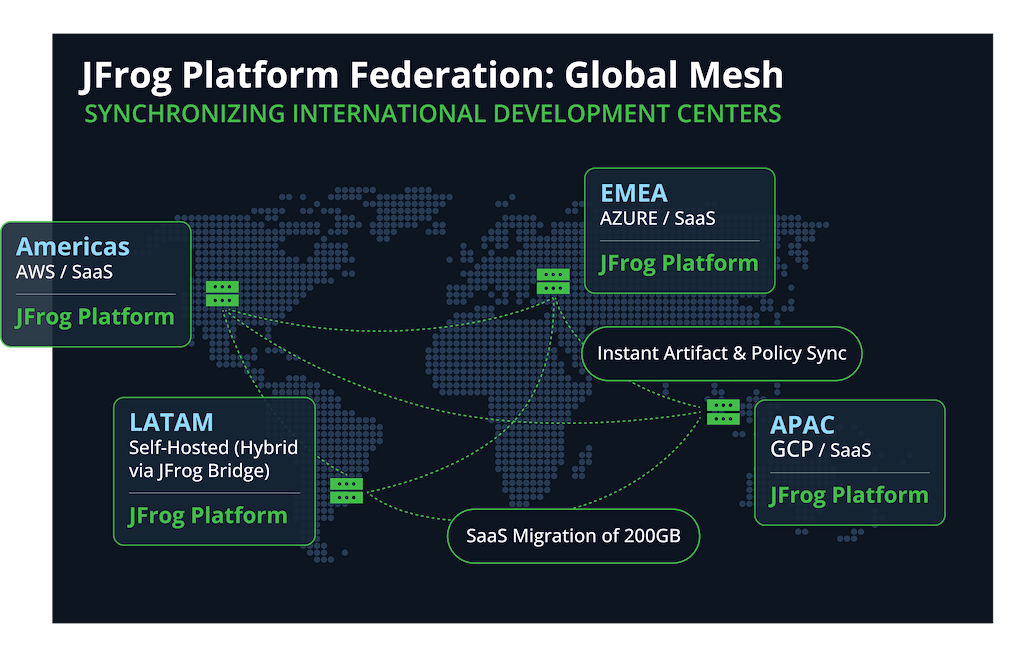
In the AI era, every site needs to stay in sync – projects, access control, policies, artifacts, repositories, and governance – with zero overhead on the platform team. That’s what JFrog Platform Federation delivers. Though each site runs on its own, an autonomous peer-to-peer mesh ensures that every site holds identical projects, access control, policies, artifacts, and repositories.
What used to be manual work now propagates automatically.
What Manual Multi-Site Work Costs – And What Federation Eliminates
Enterprises have run distributed JFrog topologies successfully for years. Federated Repositories has kept artifacts in sync across sites, and Access Federation has kept users, groups, permissions, and tokens aligned. But the platform has grown well beyond the initial capacity of those applications. Projects, stages, roles, and every kind of policy, including security, curation, and application governance, are now core to how customers run their software supply chains.
At the same time, AI coding agents generate builds around the clock across every region, making manual coordination impossible for platform teams as the topology and the platform both scale.
JFrog Platform Federation eliminates that tax in four places:
- Lost engineering capacity. Platform engineers across the industry spend 6–15 hours a week on manual tool integrations across sites, instead of that time for platform work that has a more direct impact on core business. For example, an 8-person team spending 30% of its week on cross-site coordination, comes to roughly $480,000 which could be spent on something far more strategic..
- Configuration drift. A typical JFrog topology has thousands of connected entities. At scale, any system reconciled with REST API calls and custom scripts eventually drifts. Two sites that were identical on Monday are quietly different by Thursday, usually surfacing during an incident. JFrog Platform Federation keeps every site continuously in sync so drift never opens.
- Compliance exposure. When security policies roll out by region, unpatched sites open temporary windows of exposure. In regulated environments, those windows have a price. EU cybersecurity fines under NIS2 can reach $17 million or 2.5% of global annual turnover for gaps in vulnerability handling. Platform Federation makes sure windows of exposure are closed as quickly as possible.
- Egress bills that compound. Every developer pull, every CI run, every agentic build that reaches across regions racks up cross-region egress – the fee cloud providers charge to move data between regions. JFrog Platform Federation replicates heavy artifacts once per region and keeps them local from then on, avoiding excessive egress fees due to unnecessary repetitive cross regional boundary replication.
Three Multi-Site Patterns Platform Federation Unlocks
Most enterprises don’t run a single type of multi-site setup, usually running several at once. Development teams need low-latency access to the same environment across regions, while business continuity plans need every site to keep running, even when one of the regions goes dark. In addition, many enterprises maintain both self-managed and cloud-based SaaS infrastructure, running both simultaneously. JFrog Platform Federation is built to support both self-managed and SaaS, from the same peer-to-peer mesh, so the same architecture that keeps daily development flowing is also what carries you through a regional outage or a phased SaaS migration.
- Global Distributed Development: Give every regional team low-latency access to identical projects, policies, and packages, so engineers in London, Bangalore, and São Paulo work in the same environment without waiting for cross-region pulls or filing tickets for missing artifacts. Setting up a new site for a new region, an acquisition, or a business unit takes minutes instead of weeks. Metadata and configurations propagate immediately, while heavy binaries replicate once to save on cross-region egress.
- Business Continuity and Disaster Recovery (DR): Every site runs as a live peer with real-time parity and no passive standby or failover runbook. Failover is instant and verifiable against regulated-industry continuity requirements. With AI coding agents now generating builds and pulling artifacts around the clock, zero downtime has moved from a nice-to-have to a hard requirement. Every minute a region is dark is a minute of stalled pipelines, blocked releases, and idle agents multiplying across your global topology.
- Hybrid Deployments and SaaS Migration: Federate every environment you run, including your own data centers, private cloud, airgapped sites, and JFrog Cloud SaaS,into one logical mesh. Migrate workloads on your own timeline, funded by cloud commitments you’ve already booked, without breaking centralized security or identity control.
The Peer Mesh Advantage: Configure Once, Enforce Everywhere in Seconds
Solving multi-site drag takes a shift in architecture, not better sync scripts. Isolated per-region management and hub-and-spoke designs (one central site pushing to satellites) both leave a single point of coordination that becomes a bottleneck the moment it fails or falls behind.
JFrog Platform Federation connects your distributed JFrog sites into an autonomous, peer-to-peer mesh where every site operates as an equal partner on a single logical plane. By removing central bottlenecks and automating background synchronization through the platform mesh, platform teams gain centralized control with complete regional autonomy:
- Configure once, run everywhere. Define a project, an access control, or a release policy on any peer site. The mesh propagates that configuration to every connected site in seconds, with no manual setup or drift.
- Built-in resiliency. Every site runs as an independent peer, so regional failures don’t ripple across your global supply chain. If a cloud provider or region goes down, local builds, CI/CD pipelines, and developer workflows keep operating.
JFrog Platform Federation in Action: Three Capabilities Keeping Your Multisite Development in Sync
Platform Federation will eventually extend across the full JFrog Platform. Currently there are three available capabilities that target the failure modes threatening distributed pipelines.
1. Projects Federation: Workspace Parity Across Every Region
Projects Federation keeps your multi-tenant workspaces identical everywhere. Multi-tenant workspaces, project- and global-level roles, SDLC gates (release-stage controls in the software development lifecycle), and identity access tokens all synchronize across every peer in the mesh so developers see the same environment, permissions, and release gates wherever they connect.
- Life before Projects Federation: Platform teams script and replicate project definitions, permissions, and identity tokens site by site. Local settings drift as the topology scales, and developers eventually hit missing roles, mismatched access tokens, or regional privilege gaps mid-build.
- Life after Projects Federation: One logical workspace plane spans every site. Spin up a team workspace or change an environment gate (a release-stage control in your software development lifecycle) on any peer, and Platform Federation mirrors that configuration everywhere in seconds. Backend storage stays local where it needs to; the workspace itself is global.
2. Curation Federation: One Zero-Day Rule, Enforced Globally in Seconds
Curation Federation makes open-source security policy a global property, not a per-site rollout. Blocking rules, waivers, and approvals apply to every regional pipeline, so central security teams keep authoritative control without causing bottlenecks in regional delivery.
- Life before Curation Federation: A zero-day vulnerability – a newly disclosed flaw with no patch yet, hits the news. Security writes a blocking rule and rolls it out to each regional registry. Every minute of that manual rollout is a window a malicious entity can stage an attack.
- Life after Curation Federation: Set the blocking rule, approval, or waiver once on any peer. Every pipeline worldwide enforces it within seconds. Central security keeps authoritative control; local teams maintain local delivery speed.
3. Automated Repository Provisioning: The Right Repos on the Right Sites, No Tickets Required
Automated Repository Provisioning creates the right repositories on the right sites for you, based on your Stage-to-Site mapping, that determines which release stages are stored on which regional sites. Platform teams stop managing federation topology repo by repo; the mesh handles it instead.
- Life before Automated Repository Provisioning: Platform teams create and configure repositories site by site – repo names, package types, layouts, and federation settings all replicated by ticket, script, or REST API call. Every new region is a project. Every new package type across the topology is a batch of tickets. And when repo definitions drift between sites, the errors surface as failed builds, missing artifacts, or permission mismatches, usually in the middle of a release.
- Life after Automated Repository Provisioning: Define your Stage-to-Site mapping once. When a new site joins the mesh, it automatically replicates the repositories required at each stage. The result is that adding a region takes minutes instead of weeks, and any change to the mapping propagates across the mesh with no individual repo administration required.
According to our roadmap, the same federated model will be expanding to our security and governance solutions – JFrog Xray, JFrog AI Catalog, JFrog Advanced Security, and JFrog AppTrust – so ‘configure once, enforce everywhere’ will apply across the entire JFrog Platform.
Configure Once, Trust Everywhere with the JFrog Platform
Stop maintaining sync scripts. Start configuring once and trusting everywhere.
That’s what a federated control plane does for your platform team. Only JFrog Federation includes the full stack of projects, policies, access control, artifacts and repositories combined into a single unified system.
Talk to a JFrog expert about mapping a peer-to-peer plan for your global topology or explore the JFrog Platform and the technical documentation to plan your rollout.
 New insights from +1,400 security & DevOps leaders. Get the Full Report.