 NVIDIA
  Cursor
  GitHub
 Docker
  Maven
Maven  Financial Services
  Public Sector
  Technology
  Healthcare
  Gaming
  Automotive
  Enterprise


The Secret Sauce of SLSA: DevGovOps at the Speed of Agentic AI

By
8 min read

Software supply chain engineering has reached a critical inflection point. As autonomous AI coding agents transition from generating autocomplete suggestions to planning, writing, reviewing, and deploying entire software pipelines without humans in the loop, the connection between human intent and production binaries is fracturing. This shift has created a severe structural deficit across enterprise tech stacks: our software pipelines run at machine speed, but our Governance, Risk, and Compliance (GRC) frameworks still crawl at human speed.
Every era of software delivery has demanded a dedicated discipline to match its operational constraints. DevOps united Development and Operations to eliminate siloed handoffs. DevSecOps embedded security scanning directly into CI/CD pipelines. Today, the AI Era demands a new discipline: Development Governance Operations (DevGovOps).
DevGovOps is a Software Supply Chain Engineering practice that integrates continuous governance and compliance into the DevOps software delivery lifecycle. Rather than treating compliance as a retrospective, manual hurdle or a “tax on delivery,” DevGovOps ensures that policy enforcement, continuous auditability, and cryptographic traceability become default automated outputs for every release.
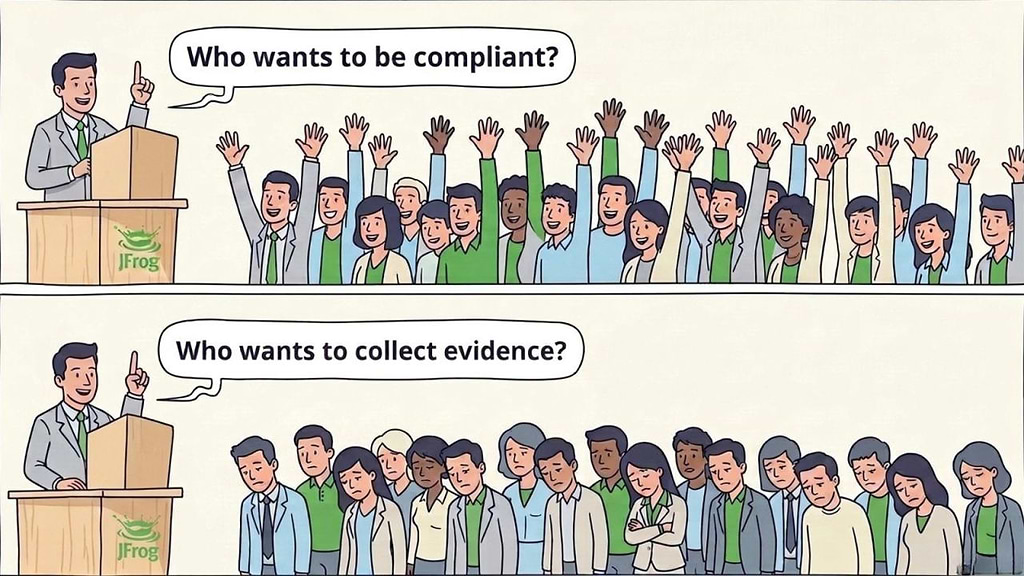
Why is DevGovOps a “must-have” right now? Because organizations are caught between machine-speed delivery and the demand for absolute, verifiable trust. When boards, strategic buyers, or auditors inevitably ask, “Your agent shipped a release today. Can you prove its compliant? Who approved this change? What is inside this release?” teams relying on periodic attestations or spreadsheet tracking are left scrambling. Simultaneously, active regulatory mandates and industry standards, from the EU Cyber Resilience Act (CRA) and NIST SSDF to international supply chain frameworks, are shifting personal legal liability directly onto CISOs and executive leadership. DevGovOps closes this gap by ensuring governance is engineered in, not bolted on, replacing “governance theater” with governance truth.
SLSA: The Global Benchmark for Software Supply Chain Integrity
A compelling, real-world application of DevGovOps principles is achieving compliance with Supply-chain Levels for Software Artifacts (SLSA).
Pronounced “salsa,” SLSA is an open-source, security-focused framework organized around progressive levels of software supply chain maturity. Created by Google and hosted by the Open Source Security Foundation (OpenSSF), SLSA was designed to protect against digital tampering, compromised package repositories, and untrusted build environments across the software development lifecycle.
Understanding the SLSA Levels
SLSA establishes a common language for software provenance and build integrity across three primary levels:
- SLSA Level 1 (Build Documentation): Requires that the build process is fully automated and produces basic provenance—a machine-readable record detailing how an artifact was built and what source code was used.
- SLSA Level 2 (Hosted Build Service): Mandates that builds run on a dedicated, hosted build service (like GitHub Actions, GitLab CI, or Jenkins) rather than a developer’s local laptop. At this level, the build service itself generates and cryptographically signs the provenance metadata, making it tamper-resistant.
- SLSA Level 3 (Hardened Build Environment): Demands isolated, ephemeral build environments where dependencies are verified, source code is strictly controlled, and the build platform prevents post-build modification of the generated provenance.
While SLSA provides an exceptional blueprint for software integrity, traditional governance solutions struggle to implement it – especially when autonomous AI agents enter the pipeline and generate thousands of artifacts at unprecedented velocity.
How DevGovOps Drives Continuous SLSA Compliance
SLSA compliance was built on the assumption that software artifacts can be verified back to an authentic, untampered source and build process. When AI agents write code, pull third-party model components, and trigger automated builds, manual verification breaks down. This is precisely where a DevGovOps program bridges the gap, translating SLSA requirements into continuous, machine-enforceable controls across the SDLC.
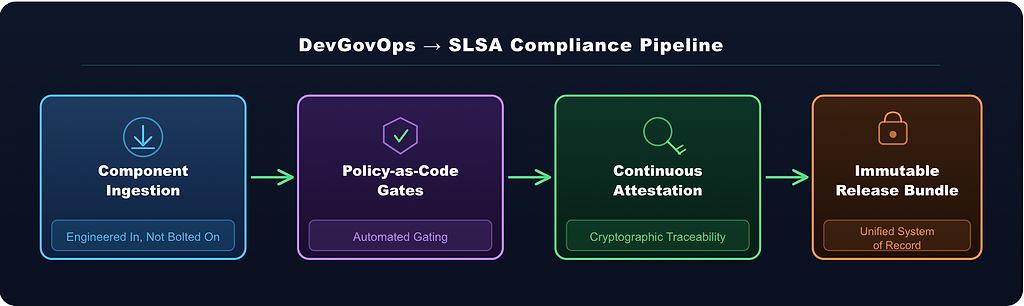
DevGovOps operationalizes SLSA compliance through three foundational pillars:
1. Easy to Enforce
SLSA requires that every build adheres to strict security standards before promotion. In a DevGovOps framework, governance rules are written as machine-readable policy (Policy-as-Code). These policies travel natively with software artifacts as application context and validate the code as it moves through the pipeline.
Vulnerability, license, and SLSA provenance checks act as automated gates. If an AI agent attempts to introduce an unvetted package or trigger a build that lacks cryptographic provenance, the DevGovOps gateway intercepts and blocks non-compliant artifacts at the boundary. Any policy bypass or waiver must be cryptographically signed, maintaining absolute process integrity and strict accountability.
2. Easy to Prove
The core of SLSA’s provenance is proving exactly where an artifact came from and how it was constructed. Under legacy frameworks, engineers spend weeks manually collecting screenshots, logs, and build records for auditors.
DevGovOps eliminates this manual audit scramble by maintaining a unified system of record. SBOMs, build metadata, and SLSA provenance attestations for all software and AI components are generated automatically as a byproduct of delivery. As artifacts move through the pipeline, evidence is cryptographically signed and bound directly to the release. This provides an immutable chain of custody, allowing AppSec and compliance teams to produce auditor-ready answers in seconds, not weeks.
3. Easy to Track
SLSA compliance is not a point-in-time check. DevGovOps extends governance beyond the initial deployment, continuously monitoring released software versions in production against evolving security policies, newly disclosed vulnerabilities, and emerging third-party risks.
Team Alignment: Winning Together with DevGovOps
DevGovOps sits at the intersection of Engineering, Security, and Governance. The practice itself is a joint effort: AppSec defines the security and governance policies, and Engineering embeds those policies directly into the pipelines they manage. By embedding SLSA compliance directly into CI/CD, DevGovOps delivers distinct, high-value outcomes for every enterprise stakeholder:
- For the CISO: Moves from governance theater to governance truth by replacing periodic attestations with continuous proof. Generates board-ready SLSA compliance reports in minutes and protects executive leadership from personal legal liability under emerging regulations like the Cyber Resilience Act (CRA) and NIST SSDF.
- For AppSec: Set policies once, and ensure every release and every AI agent follows them automatically. Eliminates the manual audit scramble with evidence collected automatically at every stage of the pipeline.
- For Engineering: Ships code at agent speed without friction. Automated policy gates replace manual approval queues, making SLSA compliance a seamless byproduct of delivery rather than a tax on innovation.
How does JFrog AppTrust Enable SLSA Governance?
To execute DevGovOps principles in practice, organizations need purpose-built tooling that operates at the speed of modern software supply chains. This is where JFrog AppTrust is helping bring trusted governance to agentic AI development frameworks..
As part of the JFrog Platform, JFrog AppTrust functions as the central system of record for software supply chain governance, placing JFrog at the forefront of DevGovOps and international compliance standards like SLSA, CRA, and NIST SSDF.
JFrog AppTrust automates SLSA compliance across the entire lifecycle by:
- Ingesting Signed Evidence: Automatically collecting signed attestations, build metadata, and provenance from across your entire toolchain (CI/CD runners, security scanners, and package registries).
- Cryptographic Binding: Binding verifiable SLSA provenance directly to the binary artifacts stored inside JFrog Artifactory, ensuring an unbroken chain of custody.
- Enforcing Policy-as-Code Gates: Automatically evaluating artifacts against enterprise governance policies before release promotion—physically blocking non-compliant, unverified, or tampered builds.
- Providing Instant Auditability: Delivering a single, authoritative dashboard where CISOs, auditors, and security leads can query the exact provenance, approval history, and compliance posture of any production release on demand.
By combining JFrog Artifactory, JFrog Curation, JFrog Xray, and JFrog AppTrust, enterprises achieve zero-friction governance, allowing developers and AI agents to build at maximum velocity while security teams maintain total control.
Key Takeaways
Why Does Every Enterprise Need a DevGovOps Leader?
The era of manual compliance reviews and retrospective log gathering is officially over. As autonomous AI coding agents accelerate delivery velocity by 10x to 50x, the risk gap between organizations that can claim compliance and those that can prove compliance will only widen.
Here are the essential takeaways for modern technology leaders:
- AI Velocity Breaks Legacy Governance: You cannot govern machine-speed development with human-speed audits. AI agents produce software velocity, but executive leadership owns the legal and financial liability.
- SLSA Is the Blueprint, DevGovOps Is the Engine: Frameworks like SLSA, CRA, and NIST SSDF define what evidence is required; DevGovOps provides the operational engineering practice to generate that evidence automatically.
- Establish a Dedicated DevGovOps Discipline: Because DevGovOps spans engineering, security, and risk management, it cannot be treated as a side task for developers. Forward-thinking enterprises are establishing dedicated DevGovOps leads and departments to build internal governance platforms, enforce policy-as-code, and scale AI safety.
- Transform Compliance into a Competitive Advantage: When governance is automated and continuous, compliance stops being a tax on delivery and becomes a strategic business driver that accelerates sales due diligence, protects revenue, and satisfies regulatory scrutiny effortlessly.
Ready to Automate Compliance at the Speed of AI?
Building an automated, continuous software governance program requires aligning your security tools, development pipelines, and regulatory policies into a single, cohesive framework.
Schedule a personalized demo with a JFrog domain expert today. We will walk through your current pipeline structure, identify critical compliance gaps, and show you how JFrog AppTrust can turn SLSA compliance into a continuous, automated output of your software supply chain.
Experience
JFrog Today
Discover how the JFrog Platform unites DevOps, DevSecOps and MLOps for secure, rapid software delivery.