 NVIDIA
  Cursor
  GitHub
 Docker
  Maven
Maven  Financial Services
  Public Sector
  Technology
  Healthcare
  Gaming
  Automotive
  Enterprise


From Prompt to Production: The New AI Software Supply Chain Security
In the era of AI, organizations will enable intelligent software creation with enterprise-grade trust and control
Listen to a NotebookLM podcast version of the blog:
When Anthropic announced Claude Code’s new security scanning capabilities, following the announcement of OpenAI’s Aardvark, it marked an important moment for the industry. For the first time, expert-level security review is becoming embedded directly into the act of writing code. Subtle, context-dependent vulnerabilities can now be flagged as they are created. Zero-days can potentially be remediated before they ever make it into a build.
And it won’t stop with Anthropic. We should expect similar announcements from other AI providers, commercial or open source. Vulnerability detection and remediation at the code layer will become broadly accessible. In time, it may even feel commoditized.
But here’s the deeper question: If AI can make code safer before it’s compiled, what remains to secure?
The Quiet Disappearance of Code
In the traditional model of software development, source code was the center of gravity. It was what teams reviewed, tested, secured, and collaborated on.
But something subtle is happening: Code is no longer the final product. It is an intermediate step.
The real output—the thing that gets shipped, deployed, and executed—is a binary artifact. A container image. A package. A library. A compiled release.
A vast portion of what ultimately impacts the behavior, security posture, performance, and compliance of a release is not written by the development team or your coding agent at all. In modern software, the majority of what is embedded into a shipped artifact originates elsewhere:
- Open-source dependencies
- Third-party packages
- Internal libraries developed by the organization
- Deep transitive libraries resolved by package managers
- Build systems, compilers, and developer extensions
- And now, AI artifacts such as skills, agents, plugins, and MCP servers
The application is no longer a codebase. It is an assembled supply chain.
And the center of gravity has moved-from source code to the artifact that integrates everything around it.
So while AI makes the source cleaner, the release itself becomes more complex. This complexity also shifts risk.
Even When the Code is Perfect, the Release is Still Vulnerable
Imagine a near future where AI-generated code is almost flawless.
It compiles cleanly. It passes static analysis. It auto-remediates vulnerabilities before you even notice them.
From a source perspective, everything looks healthy.
But once your code is compiled, the release no longer consists only of what your team or the AI wrote. It includes dozens, sometimes hundreds, of third-party binaries. One may carry a newly disclosed vulnerability. Another may contain malicious code deliberately engineered to evade detection.
In more advanced scenarios, attackers can even use AI to craft payloads designed specifically to bypass AI-based inspection systems. The same technology that helps defenders can be turned into an offensive tool, generating obfuscated logic, context-aware triggers, or dormant backdoors that blend into legitimate code patterns.
And overnight, production is exposed.
Nothing was wrong with the generated code. The issue lives inside a dependency you didn’t write.
That’s exactly what happened in the recent React2Shell incident and earlier in Log4Shell. Production teams weren’t scrambling because code review failed. They were scrambling because they didn’t know which deployed releases contained the vulnerable binary.
The challenge wasn’t code quality. It was binary visibility.
Log4Shell showed why SBOMs matter: you must know what components exist in each release. But presence alone isn’t enough—you also need to know whether the vulnerability is actually reachable inside the binary.
Today, this is also a legal obligation. Under regulations like the Cyber Resilience Act (CRA), organizations must track their released software and report known vulnerabilities without delay. If you can’t immediately identify affected releases and assess exploitability, you’re exposed—technically and legally.
In an AI-driven world, the bottleneck isn’t writing secure code. It’s knowing what you shipped.
Two Worlds of Defense
Anthropic’s announcement strengthens one critical layer: code-level defense.
This layer is about preventing vulnerabilities at creation time. It’s proactive, contextual, and increasingly AI-assisted.
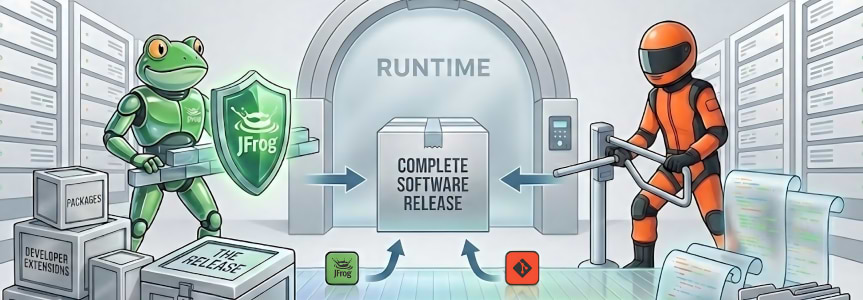
Another layer that coexists with source code security is binary-level governance, serving as both the single source of truth and the gatekeeper of the software supply chain. That’s the space JFrog leads and delivers a complementary infrastructure.
Once code is compiled, packaged, and distributed, it becomes something else. It becomes an artifact that moves through repositories, pipelines, desktops, and production clusters.
At that point, security is no longer about reviewing lines of code or scanning. It is a control plane problem.
It becomes about answering questions like:
- What exactly entered my organization?
- What is included in every release?
- What is currently running in production?
- Can I trace it, audit it, and remediate it at scale?
- Can I prove compliance with regulatory requirements?
Why AI Alone Isn’t Enough for Enterprise Governance
AI is remarkably powerful at reasoning about text and logic. But governance is not about inference. It is about control.
These are fundamentally different responsibilities. And real governance requires an authoritative system of record.
AI alone cannot:
- Act as an immutable Single Source of Truth
- Enforce promotion policies across environments
- Block unsafe binaries from entering the organization
- Maintain authoritative artifact metadata
- Record promotion logs for audit trails
- Guarantee provenance attestations
- Serve as a regulatory system of evidence
AI can advise, analyze, and even generate, but only a governed system of record can enforce, control, and prove.
The Need for a Gatekeeping Single Source of Truth
For source code, Git platforms serve as the system of record. In a world approaching fully AI-generated code, the foundations of Git-oriented collaboration are quietly evolving.
What is the equivalent for binaries?
Organizations need more than just a scalable storage. They need an active single source of truth, a gatekeeper that protects what enters the organization and directly impacts what gets released.
An active binary system of record must function as a policy-enforcing control plane that governs:
- Every dependency entering the organization
- Every build artifact stored and distributed
- Every release deployed into runtime environments
- Every remediation required after new vulnerabilities are disclosed
But critically, this control does not start at release time. It starts at install time.
The Threat Isn’t Just What You Ship
Many malicious binaries are not merely a question of whether they end up packaged into a release.
They target the developer directly the moment they are installed on a developer’s machine.
Examples include:
- Supply chain malware like the Shai Hulud npm worm, which activates at installation time
- Malicious AI extensions or plugin ecosystems
- Compromised OpenClaw skills that execute prerequisites locally when pulled
In these cases, the developer desktop becomes the first blast radius.
An active system of record must:
- Block untrusted binaries before they are ever downloaded into the organization
- Enforce policy before installation
- Validate provenance, integrity, and signatures
- Apply security controls and enterprise risk controls: license, export, and internal compliance rules
- Continuously re-evaluate stored artifacts as new intelligence emerges
This is not just a secure artifact repository. It is an enterprise governance and risk control engine—a gatekeeper that continuously determines what is allowed to enter, exist, and propagate inside your organization. It becomes the single source of truth.
AI Changes Creation; Governance Must Keep Pace
The promise of AI in development is extraordinary. It reduces friction, accelerates iteration, and democratizes expertise.
AI also changes the velocity and scope of risk.
When software can be generated at scale, the tsunami of binaries entering your organization grows just as quickly. Dependencies, tools, plugins, AI-generated components —they multiply.
Security cannot be solely about reviewing what’s written. It must govern what exists.
This is where the JFrog Software Supply Chain Platform plays a critical role as a control layer and a system of record, providing a suite of binary-centric security capabilities that enables governance, policy enforcement, and end-to-end visibility across the software supply chain.
AI strengthens what is created. JFrog governs what is downloaded, built, stored, distributed, executed, and released.
Together, they create a secure lifecycle from prompt to production.

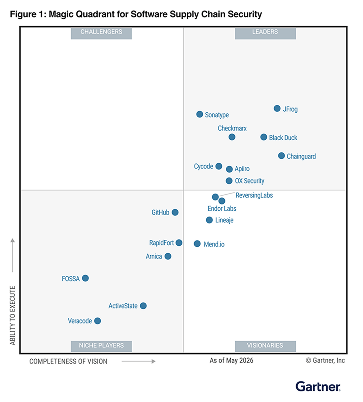
Named a leader in 2026 Gartner® Magic Quadrant™
for "Software Supply Chain Security"