 NVIDIA
  Cursor
  GitHub
 Docker
  Maven
Maven  Financial Services
  Public Sector
  Technology
  Healthcare
  Gaming
  Automotive
  Enterprise


Agentic Development Security is a Discipline that Starts Before the First Line of Code

By
7 min read

Ask most security tools what an AI coding agent just built, and they can tell you. Ask what it was allowed to consume before it started, and far fewer have an answer. That gap, between watching agentic development and controlling it, is what securing it actually comes down to.
Securing agentic development means stopping risk before it enters a build, not flagging it after. And risk prevention has a prerequisite most approaches skip: you can only account for the assets you actually hold and manage. Treated that way, Agentic Development Security (ADS) stops being a layer of tools you add on top of development and becomes a practice.
Control Both Sides of the Agentic Software Supply Chain
The agentic software supply chain has two sides, and they nest inside each other. There’s what the agent produces (the code, the open-source dependencies it pulls in, the builds, the releases that ship), and there are the assets the agent needs to perform its tasks (the MCP servers, skills, plugins, and systems’ access to function). Secure one and ignore the other and you haven’t secured agentic development, you’ve secured half of it. Securing both sides takes two jobs that reinforce each other:
- Keep risky assets from entering (prevention).
- Fix what slips through or gets written (remediation).
Prevention: Detection Finds Problems, Governance Prevents Them.
ADS is often treated as an intelligence layer that sits above development and reasons about it: smarter detection of flaws in generated code, validated fixes, prioritized findings, a graph that explains risk. All of it is valuable, and all of it is becoming table stakes. The durable differentiator isn’t how well you watch the ADLC (agentic development lifecycle). It’s whether you control it and enforce policies along it.
You can alert on a vulnerability in an asset you don’t control. You cannot block coding agents from using one. The moment a model, MCP server, or skill you’ve never inventoried gets onto a developer’s laptop or into a build, the most sophisticated reasoning engine in the world is doing forensics, not prevention.
The unit of trust isn’t the vulnerability you detect. It’s the artifact. And you can only govern the artifacts you hold. You can think of it this way: detection is a security camera and governance is the lock on the door. One tells you what happened and the other decides what gets in. Based on that metaphor, it’s easy to agree that stopping risk before it enters is better than catching it later. Prevention, taken seriously, isn’t just earlier scanning. It’s securing the organizational perimeter at the point it enters your supply chain, before it’s ever used.
Remediation: Finding Flaws Is Common, Governance of Those Flaws Isn’t.
Prevention controls what enters the supply chain before development starts. But agentic code is new code, generated in real time, and prevention never sees it. That generated code and the dependencies it pulls in still have to be found, prioritized, and fixed. Detection and remediation tools for this are becoming standard across ADS products. What remains rare is running that remediation on the same artifacts and under the same policies that govern prevention.
Most tools treat remediation as a separate layer: find issues in generated code here, manage policies there. The real differentiator is whether your governance persists, so that the same artifact-centric, policy-driven approach that stopped risky assets at the entry point also shapes how you fix flaws in what the agent builds.
JFrog’s Agentic Development Security in Practice
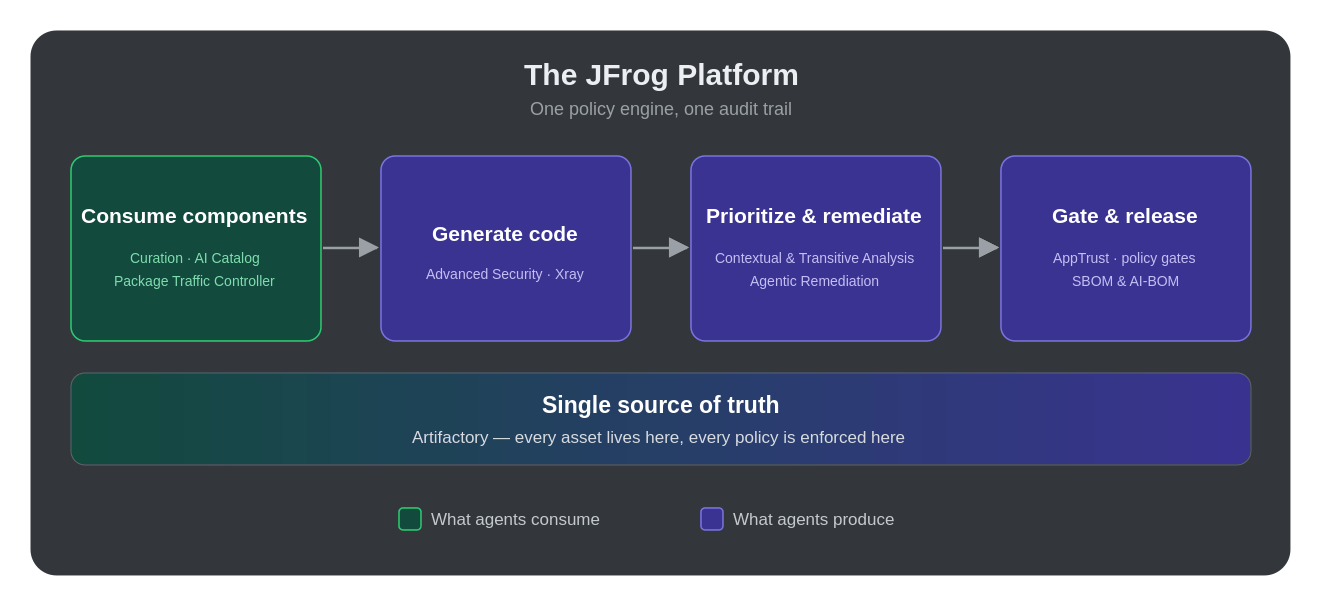
The JFrog Software Supply Chain Platform secures both what agents produce and what agents consume as first-class software artifacts, in one system of record, under one set of policies:
- Consume components: Before the coding agent writes a line, it consumes AI assets and pulls software components, and that is the first place to hold the line rather than watch it.
- JFrog Curation vets every open-source package, model, and IDE extension at the point of request, and when one violates policy, it serves a compliant version in its place so the agent keeps moving — never impeding development.
- The toolchain the agent works through gets the same handling, with the MCP servers, agent skills, and plugins it depends on inventoried and policy-gated in JFrog AI Catalog.
- Enforcement holds even when someone routes around the front door: if a developer or agent pulls straight from a public registry, Package Traffic Controller intercepts that traffic and reroutes it back through policy.
- Generate code: Once the agent starts writing code, that code and the dependencies it pulls in are artifacts too. JFrog Advanced Security runs static analysis on first-party code that goes past pattern matching to trace whether a flaw is actually reachable, and it reaches into the copied-in snippets that AI models reproduce, not just declared packages. Working alongside it, JFrog Xray performs software composition analysis on the open-source an agent selects and pulls in.
- Prioritize and remediate: Detection without prioritization only moves the noise downstream. Transitive Dependency Analysis, backed by AI-powered CVE rankings from JFrog’s in-house Security Research team, separates what is exploitable in context from what is reachable only through an indirect dependency, so teams work real risk instead of an undifferentiated queue. That is the triage, prioritization, and advanced risk analytics, applied to the artifact rather than the alert. Agentic Remediation then closes the loop where the work already happens, producing context-aware, multi-file fixes inside the developer’s existing workflow instead of a separate console.
- Gate and release: Nothing ships until it clears the gate. JFrog AppTrust enforces evidence-based policy and quality gates at each stage and certifies a release only when every policy is met. As the produced artifacts and the consumed ones live under one policy engine and one audit trail across the JFrog Platform, the SBOM, the AI-BOM, and signed evidence required for the governance report an auditor asks for come from a single source of truth, not four tools reconciled after the fact.
- Single Source of Truth: None of this works as separate tools bolted together. It works because it is one platform. Artifactory is the single source of truth underneath every stage above, the place where each asset already lives and every policy is enforced. The stages are not integrations wired across a seam; they are one continuous supply chain acting on the same artifacts in the same place. That is what makes governance an integral part of the software supply chain rather than a layer stretched over it.
Turning ADS into a Discipline
Agents touch everything from the assets they pull into the applications they produce to the development toolchain and environments they operate within, across a lifecycle that now moves at machine speed and scale. This agentic lifecycle maps directly onto how the JFrog Platform was built to work. The assets an agent consumes and the ones it produces are governed in one system of record, under one set of policies, where trust is not an afterthought but the first principle. That is what turns Agentic Development Security from an add-on layer into a discipline.
Turn Agentic Development Security into a core discipline in your organization. Schedule a meeting with one of our Solution Engineers for a personalized demo, or start a tour to test-drive the platform yourself.
 New insights from +1,400 security & DevOps leaders. Get the Full Report.