Claude
  Cursor
  Codex
Codex  Hugging Face
  NVIDIA
  Visual Studio Code
  Devin
Devin  Kiro
Kiro  Open Code
  NanoClaw
 Docker
  npm
npm  PyPy
PyPy  Wiz
Wiz 
 Financial Services
  Gaming
  Public Sector
  Automotive
  Technology
  Healthcare


NVIDIA NIM Models Are Now Governed Assets in Your Supply Chain

By
7 min read
NVIDIA NIM (NVIDIA Inference Microservices) packages production-ready AI models into optimized containers for enterprise deployment. Your developers need them. Your coding agents pull them. And until now, they pulled them directly from NVIDIA’s NGC registry, bypassing the supply chain controls you’ve spent years building. JFrog AI Catalog now brings NVIDIA NIM models under the same governance as every other artifact in your organization, with no separate registry and no governance gap.
Three out of four enterprises plan to deploy agentic AI within a year, and the ones moving fastest aren’t waiting for governance to catch up. The question isn’t whether your teams will use NIM models… they already are. The question is whether those models are passing through your supply chain controls or going around them.
What Happens When AI Models Live Outside Your Supply Chain
When NVIDIA NIM models bypass your supply chain controls, every model that enters your environment is an unscanned, unversioned, unaudited artifact. The same risk posture you eliminated for Docker images, npm packages, and Maven dependencies years ago still exists for every NIM model your developers and coding agents consume today.
Here’s what “outside the supply chain” looks like in practice. Docker images, npm packages, and Maven dependencies flow through JFrog Artifactory. JFrog Curation evaluates them against your organization’s risk policies and blocks the risky ones before they ever reach a developer’s laptop. You have an audit trail. You have RBAC. You have a single source of truth.
Your NVIDIA NIM models have none of that — yet.
What happens when a developer pulls a NIM model directly from NGC?
When a developer or coding agent pulls a NIM model directly from NVIDIA’s NGC registry, four things don’t happen that should:
- No Curation policy evaluation — Your organization’s risk tolerance, licensing requirements, and approval workflows are completely bypassed.
- No Artifactory version record — No version of that model is tracked in your repository, making it impossible to trace which model shipped in which release.
- No audit trail — Security can’t answer “what AI models were running in last quarter’s builds?” because the data doesn’t exist.
These aren’t edge cases. A coding agent pulling a NIM model at 2am to finish a task is exactly what agentic AI is designed to do. You find out it happened when someone asks why that model is running in production. This isn’t a security team problem, it’s a supply chain problem. And it’s the same problem you already solved for every other artifact type.
How Does JFrog AI Catalog Govern NVIDIA NIM Models?
JFrog AI Catalog now includes NVIDIA NIM models as native, first-class artifacts — governed, versioned, and secured with the same controls you apply to every other binary in your supply chain. NIM models flow into your environment the same way a Docker image does: through Artifactory, under your RBAC model, and evaluated by Curation policies. No separate registry. No parallel governance process.
The following capabilities are now available for NVIDIA NIM models in the AI Catalog.
Unified discovery for every AI asset your teams consume
JFrog AI Catalog brings NVIDIA NIM models and Hugging Face models together in a single discovery tab. Developers no longer jump between NGC and your internal registry to find what they need. NIM models appear in the trending list alongside the open-source models your teams already use, with full metadata, version history, and governance status visible at a glance.
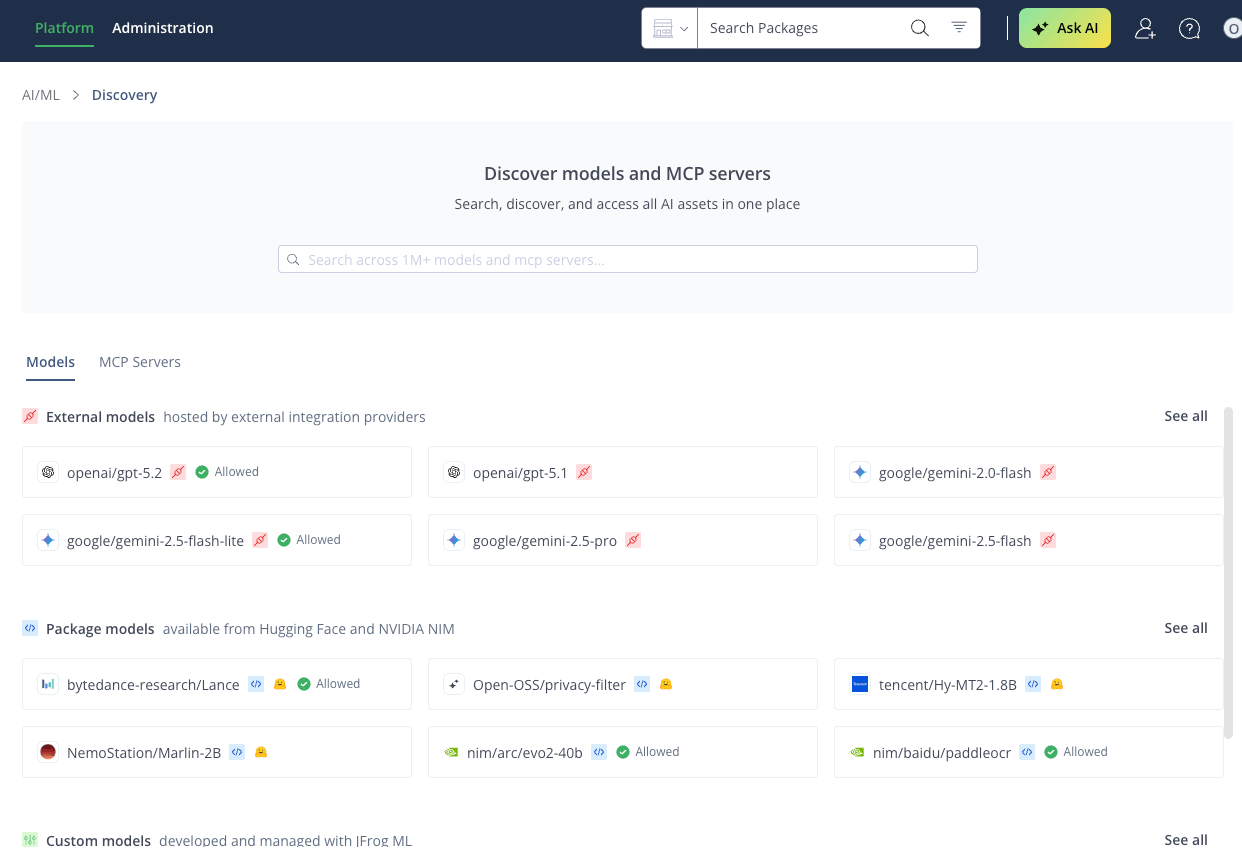
The JFrog AI Catalog Discovery page, where developers can browse both Hugging Face and NVIDIA NIM models in a single, unified view.
Explicit allow/block governance for every NIM model
Every NVIDIA NIM model in the Catalog carries an explicit governance status. Your security or platform team marks each model as Allowed or Blocked based on your organization’s security requirements, licensing policies, and compliance obligations — the same way you govern npm packages or Docker images with JFrog Curation.
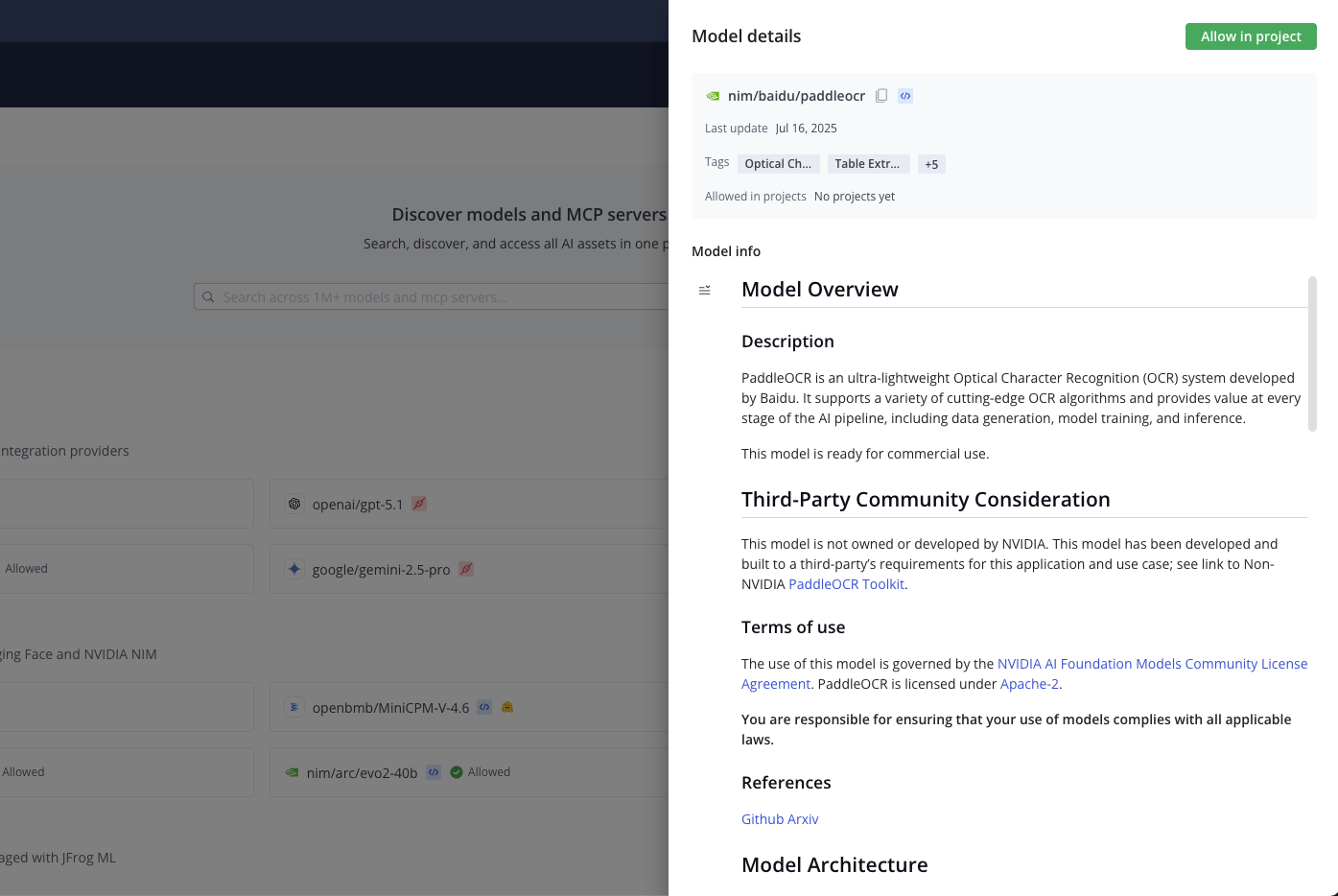
Review comprehensive model details and apply strict governance by explicitly allowing approved NIM models for your projects.
The difference this makes is significant. Here’s a direct comparison of the before and after state:
| Scenario | Without JFrog AI Catalog | With JFrog AI Catalog |
| Developer pulls a NIM model | Direct from NGC, no policy check | Checked against your allowlist first |
| Model fails security requirements | Enters environment, discovered later | Blocked before reaching any developer |
| Audit request for AI models in Q3 builds | No clean answer available | Full audit trail in Artifactory |
| Coding agent pulls a model at 2am | No visibility, no control | Governed like any other dependency |
| New NIM model version released | Unknown until someone asks | Version tracked and visible in Catalog |
This is the governance parity your security team has been asking for. NVIDIA NIM models now get the same treatment as every other dependency in your software supply chain.
From NGC to production in minutes, not days
JFrog AI Catalog walks developers through NGC Docker authentication and Kubernetes environment setup with copy-paste commands. The three-step process is straightforward:
- Authenticate — Copy the generated Docker login command to connect your NIM client to NGC through JFrog Artifactory.
- Discover — Browse available NIM models in the unified catalog view, with governance status and version metadata visible before you pull anything.
- Deploy — Pull and run NIM models locally or directly on Kubernetes via Artifactory with the generated Docker commands.
For developers and coding agents alike, the model they need is discoverable, authentication is handled, and the path from discovery to running code takes minutes. The governance happens behind the scenes, and they never have to think about it.
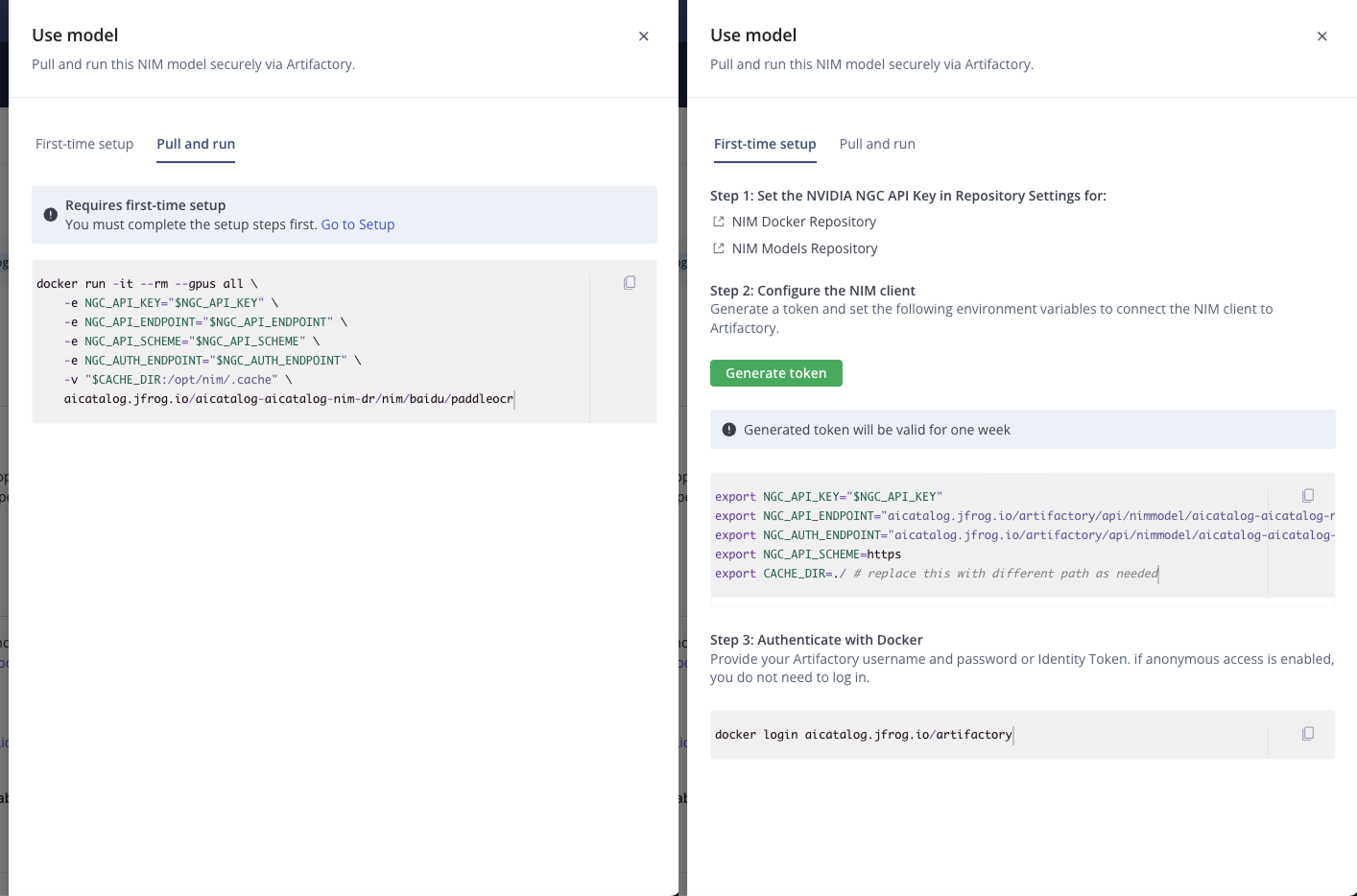
First-time setup: Simple copy-paste instructions to securely connect and authenticate the NIM client. Once authenticated, developers can easily copy the exact Docker commands to pull and run the NIM model.
One Supply Chain. No Exceptions.
JFrog AI Catalog now covers every major public AI hub your teams rely on. NVIDIA NIM joins Hugging Face in a single governed registry, and both live in Artifactory alongside your Docker images, packages, and binaries, under one RBAC model, one audit trail, and one set of policies enforced by JFrog Xray and Curation.
This isn’t a new tool bolted onto your stack. It’s the JFrog Software Supply Chain Platform extended to cover the AI assets that were previously outside it. The gap that lets AI models bypass your controls is closed. Your developers keep building at full speed. Your coding agents keep running around the clock. And every NVIDIA NIM model they consume passes through the same governance controls that protect everything else your organization ships.
Get NVIDIA NIM Models Under Your Supply Chain Governance
If your teams are using NVIDIA NIM models, or are planning to, now is the time to close the governance gap before it becomes a security incident. JFrog AI Catalog gives you the unified discovery, explicit allow/block policies, and full audit trail that enterprise AI adoption requires.
Ready to bring NVIDIA NIM models under your supply chain governance? Book a demo with one of our experts or explore the JFrog-NVIDIA partnership to see how it fits into your existing setup.
 New insights from +1,400 security & DevOps leaders. Get the Full Report.