 NVIDIA
  Cursor
  GitHub
 Docker
  Maven
Maven  Financial Services
  Public Sector
  Technology
  Healthcare
  Gaming
  Automotive
  Enterprise


Native Nix Support in Artifactory: The Binary Cache for the Enterprise

By
6 min read

The “works on my machine” era is officially over.
Nix is changing the way we think about software by treating packages as functional, immutable values, ensuring that a build works exactly the same way every time, on every machine. But while Nix excels on a local laptop, scaling that level of reproducibility across a global enterprise has historically been a challenge.
Without a centralized, high-performance home for these binaries, Nix users often struggle with slow build times, reliance on the public internet, and a lack of visibility into artifact provenance.
Today, we are changing that. We are thrilled to announce Native Nix Repository support in the JFrog Platform, making Artifactory the ultimate enterprise-grade registry for Nix.
The Challenge: Why Local Nix Magic Struggles at Scale
Nix is famous for its functional approach: If you build a package once, you should never have to build it again. However, in an enterprise setting, several “real-world” problems break this flow:
- The bandwidth bottleneck: Constantly pulling from public caches (like
cache.nixos.org) wastes massive amounts of bandwidth and slows down CI/CD pipelines. - The fragility of public dependencies: If the public internet goes down or a package is removed from an upstream source, your builds break.
- The security gap: Enterprises need to host proprietary binaries securely, with fine-grained access control that local-only setups can’t provide.
The Solution: Artifactory as Your Nix Registry
By adding native support for Nix, Artifactory acts as a high-performance substituter—a specialized Nix binary cache that allows your environment to fetch pre-built packages instead of compiling them from source.
Instead of your Nix client constantly querying the public internet or rebuilding complex dependencies locally, it simply asks Artifactory: “Do you have the binary for this cryptographic hash?”
As your authoritative registry, Artifactory provides the definitive answer. If the binary exists in the cache, it downloads instantly. If not, it can be built once, stored securely, and made immediately available to every other developer in your global organization.
4 Ways Artifactory Makes Nix Enterprise-Ready
- Proxied Reliability: Artifactory Remote Repositories proxy public Nix caches to ensure the Nix packages required for your builds are always available. By caching these binaries locally, you eliminate the risk of upstream deletion or public cache downtime. This gives your team a resilient “Single Source of Truth” that keeps your builds moving, even when the public internet doesn’t.
- Fine-Grained Control with Local Repositories: For your first-party packages, Local Repositories provide a secure haven. You can host and share your own Nix builds and custom channel expressions with fine-grained access control. This allows you to govern access to proprietary packages with the same precision you already apply to Docker or npm.
- Global Consistency with Federated Repositories: This is where JFrog is truly unique. If you have a team in Bangalore and another in Boston, Federated Repositories automatically synchronize your Nix packages. When a Nix artifact is uploaded to a repository in the US, it is instantly mirrored to India. This ensures 100% consistency across the globe.
- Simplified “Single Source of Truth”: Using Virtual Repositories, you can aggregate local and remote Nix repos under a single URL. Your developers only need to configure one endpoint to access everything they need.
Technical Quick-Start: How to Connect Nix to Artifactory
We designed this integration to feel native to your existing workflow. Here is how you can set up Artifactory as your primary binary cache in three steps.
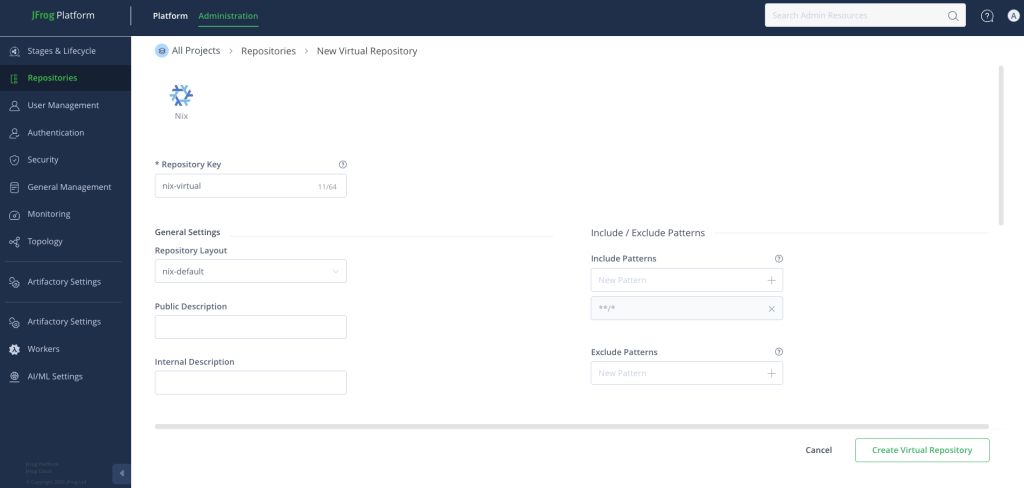
Step 1: Create Your Nix Repository
In the Artifactory Administration tab, create a new Nix repository. We recommend starting with a Virtual Repository, which aggregates your local and remote sources under a single URL to simplify developer configuration.
Step 2: Configure the Substituter
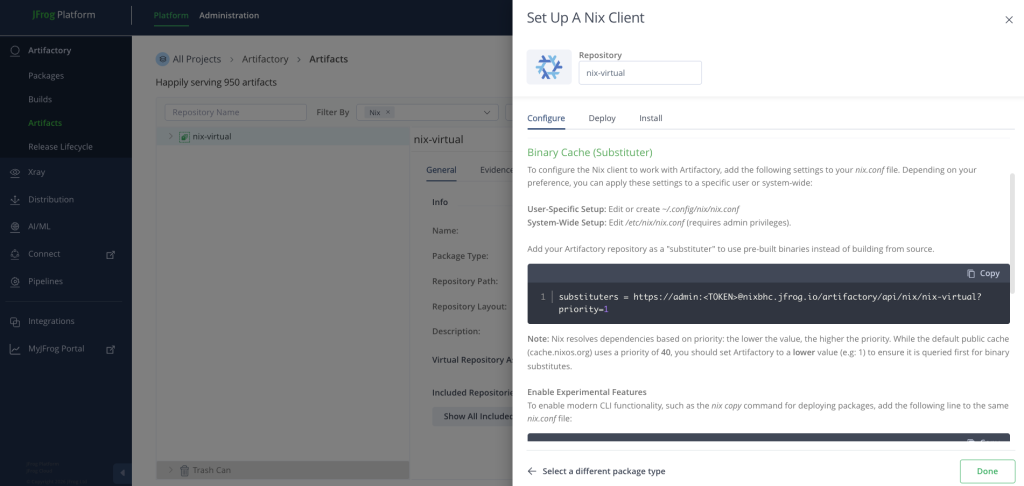
To use Artifactory as a binary cache instead of building from source, add it to your nix.conf file (located at /etc/nix/nix.conf or ~/.config/nix/nix.conf).
Add the following line, ensuring the priority is lower than 40 to override the public cache:
substituters =
https://<USERNAME>:<AUTH>@<JFrogPlatformURL>/artifactory/api/nix/<REPO_NAME>?priority=20
Step 3: Deploy and View Your First Package
Use the standard nix copy command to push packages from your local store directly to Artifactory:
nix copy --to
"https://<USERNAME>:<AUTH>@<JFrogPlatformURL>/artifactory/api/nix/<REPO_NAME>/" --file default.nix</
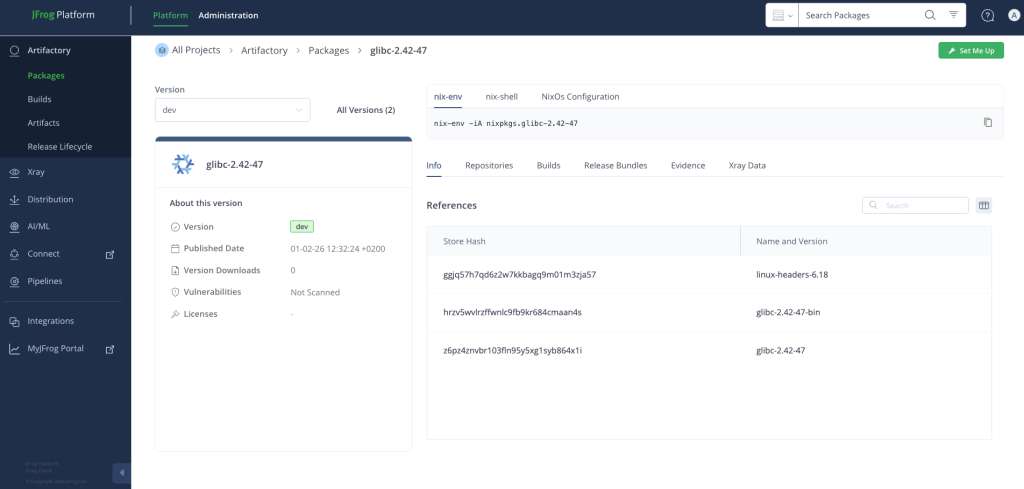
Once the command executes, Artifactory automatically calculates and indexes the metadata. You can immediately view your uploaded package in the Package details page.
What’s Next: Advancing Nix security with JFrog
This launch is only the beginning. We are actively exploring the next phase of our Nix support, with a focus on enhancing security and trust for organizations adopting Nix at scale.
Our goal is to bring the full weight of the JFrog Platform to the Nix ecosystem. We are looking ahead to provide deeper visibility and governance over pre-built Nix binaries as they move through your software supply chain. By introducing enterprise-grade security capabilities at the binary cache level, we aim to empower teams to assess and consume third-party Nix packages with absolute confidence, protecting the reproducibility and determinism that make Nix so powerful.
Absolute Confidence in Every Build
Nix offers the best promise of reproducibility in the industry, and Artifactory provides the platform to scale that promise. By combining the functional purity of Nix with the power of the JFrog Platform, you can finally eliminate dependency hell and ship software with absolute confidence.
No more “it worked on my machine.” From now on, if it works in Artifactory, it works everywhere.
Ready to experience the Universal Binary Cache? Read the full technical documentation for advanced channel configurations or start a free trial of the JFrog Platform today.
 New insights from +1,400 security & DevOps leaders. Get the Full Report.