Claude
  Cursor
  Codex
Codex  Hugging Face
  NVIDIA
  Visual Studio Code
  Devin
Devin  Kiro
Kiro  Open Code
  NanoClaw
 Docker
  npm
npm  PyPy
PyPy  Wiz
Wiz 
 Financial Services
  Gaming
  Public Sector
  Automotive
  Technology
  Healthcare


JFrog VS. Sonatype:
Your Pipeline has Outgrown Nexus
Secure your software supply chain from code to production
with a unified platform built for global enterprise scale.
See how JFrog Compares to Sonatype
Please note that the following research findings reflect information that is available to the public and is to our best understanding.
JFrog

Sonatype

Technology Breadth
60+ supported technologies (Including OSS packages, AI models, skills, and MCP servers)
~25 supported technologies
Enterprise Scale & Resilience
Full High Availability (HA), edge nodes for global caching, and mature multi-site Disaster Recovery.
Limited HA, edge capabilities, and replication.
Cloud and Deployment
Multi-cloud (AWS, Azure, GCP) and on-prem; 99.99% SLA; SCIM and PrivateLink support.
SaaS limited to US AWS/Azure regions; no SCIM or PrivateLink support.
Supply Chain Security
Federated policies; auto-substitutes safe versions across public, private, and uncataloged repos.
Primarily public registries; safe-version auto-selection is limited to npm and Python.
AppSec Consolidation
Unified platform encompassing SAST, SCA, secrets, and container runtime for all languages.
Requires separate product integrations. Includes SCA, but call-graph reachability is Java-only.
Vulnerability Triage
Multi-language Contextual Analysis filters out unused code paths to minimize alert noise.
Java-only call-graph analysis; higher manual remediation overhead for developers.
AI & ML Governance
Includes AI Catalog, Shadow AI detection, and governance for MCP servers and IDE extensions.
Hugging Face support only; lacks AI catalogs and Shadow AI detection.
Storage & Lifecycle
Fully automated lifecycle policies
Manual cleanup and blob-store compaction
Platform Adoption
Single UI, API, and policy model for faster onboarding and time-to-value
Separate products requiring individual repo-target configuration
Support SLA
24/7 engineer-led support included starting from the second tier
Standard 9 to 5 support; 24/7 coverage requires a paid upgrade.
Trust & Compliance
Unified provenance, SBOMs, and evidence collection across the full artifact lifecycle.
Requires external tooling or manual processes for full compliance coverage.
JFrog has been a game-changer for Adyen, enabling us to shift security left by embedding vulnerability scanning directly into our merge requests. This not only empowers developers to take ownership of security early in the lifecycle but also helps us control and correct the complex security requirements of our monolithic applications.
By unifying scans across our technology stack and creating a streamlined, proactive workflow, we’ve transformed how we address vulnerabilities in dependencies.
Secure Your Software Supply Chain With Confidence
Secure your software supply chain from code to production. JFrog’s unified platform delivers universal package management and native security for every asset, including AI and ML models.

Native Security
Simplify your infrastructure with native security built directly into your registry. JFrog provides unified vulnerability scanning, secrets detection, and infrastructure as code analysis.

Reduce Alert Fatigue
Focus on vulnerabilities that are actually reachable. JFrog contextual analysis determines if a CVE is exploitable in your specific configuration, reducing alert noise by up to 90%.

End-to-End AI Security
JFrog helps you manage, scan, and govern AI and ML models with the same rigor and automation as your standard software binaries.

Eliminate Tool Sprawl
Stop juggling disconnected tools. JFrog provides a single system of record for over 40 package types, AI models, and integrated security.

Scale Without Limits
Deploy anywhere without compromise. JFrog delivers true hybrid flexibility, multi-cloud support, and enterprise-grade scalability.
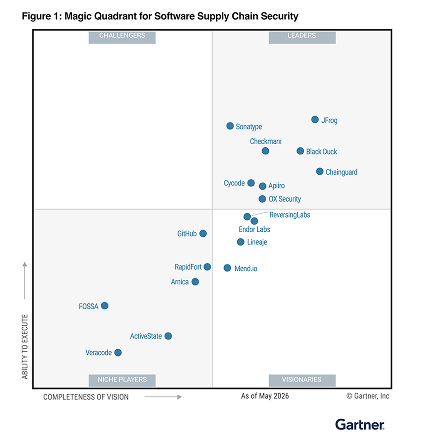
JFrog named a Leader in the
2026 Gartner® Magic QuadrantTM Software Supply Chain Security
Highest in Ability to Execute. Recognized for Vision and Execution in the software supply chain security market.
Why Leading Companies Choose JFrog
Serving 80% of the Fortune 100
I follow the basic principles for AppSec — Prevent, Detect, Remediate. And when I look at the offerings from JFrog, they’re checking those boxes for me.

-
JFrog eliminates security tool sprawl by consolidating SAST, SCA, secrets detection, and container security into one native platform. While Sonatype primarily focuses on open-source packages and limits its reachability analysis strictly to Java, JFrog Advanced Security provides complete, multi-language visibility into first- and third-party code without the need to manage disconnected tools
-
JFrog Advanced Security uses contextual analysis to determine if a vulnerability is actually reachable in your specific configuration. This helps teams prioritize the most critical risks and significantly reduces alert fatigue compared to traditional scanners. Sonatype limits reachability analysis only for Java, leaving multi-language teams with uneven security coverage.
-
JFrog extends artifact governance to the full AI/ML supply chain – model registries, MCP servers, IDE extensions, and Shadow AI detection – as first-class capabilities. Sonatype’s AI coverage is limited to Hugging Face with no tooling for the broader GenAI ecosystem.
-
JFrog is built for enterprise scale with full high availability (HA) across every package type, edge nodes for low-latency global access, and mature disaster recovery. Sonatype’s HA support is partial: security features and some package types are excluded, and multi-site replication is limited.
-
JFrog offers true multi-cloud flexibility – AWS, Azure, GCP, and hybrid – with a 99.99% SLA. Sonatype’s SaaS is limited to AWS and Azure in US regions only, which is a hard blocker for EU customers with data locality requirements.
-
JFrog Curation acts as a proactive gatekeeper – evaluating every package, including from private and uncataloged sources, before it ever enters your ecosystem. Sonatype’s firewall focuses primarily on public registries and offers auto-remediation only for npm and Python.
-
JFrog is the stronger fit for regulated environments. Trusted Releases, Evidence Collection, and AI-BOM provide a unified provenance and audit trail across the full artifact lifecycle – natively, without external tooling. PrivateLink keeps traffic off the public internet, SCIM automates identity lifecycle for audit compliance, and the 99.99% SLA meets the uptime bar most regulated industries require. Sonatype requires external tools or manual processes to achieve equivalent compliance coverage.
-
JFrog automates the full artifact lifecycle – active use, cold storage, and cleanup – with no manual intervention required. Sonatype relies on cleanup tasks and blob-store compaction that add operational steps and delay real cost savings.