Claude
 Cursor
 Codex
 Hugging Face
 NVIDIA
 Visual Studio Code
 Devin
 Kiro
 Open Code
 NanoClaw

 Docker
 npm
 PyPy
 Wiz

 Financial Services
 Gaming
 Public Sector
 Automotive
 Technology
 Healthcare


Frequently Asked Questions
Answers to common questions about software supply chain security assessments, maturity scoring, peer benchmarking, AI security, and what is included in your personalized findings report.


JFrog immunizes what agents consume and controls how they build and deploy — every AI model, agent skill, plugin, MCP server, package, and AI-generated artifact, governed in a single source of truth.
Run with a trusted agentic workforce.
The universal and adaptable JFrog Platform solves essential cross-industry agentic software supply chain challenges.
Accelerate software delivery while meeting strict regulatory standards like HIPAA and FedRAMP
Build a continuous audit trail for CRA, DORA, NIST SSDF, and CERT-In compliance.

 Security Maturity
Assessment




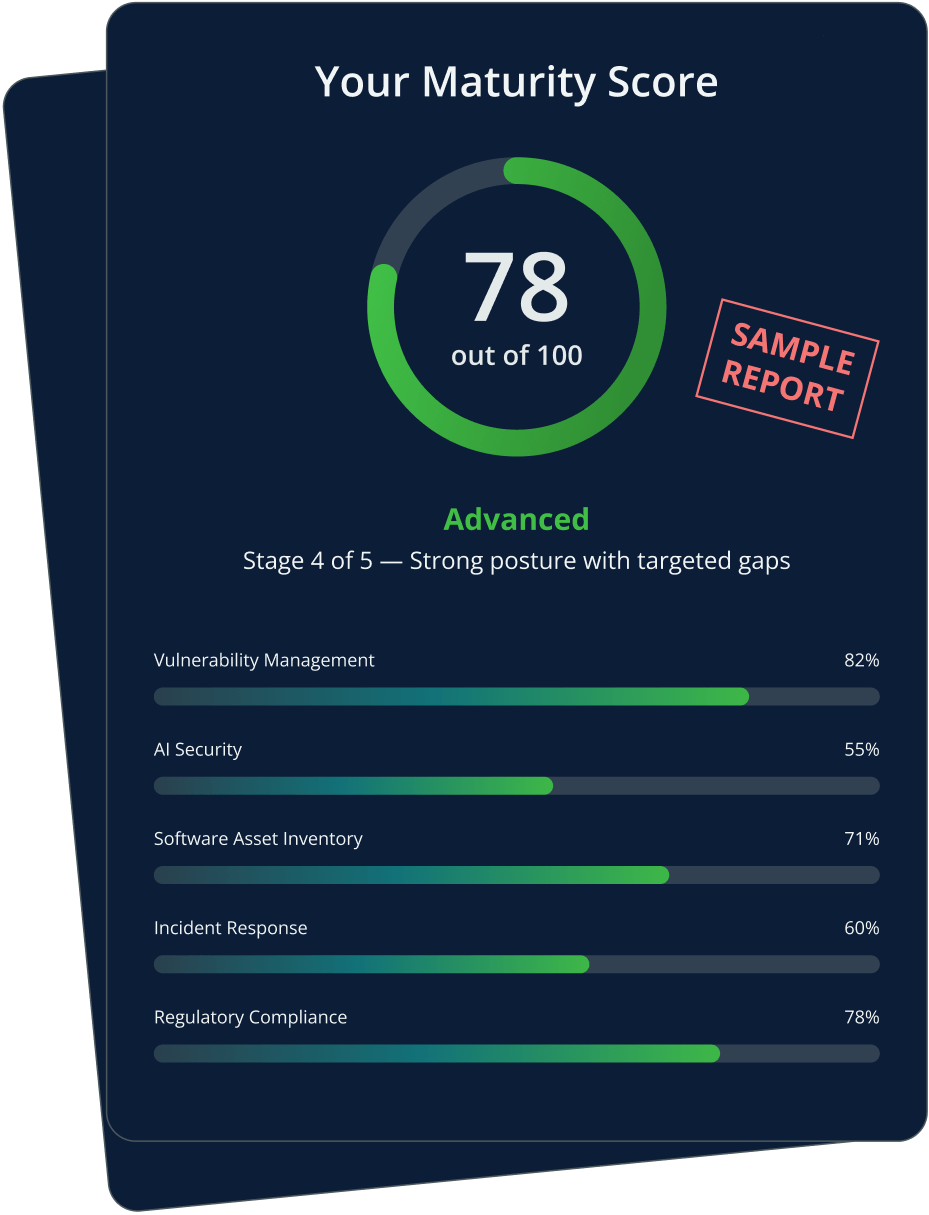

Know your supply chain security posture. Get a maturity score across 11 domains based on your actual practices, plus a clear view of where to focus next.

See industry data and market signals alongside your results for context as you set priorities.

See the areas where you reported the least mature practices, from software asset visibility and configuration to incident response and AI security.

Get prioritized recommendations for your weakest areas, with quick wins and longer-term steps that keep security in step with the speed and scale of delivery.

Give security, DevOps, AppSec, governance, and leadership teams a shared view of reported maturity, gaps, and next steps, so everyone can work from the same picture.

Review how you manage approved AI assets, agents, and models, and how you detect Shadow AI, so you know where to focus as AI usage grows.

Assess how well you inventory your software components and dependencies, including whether you can produce and maintain accurate SBOMs.

Protect sensitive data, secrets, and credentials from exposure across development and delivery workflows.

Maintain secure standards across systems, repositories, and environments to reduce misconfiguration risk.

Identify, prioritize, and address vulnerabilities before they create greater risk across the software supply chain.

Detect and prevent malicious software from entering your software supply chain and runtime environments.

Strengthen application security practices across development, testing, and release workflows.

Improve your ability to detect, coordinate, and respond to software-related security incidents.

Regulatory requirements are constantly updated. Check whether your process for tracking applicable laws, regulations, and standards is documented and actively maintained.

Clarify ownership and align teams around shared security responsibilities and expectations.

Connect security risks to business impact so teams can prioritize what matters most.

Assess how well you govern approved AI assets, detect Shadow AI, and control model access and usage across the software supply chain.
Enter your details to get started.
Answer guided questions across 11 security domains. (approx. 15 min)
Get your maturity score and see industry data for context alongside your results.
Get a personalized report with your score and recommended next steps.
Meet with a JFrog security expert to review your findings and build an actionable plan to strengthen software security.

Gain visibility into security maturity to guide strategy and prioritize investments.

Assess the maturity of your delivery pipelines, software asset controls, and governance practices across five stages.

Evaluate security practices across SAST, SCA, and runtime protection.

Review how documented and reviewed your processes are for tracking the requirements that apply to you.

Evaluate AI governance, model controls, and shadow AI risks.

Assess security maturity across teams, tools, and environments.
Answers to common questions about software supply chain security assessments, maturity scoring, peer benchmarking, AI security, and what is included in your personalized findings report.
A security maturity assessment helps you review how your organization manages security practices, controls, and risk across key domains, based on your own answers. The JFrog Security Maturity Assessment focuses on software supply chain security, helping teams understand their current maturity stage, see industry context, and identify practical next steps to improve.
Software supply chain security is assessed by reviewing visibility, governance, vulnerability management, application security, incident response, documented processes and review, AI security, and related controls across development and delivery workflows. The assessment scores maturity across 11 domains to show where you reported strong practices and where gaps may exist.
Software supply chain security maturity describes how consistently an organization can identify, govern, secure, and trust the software, packages, models, and artifacts moving through its delivery pipelines. In general, higher stages reflect stronger visibility, policy enforcement, risk prioritization, and clearer cross-team ownership. In this assessment, maturity stages describe the practices you report. They do not confirm that those practices are documented, consistently followed, or effective.
Most teams can complete the assessment in about 15 minutes. After answering guided questions across the core security domains, you receive a maturity score, industry context, domain-level findings, and prioritized recommendations.
The report includes your overall maturity score, domain-level findings, industry context, gaps based on your answers, and recommended next steps. It is designed to help security, DevOps, AppSec, governance, and leadership teams align on priorities and move from assessment to action. The report is based on your answers and is not an audit, certification, or compliance determination.
DevSecOps maturity is measured by evaluating how well security is integrated into software delivery practices, including vulnerability management, secure configuration, application security testing, incident response, documented processes and review, and team ownership. The goal is to understand whether security is proactive, repeatable, and scalable across teams.
An AI security assessment evaluates how well an organization controls AI assets, approved models, model access, usage policies, and Shadow AI risk. It helps teams understand whether AI and ML assets are visible, governed, and aligned with security expectations before unmanaged usage creates greater software supply chain risk.