NVIDIA
  Cursor
  GitHub


 Docker
  Maven
Maven  Financial Services
  Public Sector
  Technology
  Healthcare
  Gaming
  Automotive
  Enterprise


JFrog vs Snyk: Why Effective AppSec Must Move Beyond Source Code
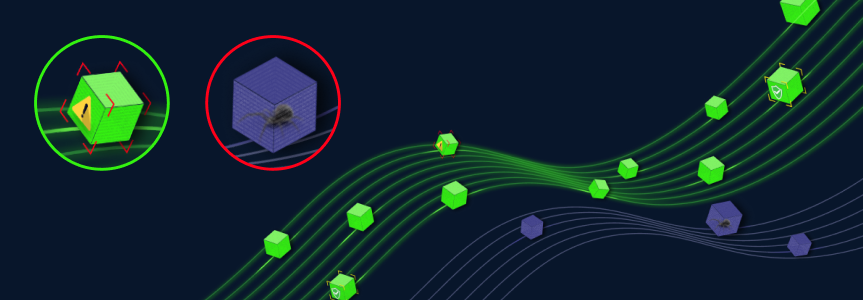
The tech world is abuzz with the potential of AI and automated development, but this rapid advance is fueling a massive increase in regulatory scrutiny and supply chain risk. While many teams rely on source code scanning, focusing on code alone leaves a critical “malware blind spot” in the software supply chain. Today’s applications are assembled from binaries, third-party packages, and AI models—not just written line-by-line.
If you only secure what your developers write, you’re missing the actual targets that attackers exploit. To reconcile the tension between release speed and security, organizations must focus on binaries.
Why is Source Code Scanning Insufficient for Supply Chain Security?
Source code is the intent, but the binary is the reality. Relying solely on source code scanning, such as SAST, creates a blind spot because it cannot detect vulnerabilities introduced later in the CI/CD process like malicious build scripts or corrupted dependencies.
Traditional AppSec tools like Snyk often focus primarily on the “shift-left” code phase. However, the most significant threats often live in third-party components and the compiled artifacts. JFrog Xray addresses this by providing continuous, binary-focused scanning. Because JFrog Xray analyzes the final compiled artifact, it identifies risks that source-only tools simply cannot see, ensuring that what you ship is what you actually secured. JFrog Advanced Security adds capabilities like secrets scanning for BOTH source and binary code, because scanning for secrets only in source code can lead to significant risks being overlooked. Check out the Snyk vs JFrog comparison table for details.
How Does JFrog Provide Better Vulnerability Prioritization than Snyk?
Security teams are often overwhelmed by “noise”—thousands of CVEs with no clear priority. While Snyk prioritizes based on code-level reachability, the JFrog Software Supply Chain Platform uses deep artifact-aware transitive contextual analysis.
By using JFrog Advanced Security, teams can determine if a vulnerability is actually exploitable in the context of their specific applications’ code base. Unlike Snyk’s source-code only reachability, JFrog also offers configuration-based contextual analysis. With JFrog’s Ultimate Security bundle teams can leverage transitive contextual analysis – going even deeper into dependencies. This “Product Pulse” of intelligence ensures your experts spend their finite time fixing the 10% of vulnerabilities that actually pose a threat, rather than chasing 90% that are unreachable in your production environment.
What are the Key Differences Between JFrog and Snyk?
The following comparison is based on publicly available information and our internal analysis:
| Capability | JFrog | Snyk |
| Single System of Record for the Software Supply Chain | ✅ Yes | ❌ No |
| Comprehensive Software Composition Analysis (SCA) | ✅ Yes | ✅ Yes |
| Binary Scanning (Secrets Included) | ✅ Yes | ❌ No |
| Intelligent CVE Prioritization with Contextual Analysis | ✅ Yes | ⚠️ Partial (source reachability only) |
| Preemptive Blocking of Risky/Malicious 3rd-Party Components | ✅ Yes | ❌ No |
| End-to-End Release Integrity | ✅ Yes | ❌ No |
Can You Block Malicious Packages Before They Enter the SDLC?
The recent string of attacks, which primarily target the npm registry, prove that the “front door” of your development environment is the primary gateway for risk. If a developer pulls a malicious package, the attack succeeds before the code is even scanned.
JFrog Curation acts as an automated gatekeeper, natively integrated into the JFrog Platform. Unlike bolt-on tools, JFrog Curation checks every requested package against a database of known malicious versions and unauthorized licenses before they enter your environment. It verifies developer requests for packages, models, IDE extensions and more against your policies, proactively blocking threats like the record-breaking 2025 npm phishing campaign from ever reaching your environment.
What is the Value of a Single System of Record for AppSec?
Fragmented tools create a “crisis of trust”. When security is bolted-on rather than native, it introduces friction that slows down your release velocity.
The JFrog Software Supply Chain Platform serves as a single source of truth for all artifacts—binaries, containers, and AI models. As Billy Norwood, CISO at FFF Enterprises, notes:
“By deploying JFrog, we’ve seen fewer vulnerabilities… with different development teams all being on the same platform, it has centralized and streamlined the process”.
By consolidating artifact management and security into one system, the JFrog Platform enables continuous and automated governance, eliminating the need for manual, point-in-time audits and strengthening your security posture.
How Does JFrog Secure the AI/ML Lifecycle Compared to Competitors?
AI/ML is arguably the most disruptive technology since the smartphone, but it requires unprecedented transparency. Organizations are TO now facing regulations like the EU AI Act, which can impose penalties of up to 6% of global revenue for non-compliance.
To help tackle security, transparency and regulatory issues, the JFrog AI Catalog provides a secure environment for discovering and managing models. By treating AI models as artifacts within the JFrog Platform, you can leverage JFrog Evidence Collection to automatically generate a verifiable trail of every step taken to advance a model into production. This ensures your “Agentic AI” initiatives are governed by the same rigorous standards as your traditional software.
JFrog’s recently introduced AI Generated Code Validation also has you covered for when developers use AI-generated code snippets, potentially introducing security, licensing and compliance risk into your applications.
Is Your AppSec Ready for Today’s Software Supply Chain?
Securing modern software requires more than a code scanner; it requires a true DevSecOps platform that is end-to-end, native, binary-focused and integrates directly into where your artifacts are managed. By aligning security with the JFrog Software Supply Chain Platform, you turn security into an enabler of velocity rather than a blocker, and DevOps and developers into your allies, rather than siloed teams.
Ready to see the binary difference for yourself? Take a tour of the JFrog Platform or book a demo with one of our AppSec Security Experts today.
 New insights from +1,400 security & DevOps leaders. Get the Full Report.