Claude
  Cursor
  Codex
Codex  Hugging Face
  NVIDIA
  Visual Studio Code
  Devin
Devin  Kiro
Kiro  Open Code
  NanoClaw
 Docker
  npm
npm  PyPy
PyPy  Wiz
Wiz 
 Financial Services
  Gaming
  Public Sector
  Automotive
  Technology
  Healthcare


Definition
The Internet of Things (IoT) is a distributed network of physical objects embedded with sensors and software that autonomously exchange data over the internet. This connectivity extends digital logic into physical infrastructure across consumer, industrial, and public domains. Organizations use these real-time telemetry streams to shift from reactive troubleshooting to proactive optimization. Securing this expanded infrastructure requires automated artifact management and code signing to ensure safe device updates.
What is the Internet of Things (IoT)?
The IoT is a distributed network of physical objects embedded with sensors, software, and connectivity. These smart devices autonomously collect and exchange data, bridging the gap between the physical and digital worlds to provide real-time visibility across everything from household appliances to global industrial fleets.
The Value of Autonomous Connectivity
Unlike traditional hardware that requires manual input, IoT operates at scale to enable continuous automation and intelligent decision-making. By leveraging these networks, organizations can:
- Optimize resources and monitor assets remotely.
- Reduce downtime by shifting from reactive repairs to predictive maintenance.
- Enhance visibility across the entire operational lifecycle.
IoT and the Software Ecosystem
As digital logic extends into physical infrastructure, IoT becomes a critical component of the DevOps ecosystem. Managing the software supply chain at the “edge” requires robust practices for artifact management and security governance.
Deploying devices is only the beginning. Long-term success depends on over-the-air (OTA) firmware updates to patch vulnerabilities and deliver new capabilities. By using techniques like code signing, organizations can verify update integrity and maintain trust across the device fleet, ensuring systems remain resilient long after the initial rollout.
Four Types of IoT
Every successful IoT deployment relies on a strategic blend of physical connectivity and efficient messaging protocols to ensure data flows reliably between devices and the cloud. The table below categorizes these deployments by their scale and environment.
| Domain | Focus | Key Use Cases |
| Consumer | Personal Lifestyle | Smart home ecosystems (lighting, HVAC), wearables, and connected appliances. |
| Industrial (IIoT) | Efficiency and Safety | Predictive maintenance via digital twins, factory automation, and precision agriculture using soil/climate sensors. |
| Commercial | Business and Healthcare | Continuous remote patient monitoring, smart office building management, and retail inventory visibility. |
| Infrastructure | Public Management | Smart city systems including adaptive traffic signaling, utility grid monitoring, and responsive waste management. |
Why Does IoT Matter?
IoT is one of the most significant enablers of digital transformation today. It automates data collection from the physical world, reduces manual oversight, and provides real-time visibility into assets, processes, and environments. Instead of relying on periodic reports or human observation, IoT systems stream live telemetry that informs decisions instantly, allowing organizations to transition from reactive problem solving to proactive optimization.
Optimizing Global Infrastructure
IoT improves operations across manufacturing, energy, logistics, agriculture, healthcare, and smart cities by enabling real-time monitoring, predictive maintenance, and more efficient resource use. This connectivity transforms traditional infrastructure into autonomous and intelligent systems.
Enhancing Consumer Lifestyles
In daily life, IoT shows up through smart homes and wearables that learn routines, automate lighting and temperature, track health metrics, and provide remote control of appliances and security systems. These connected devices increase comfort, reduce energy usage, and make everyday environments safer and more responsive.
Driving Strategic Enterprise Value
Enterprises gain live visibility into assets and supply chains, reduce downtime, and unlock new revenue streams through connected products and data services. IoT telemetry fuels analytics and automation for smarter decision-making.
What is the Technical Architecture?
IoT architectures are layered systems designed to sense, transport, analyze, and act on data. This integrated stack turns raw environmental inputs into meaningful operational decisions.
The Perception Layer: Sensors and Actuators
Everything begins with hardware that interacts with the physical world.
- Sensors: These capture environmental, mechanical, or biometric data, including temperature, vibration, GPS location, and heart rate.
- Actuators: These components close the loop by converting digital commands into physical action, such as opening valves, adjusting motor speeds, or triggering alerts.
- Power Efficiency: Because many devices operate in the field for years, low-power chipsets and energy harvesting techniques are critical to extending operational life without frequent maintenance.
The Connectivity Layer: Protocols and Standards
Network protocols determine the power consumption, range, and cost of the system. A successful ecosystem relies on a strategic blend of physical transport and efficient messaging protocols.
| Category | Technologies | Primary Use Case |
| Short-Range | BLE, Zigbee, Z-Wave | Personal sensor networks and smart home devices. |
| High-Bandwidth / Local | Wi-Fi, Ethernet | Local environments requiring high data throughput. |
| Wide-Area (WAN) | LTE/5G, LoRaWAN, NB-IoT | Large-scale connectivity across cities, farms, or industrial sites. |
| Messaging Protocols | MQTT, HTTP/REST, CoAP, AMQP | Moving data between devices and servers; MQTT is the standard for lightweight telemetry. |
The Intelligence Layer: Edge and Cloud Computing
Processing power is distributed across the network based on the need for speed and depth of analysis:
- Edge Computing: Local nodes process data on-site to reduce latency and bandwidth costs. This is vital for real-time control in robotics, autonomous vehicles, and industrial safety systems.
- Cloud and Data Analytics: Centralized backends handle high-volume ingestion, secure storage, and complex time-series analysis. Historical data processed in the cloud is used to train Machine Learning models and forecast demand.
Management and User Interface
The final layer provides the human-to-machine connection. Dashboards and mobile apps offer visibility and control, while specialized device management platforms handle secure onboarding and monitoring. Continuous software delivery via secure OTA updates ensures that the entire fleet remains resilient and functional over its entire lifecycle. For developers and DevOps teams, executing these updates requires seamless compatibility with standard embedded workflows. Modern architecture patterns must natively support standard package formats (such as Debian, RPM, and Docker/OCI containers) alongside specialized embedded build environments like the Yocto Project and BitBake.
Securing the IoT Ecosystem and Lifecycle
The expansion of IoT creates significant operational and security challenges that must be addressed to maintain system integrity. As billions of devices connect to corporate and public networks, they increase the attack surface and introduce complexities in data management.
Key Implementation Challenges
- Security and Scale: Many IoT devices lack the processing power for traditional security software, making them vulnerable to exploitation. Managing security across a fleet of thousands of devices requires automated, scalable solutions rather than manual intervention.
- Data Privacy and Compliance: IoT systems often collect sensitive personal or industrial data. Beyond standard data protection mandates like the GDPR, organizations must comply with stringent device-specific frameworks. This includes aligning with U.S. Executive Order 14028 mandates and preparing for the EU Cyber Resilience Act (CRA), which enforces its first critical reporting deadline for actively exploited vulnerabilities and severe security incidents in September 2026.
- Interoperability: The lack of universal standards often leads to “walled gardens” where devices from different manufacturers cannot communicate. This fragmentation can hinder the seamless flow of data across an organization.
Managing the Software Supply Chain
To mitigate these risks, IoT security must be treated as a continuous lifecycle rather than a one-time setup. Long term success depends on the ability to manage the software supply chain at the edge.
- Secure Onboarding and Identity: Each device requires a unique, verifiable identity to ensure that only authorized hardware can connect to the network. This prevents spoofing and ensures that telemetry data is coming from a trusted source.
- OTA Updates: Because IoT devices are often deployed in hard to reach locations, the ability to deliver remote firmware updates is critical. OTA updates allow organizations to patch vulnerabilities and deploy new features without physical access to the hardware.
- Artifact Management and Code Signing: Maintaining trust across a device fleet requires rigorous software governance. Artifact management ensures that only approved software versions are deployed, while cryptographic code signing verifies that the firmware has not been tampered with during transmission.
What is the Future of IoT?
IoT is moving toward greater intelligence, autonomy, and scale. As connected devices multiply across industries and cities, AI/ML will turn raw telemetry into predictive automation; systems that detect issues early, optimize performance, and trigger actions without intervention. This AI-enabled evolution, often referred to as AIoT, will be supported by faster networks like 5G and more capable edge computing, allowing decisions to happen closer to the device for lower latency and reduced cloud dependency.
Digital twins will increasingly simulate equipment, production lines, and infrastructure, while sustainability initiatives leverage IoT to reduce energy consumption, prevent waste, and monitor environmental impact. This expansion also heightens security and lifecycle demands. Billions of devices now require secure updates, robust identity management, and compliance with evolving data regulations.
In short, IoT devices will increasingly decide and adapt on their own. Organizations with strong DevOps foundations, secure OTA processes, and continuous device management will scale more confidently as IoT becomes smarter, more proactive, and more essential.
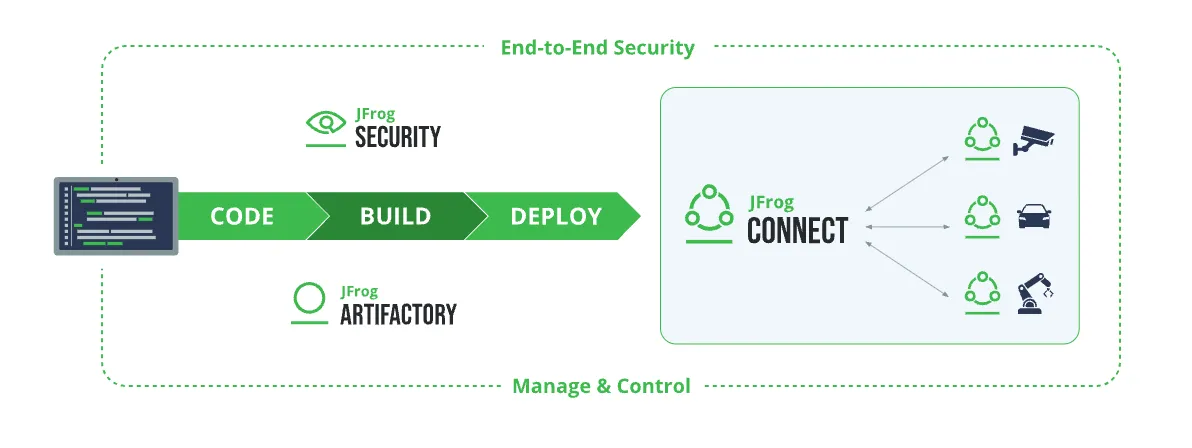
Bringing IoT and Software Delivery Together with JFrog
As device fleets scale, managing software updates becomes as critical as managing the hardware itself. IoT systems require continuous patches, secure OTA delivery, lifecycle governance, and visibility into artifacts moving across the supply chain. The JFrog Platform ties DevOps, device management, security, and release automation together, enabling organizations to reliably and securely connect code to devices with traceability from development to deployment.
The JFrog platform aligns specific responsibilities to individual modules rather than attributing all workflows to a single component:
- JFrog Artifactory and JFrog Distribution: These modules manage and securely transport signed artifacts across standard embedded workflows, natively supporting package formats like Debian, RPM, and Docker/OCI, as well as build systems like the Yocto Project and BitBake. Distribution specifically handles the secure distribution of release bundles.
- JFrog Connect: This module provides the runtime deployment execution, device inventory, runtime visibility, and monitoring directly on the edge devices.
Importantly, adopting this unified delivery layer does not require a disruptive overhaul of your cloud setup. The JFrog Platform is designed to complement and seamlessly integrate with major public cloud IoT hubs—such as AWS IoT Core and Azure IoT Hub—serving as your secure software supply chain foundation rather than replacing your existing cloud infrastructure.
Whether your environment spans a handful of embedded devices or millions of distributed sensors, this structured ecosystem unifies software supply chain workflows, automates delivery, and maintains trust with verifiable updates.
Take a virtual tour, schedule a demo, or start a free trial today to to see how to securely deploy and monitor software updates across your distributed device fleet.