JFrog VS. Cloudsmith

JFrog is the proven, 
fully-managed artifact management partner 
you can trust

Modern AI-ready software factories require the right foundation. See why development teams choose JFrog over Cloudsmith for enterprise-scale artifact management.

coudsmith hero banner

Why JFrog?

JFrog is the proven leader in artifact management and trusted software supply chain delivery with over 4,000 fully-managed SaaS customers. If you’re looking to modernize the way you manage, secure, and govern software delivery for the AI era – we’ve got you covered.
  • The JFrog Platform is a modern, Kubernetes-based solution that delivers intelligent autoscaling and a fully managed, zero-provisioning experience for thousands of global organizations. While Cloudsmith is restricted by its exclusive reliance on AWS, JFrog provides true multi-cloud freedom, allowing you to choose your host and region to satisfy strict data sovereignty and compliance requirements. By maintaining a unified codebase across our SaaS and self-managed offerings, we enable seamless hybrid configurations and consistent DevOps workflows that Cloudsmith’s AWS-only model simply cannot support.

    Cloud Native Flexibility
    JFrog
    • SaaS (AWS, Azure, Google Cloud, including multi-cloud)
    • Self-managed
    • Hybrid
    Cloudsmith
    • SaaS only (single-cloud, AWS only)
  • The JFrog Platform is the industry’s most comprehensive universal artifact repository, providing native support for over 60+ package technologies. While Cloudsmith claims universal coverage, it often lacks critical functionality like proxy caching for public registries, which can compromise pipeline security and velocity. By serving as a high-performance single source of truth with deep ecosystem integrations, JFrog eliminates the functional gaps found in „thin“ alternatives to ensure total artifact reliability across your software supply chain.

    Package Support Comparison
    JFrog
    • 60+ native package technologies
    Cloudsmith
    • 30+ package technologies
    • Support can be inconsistent across technologies
  • JFrog’s superior elastic architecture supports tens of thousands of downloads per second and massive data transfer volumes without any enforced rate limits. Customers can scale globally with confidence, backed by uptime SLAs up to 99.99%. In contrast, Cloudsmith enforces explicit rate limits that vary by subscription tier, requires downtime for maintenance which leads to outages, and can only guarantee a 99.9% SLA, which may constrain enterprise workloads.

    SaaS Performance
    JFrog

    No rate limits enforced at any subscription tier. Easily handles 5M+ requests per minute across cloud providers, and even more for those with higher workloads. Uptime SLAs up to 99.99%.

    Cloudsmith

    Enforces rate limits per subscription tier. Can guarantee only 99.9% uptime SLA, and requires downtime for maintenance, which can lead to outages.

  • JFrog provides comprehensive software supply chain security that goes far beyond the basic open-source scanners offered by Cloudsmith. Unlike Cloudsmith, JFrog proactively blocks malicious packages before they hit your developer’s machine. By leveraging deep contextual analysis, prioritization, and zero-touch remediation, JFrog delivers code-to-runtime security that allows dev teams to focus on what matters, eliminating the noise and inaccuracy associated with generic security tools. JFrog’s security is backed by the JFrog Security Research Team – a CVE Numbering Authority (CNA) that (as of October 29, 2026) has disclosed over 4 million malicious artifacts and 200+ zero-day vulnerabilities, scored over 4,400 CVEs, and (since the beginning of 2026) identified over 2,000 exclusive dependency confusion attacks.

    Security Approach
    JFrog

    Proactive blocking (cached packages too), in-house development + dedicated research team (CNA), contextual CVE analysis, continuous release monitoring with alerts on newly vulnerable stored packages

    Cloudsmith

    Scans after the first download by default, open-source feeds and tools, no CVE applicability analysis, limited continuous monitoring alerting

  • Ship fast without losing control. JFrog governs your software as complete applications, not just individual packages. Every build becomes an application version that moves from Dev to Production through automated policy gates at each stage. Policies are written as code, can warn or block, and can be set for a single application, a project, or your entire organization. At every gate, JFrog checks signed evidence, including scan results, SBOMs, and data from your CI/CD tools. Versions that don’t pass are held back until the issue is fixed or a waiver is approved. Built-in integrations with GitHub, Jira, AI Coding Agents, and ServiceNow bring pull requests, tickets, context, and change requests into the same evidence trail. Every promotion and policy decision is logged with who, what and when. Audit preparation becomes a few clicks, instead of assembling evidence by hand across tools. Cloudsmith’s policy management works at the package level, controlling which packages can enter, exist in, and leave repositories. JFrog extends governance to the whole application and its release, allowing organizations to enforce rigorous security and compliance standards while maintaining high-velocity delivery.

    Governance Maturity
    JFrog

    Application-level governance with reusable cross-app rules. Automated policy-as-code gates at every lifecycle stage, signed evidence and audit trail, out-of-the-box integrations

    Cloudsmith

    Package-level policies controlling what enters, exists in, and leaves repositories.

  • JFrog manages AI assets with the same controls as your other artifacts, including skills, MCP servers, and agent plugins. Artifactory’s machine learning repository stores models in formats including ONNX, PyTorch, scikit-learn, CatBoost and Hugging Face with the Hugging Face repository able to proxy the public Hub. Models, skills, MCP servers, and agent plugins are scanned before they enter your supply chain with strict controls determining which AI tools can be used by which agent, developer, or team. Unmanaged and “shadow AI” are surfaced across repositories and locally on the developer’s machine. While Cloudsmith can host and proxy Hugging Face models and datasets, its own documentation lists limitations. By integrating built-in scanning and governance, JFrog ensures that your AI models, MCP Servers, and AI assets are as secure and compliant as your traditional software artifacts. JFrog serves as the definitive solution for organizations looking to scale enterprise AI without compromising on security or visibility across the software supply chain.

    AI and Machine Learning Support
    JFrog

    Manages, governs and secures all major model formats, frameworks, AI services, MCP servers, skills, plugins, and supports Agent Package Manager (APM)

    Cloudsmith

    Manage Hugging Face models only

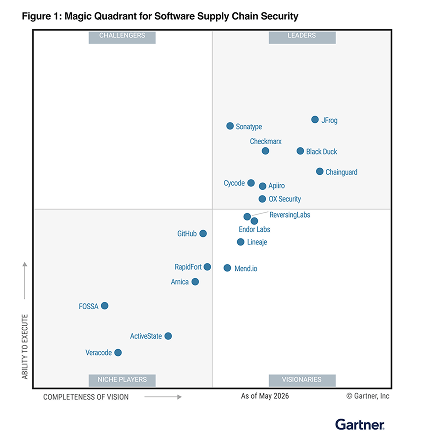
A Leader in Gartner’s first-ever Magic Quadrant for Software Supply Chain Security, and positioned highest for Ability to Execute among the vendors evaluated.
Magic Quardrant

Feature Comparison

Flexible deployment options
Flexible
SaaS (AWS, Azure, Google Cloud, including multi-cloud), Self-managed or
Hybrid
Single Cloud
SaaS only (single-cloud, AWS only)
Cloud-native
Yes
- Kubernetes based, and leverages native hyperscaler services across providers
Yes
- Based on proprietary AWS ECS infrastructure, making adding other clouds challenging
Cloud security - Data isolation
Advanced
Supports PrivateLink; Customer data is fully isolated
Limited
No PrivateLink; Single host architecture means shared infrastructure and resources between customers, potentially leading to security breaches and data leaks
Performance & scalability
Highly scalable
No rate limits enforced at any subscription tier. Easily handles 5M+ requests per minute across cloud providers, and even more for those with higher workloads. Uptime SLAs up to 99.99%.
Limited
Enforces rate limits per subscription tier. Can guarantee only 99.9% uptime SLA, and requires downtime for maintenance, which can lead to outages.
Multi-site support
Yes
Platform Federation connects multiple JFrog sites with bi-directional or one way sync of assets and policies. Also offers content serving from CDN.
Limited
No active multi-site content sync. Relies on external read-only, public CDN services.
Disaster recovery
Recovery Point Objective (RPO) is 1 hr
Recovery Point Objective (RPO) is 24 hrs
Ecosystem coverage
Broadest in the market
Supports 60+ package technologies
Sufficient
Supports 30+ package technologies; however, support can be inconsistent or broken across technologies
Seamless automation
Yes
REST APIs, CLI, Agent-ready MCP Server (remote), integrations, and Custom Lambda Workers. For packages, users only need to know the package name and version, making scripting fully automatable
Limited
Operates using unpredictable external package identifiers (slugs), meaning clients need to keep track of each package's unique ID and manually look them up during scripting - essentially defeating the purpose of CLI commands.
Lifecycle management and cleanup
Yes
Full artifact lifecycle management with Smart Archiving and cleanup
Limited
Basic retention and deletion at the repository level
Breadth of security offering
Comprehensive
Code and Binary Software Composition Analysis (SCA), SAST, IaC Scanning, Malicious Package Detection, Runtime Security, Zero-touch Remediation, and more.
Limited
Code Software Composition Analysis (SCA) and Malicious Package Detection only.
Security data sources
Proprietary - Enriched & Public
World class vulnerability database of 20+ public sources plus the world class JFrog Security Research team, a CNA.
Limited - Public only
Relies only on 15+ public CVE sources. No security research team.
CVE applicability - Focus remediation efforts on what actually matters
Yes
Contextual Analysis determines whether a CVE is applicable to the scanned artifact, for example whether the vulnerable function is reachable. Policies can skip CVEs found not applicable.
Not supported
No code-level applicability or reachability analysis.
Blocks malicious and non-compliant packages at first download
Yes
Curation guarantees first requests for uncataloged packages can be held.
Limited
By default, Cloudsmith serves a never-seen upstream package before evaluating it. Closing that gap needs an Early Access, workspace-wide setting.
Seamless developer experience with transparent fallback to compliant package
Yes
Transparently serves the latest compliant version under all policy conditions, enabling an optimal developer experience
Limited
Covers just a subset of policies, leaving developers with no automated package alternative suggestion
Request-time security enforcement for cached packages
Yes
Evaluates each download request, including ones served from cache.
Limited
Re-evaluates stored packages on triggers and schedules and only then changes their state if needed.
Continuous monitoring and alerting on newly vulnerable stored packages in released software
Yes
Re-checks stored artifacts as new vulnerabilities are published and alerts by email, Slack, webhook or Jira. It can also block downloads or fail builds.
Limited
Re-checks stored packages, but alerting relies on generic package webhooks, and no built-in new-vulnerability alert is documented.
Native agent security and integration
Yes
JFrog Agent Plugin embeds supply chain context and policy checks into agents like Claude Code, Cursor, VS Code, and Devin. Enforce allow/deny rules when installing skills, plugins, or MCP servers and detect unapproved shadow AI locally. The Agent Plugin also helps route agent dependency downloads securely through JFrog.
Limited
Offers an MCP server so AI assistants can manage repositories and packages. Enforcing your policies inside the agent isn’t documented.
Secure model registry
Yes
Full support (including native model scanning, and native Hugging Face Xet protocol support for optimized model delivery)
Limited
Partial support
AI asset registries
Yes
Skills, MCP servers, plugins, Agent Package Manager (APM)
Not natively supported
Agentic asset scanning
Yes
Scans skills, plugins, MCP servers, models, and agent packages and blocks risky or malicious assets before developers or agents can use them. Bring your own LLM key to keep scanning on infrastructure you control.
Not natively supported
No controls for vetting the MCP servers and skills agents rely on.

Settle for Nothing Less Than exceptional

cloudsmith asset (1)

Frequently Asked Questions

  • JFrog is the preferred choice for enterprise development teams. The JFrog Platform supports customers with petabytes of monthly data transfer, thousands of concurrent requests, and hundreds of thousands of requests per minute. Trusted by 80% of the Fortune 100, JFrog offers unbeatable scale and performance for teams of any size.

  • Yes, JFrog makes it easy to migrate from Cloudsmith with an easy to use migration tool. Talk to our team today.

  • In today’s AI era cloud flexibility is more important than ever. With JFrog’s hybrid and multi-cloud support you can easily shift workloads to take advantage of the best possible AI tools from the cloud providers while optimizing costs across cloud providers and self-managed deployments.

  • JFrog leverages proprietary security tools, databases, and research to provide best-in-class protection across the SDLC. Cloudsmith embeds free, open source scanning tools into their product and builds on open data sources. By default, a package Cloudsmith hasn’t seen before can be served to the first requester before policy evaluation finishes, even a risky or non-compliant one, which could leave customers exposed. JFrog Curation evaluates each download request, including requests served from cache when cached-package enforcement is enabled, and can hold first requests for packages not yet in the JFrog Catalog while they are assessed.

  • JFrog offers robust support for AI assets and machine learning models. JFrog serves as your advanced model registry with that ability to manage all major model formats. JFrog also manages MCP servers, agent skills, IDE extensions (including for Cursor and Windsurf) and can control access to AI services (such as OpenAI). Assets are scanned before use, and shadow AI already present in your artifacts is detected.

  • Yes. JFrog was named a Leader in the 2026 Gartner® Magic Quadrant™ for Software Supply Chain Security, the first Magic Quadrant for this category, and placed highest for Ability to Execute among the vendors evaluated.