Claude
  Cursor
  Codex
Codex  Hugging Face
  NVIDIA
  Visual Studio Code
  Devin
Devin  Kiro
Kiro  Open Code
  NanoClaw
 Docker
  npm
npm  PyPy
PyPy  Wiz
Wiz 
 Finanzdienstleistungen
  Gaming
  Öffentlicher Sektor
  Automobil
  Technologie
  Gesundheitswesen


Häufig gestellte Fragen
Alles, was Sie über die Auszeichnung von JFrog und den Gartner® Magic Quadrant™ für Software Supply Chain Security wissen müssen.


JFrog prüft und härtet alles, was Ihre Agents nutzen, und steuert, wie sie bauen und deployen – jedes KI-Modell, jeden Agenten-Skill, jedes Plugin, jeden MCP-Server, jedes Paket und jedes KI-generierte Artefakt, verwaltet in einer Single Source of Truth.
Eine Agentic Workforce, der Sie vertrauen können.
Das ist AgentSecOps.
Die universelle und anpassungsfähige JFrog Plattform löst wesentliche branchenübergreifende Herausforderungen der agentischen Software-Lieferkette.
Beschleunigen Sie die Softwarebereitstellung unter Einhaltung strenger regulatorischer Standards wie HIPAA und FedRAMP
Build a continuous audit trail for CRA, DORA, NIST SSDF, and CERT-In compliance.
Sicherheit in der Softwarelieferkette
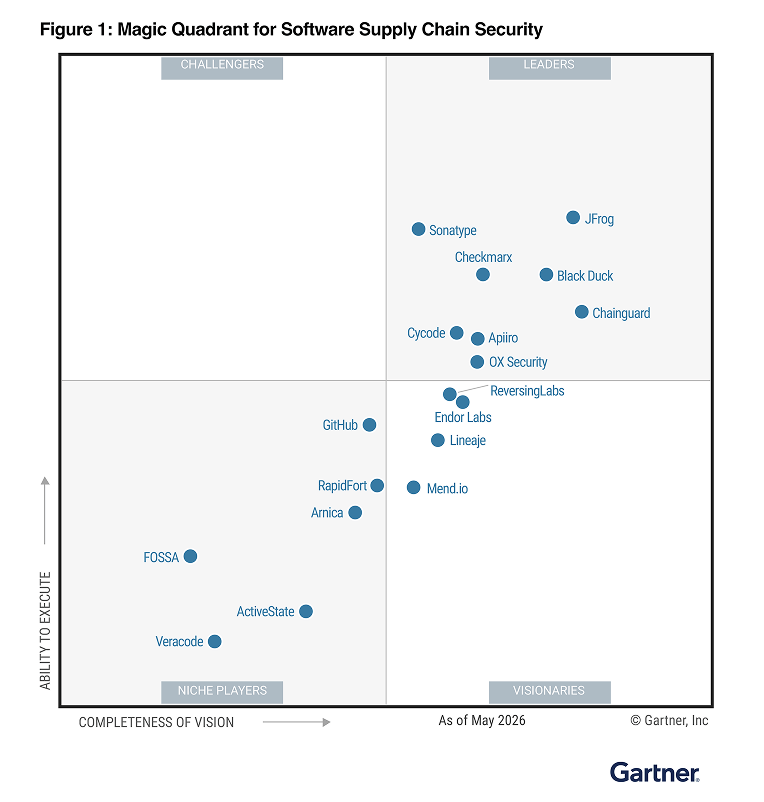
Zum ersten Mal hat Gartner® Software-Lieferketten-Sicherheit als eigene Kategorie im Magic Quadrant™ definiert.
Im ersten Report wurde JFrog als Leader ausgezeichnet.

Umfassende Transparenz über jedes Paket, jede Binärdatei und jede Abhängigkeit – über alle Sprachen, Tools und Phasen Ihres SDLC hinweg

CVE-Analyse, Secrets-Erkennung und das Aufspüren schadhafter Pakete – samt Kontext, damit Sie wissen, welche Schwachstellen tatsächlich ausnutzbar sind
Sicherheit als fester Bestandteil der Pipeline, nicht als Anhängsel. Die Behebung von Schwachstellen hält dank automatisierter Remediation mit dem Entwicklungstempo Schritt

Wir müssen nicht mehr tagelang Schwachstellen hinterherjagen. Dank JFrog verfügen wir über volle Transparenz und automatisierte Prozesse, damit wir innerhalb von Stunden statt Tagen handeln können.

Wir haben uns für die JFrog Plattform entschieden, weil wir sie nicht nur als Repository, sondern als vollständige Plattform betrachten. JFrog bietet nicht nur Artifactory, sondern eine ganzheitliche End-to-End-Sicherheitslösung.
Ich befolge die Grundprinzipien von AppSec – vorbeugen, erkennen, beheben. Und wenn ich mir das Angebot von JFrog ansehe, erfüllt es genau diese Kriterien für mich.
Unsere Entwickler- und Sicherheitsteams können viel Zeit damit verlieren, Schwachstellen zu sichten und zu priorisieren. Die Kontextanalyse- und Anwendbarkeits-Scanning-Features in JFrog Xray … helfen uns dabei, zu priorisieren, welche Schwachstellen unsere sofortige Aufmerksamkeit erfordern … so fließt die gewonnene Zeit direkt in die Behebung.

Alles, was Sie über die Auszeichnung von JFrog und den Gartner® Magic Quadrant™ für Software Supply Chain Security wissen müssen.
Der Gartner® Magic Quadrant™ für Software Supply Chain Security ist ein unabhängiger Untersuchungsbericht, der qualifizierte Anbieter anhand von zwei Dimensionen bewertet: „Ability to Execute“ (Umsetzungsfähigkeit) und „Completeness of Vision“ (Vollständigkeit der Vision). Der Report beleuchtet, inwieweit die einzelnen Anbieter den gesamten Sicherheitslebenszyklus der Software-Lieferkette auf Basis der von Gartner definierten Bewertungskriterien sowie obligatorischer und optionaler Funktionen abdecken.
Nach dem Absenden des JFrog-Formulars erhalten Sie einen Link zum Download des vollständigen PDF-Berichts. Er enthält die Methodik von Gartner, eine Analyse der Anbieter, Marktdefinition und eine Anleitung, wie Sie Lösungen anhand der Anforderungen Ihres Unternehmens bewerten und auswählen.
Gartner stuft Anbieter im Leaders Quadrant ein, wenn sie ihre aktuelle Vision überzeugend umsetzen und für die Zukunft gut aufgestellt sind.
Dass JFrog bereits im Premierenjahr dieser Kategorie im Leaders-Quadrant platziert wurde,bedeutet, dass Gartner JFrog als Anbieter ausgereifter Lösungen sieht, die den aktuellen Marktanforderungen perfekt entsprechen und
haben den notwendigen Weitblick bewiesen, um ihre Marktposition zu behaupten
sich künftigen Anforderungen anpassen. Das Kennzeichen von Marktführern ist, dass sie sich auf ihre Angebote konzentrieren und so stark in diese investieren, dass sie den Markt anführen und dessen allgemeine Richtung beeinflussen können. Infolgedessen gehören Leader zu den wichtigsten Anbietern, die man im Auge behalten sollte, wenn es darum geht, die zukünftige Evolution neuer Marktlösungen zu verstehen.
Leaders im Bereich SSCS tendieren zu innovativen Methoden für den Schutz vor Risiken durch Drittanbietersoftware. Sie bieten eine vollständiges Lösung für das SBOM-Lebenszyklusmanagement, volle
Kontextualisierung von Findings innerhalb des Ökosystems eines Unternehmens sowie entwicklerfreundliche Controls, mit denen sich SSCS flexibel skalieren lässt. Zudem haben führende Anbieter auf dem SSCS-Markt umfangreiche Investitionen in die KI-Lieferkettensicherheit getätigt.
Marktführer richten sich in der Regel an eine weit gefasste Zielgruppe, indem sie ein breites Spektrum an Anforderungen abdecken. Allerdings werde sie den spezifischen Anforderungen vertikaler Märkte oder anderer, stärker spezialisierter Segmente unter Umständen nicht gerecht.
Gartners Bewertungskriterien für den Software Supply Chain Security Magic Quadrant™ decken mehrere Dimensionen über beide Achsen hinweg ab. Hinsichtlich der „Ability to Execute“ bewerten sie die Produkt-/Service-Fähigkeit und -Qualität, die allgemeine Rentabilität des Anbieters, die Vertriebsausführung und Preisgestaltung, die Marktreaktionsfähigkeit, die Marketingausführung, die Erfahrung von Kunden sowie den operativen Betrieb. Bei der Bewertung der „Completeness of Vision“ berücksichtigt Gartner das Marktverständnis, die Marketing- und Vertriebsstrategie, die Produkt- und Angebots-Strategie, das Geschäftsmodell, Branchen- und vertikale Strategien, die Innovationskraft sowie die geografische Ausrichtung.
Der Bericht enthält eine detaillierte Beschreibung der Methodik. Wir empfehlen Ihnen, den Report vollständig zu lesen, da die Bewertungskriterien von Gartner vermutlich dieselben sind, die auch Sie bei der Bewertung eines Anbieters in diesem Bereich heranziehen.
JFrog bietet End-to-End-Sichtbarkeit und -Kontrolle über die gesamte Software-Lieferkette hinweg: Von dem Moment an, in dem ein Entwickler einen Prompt sendet, eine Open-Source-Abhängigkeit abruft, bis hin zu Build, Test, Paketierung, Verteilung und Bereitstellung in der Produktion.
Zu den wichtigsten Funktionen gehören: JFrog Curation, das schadhafte Packages, Lizenzverletzungen und High-Risk-Dependencies proaktiv blockiert, bevor sie überhaupt in Ihre Umgebung gelangen; JFrog Artifactory,das als universelles Artefakt-Repository und Single-Source-of-Truth für alle Binaries über alle Programmiersprachen und Package-Typen hinweg dient; JFrog Xray, für das Scannen auf CVEs und Lizenzkonformität; JFrog Advanced Security (JAS), das eine tiefgreifende kontextbezogene Analyse, Secrets Detection, das Scannen von IaC-Fehlkonfigurationen sowie SAST über Ihren gesamten SDLC hinweg ermöglicht; und Runtime Security, das Bedrohungen in der Produktionsumgebung aufspürt um schnell darauf reagieren zu können.
Da alles über eine einzige Plattform läuft, erhalten Sicherheitsteams eine vollständige Software Bill of Materials (SBOM), eine nachvollziehbare Artefakt-Lineage und eine automatisierte Richtliniendurchsetzung — ohne dass Entwickler ihre Arbeitsweise ändern müssen.
Ja! Und Sie sind vermutlich schon weiter, als Sie denken. Artifactory ist das Fundament der JFrog Plattform. Wenn Sie die Plattform bereits nutzen, verfügen Sie über genau die Single Source of Truth, die Sie benötigen, um einen verlässlichen Trust Layer für Ihren gesamten SDLC bereitzustellen.
Die Gartner-Bewertung erfolgte auf Basis unserer JFrog Software Supply Chain
Plattform, die JFrog Curation (proaktive Blockierung schädlicher Pakete und risikoreicher Abhängigkeiten, bevor diese in Ihre Umgebung gelangen), JFrog Xray (Sicherheitsscans und CVE-Analyse), JFrog Advanced Security (Secrets Detection, kontextbezogene Erreichbarkeitsanalyse und SAST) sowie JFrog Runtime Security umfasst. Wenn Sie noch nicht alle Funktionen voll ausschöpfen, zeigt Ihnen Ihr Account-Team gerne, wie Sie diese Lücken in Ihrem bestehenden Deployment schließen können – ganz ohne alle neu aufziehen zu müssen.
Aus Sicht von JFrog zeichnet sich unser Ansatz durch einige entscheidende Aspekte aus: Wir decken den gesamten Lebenszyklus von Binärdateien über eine einzige Plattform ab, anstatt Einzellösungen zusammenzufügen (inklusive über 60 Technologiearten); JFrog Curation blockiert schadhafte Packages, Lizenzverletzungen und High-Risk-Dependencies proaktiv direkt beim Ingest, bevor sie überhaupt in Ihre Development-Umgebung gelangen – ein grundlegend anderer Security-Ansatz als das bloße Scannen nach Problemen im Nachhinein. Unser Security-Scanning bietet zudem eine kontextbasierte Reachability-Analyse, die False-Positive-Raten drastisch reduziert. Und mit mehr als 6.600 Enterprise-Kunden sowie über 15 Jahren Praxiseinsatz wurde die Plattform in einem Umfang auf Herz und Nieren geprüft, den andere Anbieter nur schwer erreichen können.
Der vollständige Report enthält die unabhängige Bewertung von Gartner zu den Stärken und Herausforderungen der einzelnen Anbieter – die beste und objektivste Grundlage für Ihren Anbietervergleich. Wir empfehlen Ihnen, diese Abschnitte sorgfältig zu lesen, anstatt sich auf die Eigenbeschreibung eines Anbieters zu verlassen.
Gartner, Magic Quadrant for Software Supply Chain Security, 17. Juni 2026, von Aaron Lord, Johnny Walters, Jason Gross
Gartner und Magic Quadrant sind Marken von Gartner, Inc. und/oder deren Tochtergesellschaften.
Gartner unterstützt keine in seinen Publikationen dargestellten Unternehmen, Anbieter, Produkte oder Services und empfiehlt Technologienutzern nicht, ausschließlich Anbieter mit den höchsten Bewertungen oder einer anderen Auszeichnung auszuwählen. Gartner-Publikationen bestehen aus den Meinungen der Business- und Technologie-Insights-Organisation von Gartner und sollten nicht als Tatsachenbehauptungen ausgelegt werden. Gartner übernimmt in Bezug auf diese Publikation keinerlei Gewährleistung, sei es ausdrücklich oder stillschweigend, einschließlich jeglicher Garantien der Marktgängigkeit oder der Eignung für einen bestimmten Zweck.