NVIDIA
  Cursor
  GitHub


 Docker
  Maven
Maven  Financial Services
  Public Sector
  Technology
  Healthcare
  Gaming
  Automotive
  Enterprise


Definition
A software vulnerability is a specific flaw or weakness in an application's codebase, architecture, or configuration that can be exploited by a threat actor to breach the system's security boundaries.
Overview of Software Vulnerabilities
A software vulnerability is a flaw or weakness in code that attackers can exploit to compromise the confidentiality, integrity, or availability of systems. Vulnerabilities may arise from insecure coding practices, misconfigurations, or overlooked software dependencies. When left unaddressed, they expose organizations to cyberattacks, data breaches, and compliance failures.
As software supply chains grow more complex, the risk of vulnerabilities also increases. Understanding what software vulnerabilities are, how they impact businesses, and how to manage them effectively is essential for any organization building or maintaining software today.
What are the Causes and Risks of Software Vulnerabilities?
A software vulnerability is a defect or gap in a program that can be exploited to perform unauthorized actions. Vulnerabilities may exist in operating systems, applications, or libraries and are often discovered after software is deployed.
The main causes of software vulnerabilities include:
- Architectural design flaws
- Faulty logic
- Implementation errors
- Coding mistakes
- Insecure configurations
These are just some examples of the causes of vulnerabilities that leave systems open to exploitation.
Vulnerabilities are not just theoretical risks. They are active targets for attackers who constantly scan for these types of weaknesses. This makes early detection and remediation a key part of any software supply chain security strategy.
What are the Types of Software Vulnerabilities?
There are many types of vulnerabilities, ranging from coding oversights to misconfigurations. Four of the most common categories include:
- Buffer overflow vulnerabilities, where programs write more data to memory than allocated, potentially allowing attackers to execute arbitrary code.
- Injection vulnerabilities, such as SQL injection, where attackers insert malicious commands into queries or scripts.
- Cross-site scripting (XSS), which allows attackers to inject malicious scripts into web applications to steal user data.
- Privilege escalation vulnerabilities, where flaws enable attackers to gain higher levels of access than intended.
Real-world examples highlight their impact. The 2021 Log4j attack was traced to a flaw in how the Log4j library handled Java Naming and Directory Interface lookups. The impact affected millions of applications, causing approximately 93% of cloud environments to be at risk. More recently, the npm and React2Shell vulnerabilities, discovered in 2025, demonstrated once again how a flaw in a widely used open-source library can put thousands of organizations at risk in a very short period of time.
These examples show that vulnerabilities in even a single component can cascade across entire ecosystems and even entire industries.
Understanding the Impact of Software Vulnerabilities
The risks associated with software vulnerabilities are both immediate and long-term:
- Operational risks: Exploits can lead to service outages, ransomware infections, and theft of sensitive data.
- Financial risks: Breaches often result in regulatory fines, legal settlements, and lost revenue.
- Reputational risks: Customers may lose trust in organizations that fail to protect their data.
Left unmanaged, vulnerabilities can accumulate into technical debt that undermines both security and business resilience.
How to Decrease the Likelihood and Impact of Software Vulnerabilities
Reducing vulnerability risk requires a proactive approach that combines secure coding practices, patch management, and continuous assessment, including scanning websites and applications for vulnerabilities to identify gaps across all environments.
- Secure coding and development: Following established guidelines such as OWASP standards ensures fewer flaws enter production. Regular code reviews and static analysis tools can catch issues early.
- Regular updates and patch management: Applying patches promptly is one of the most effective defenses. Many large breaches, including Equifax, were caused by unpatched systems.
- Vulnerability scanning and assessment: Automated vulnerability scanning tools identify weaknesses before attackers do. Coupled with penetration testing, they provide a comprehensive view of exposure.
- Third-party dependency checks: Open-source components must be monitored for flaws. Integrating software composition analysis (SCA) ensures dependencies are continuously scanned for vulnerabilities.
Adopting these practices not only reduces the likelihood of vulnerabilities but also minimizes their impact if exploited.
Challenges in Protecting Against Software Vulnerabilities
Organizations face several recurring obstacles when it comes to addressing vulnerabilities effectively:
Development Speed
One of the most common is the speed of development. Agile and DevOps practices prioritize rapid iteration and frequent releases, but this often comes at the expense of thorough security reviews. In the rush to deliver features, critical flaws may be overlooked until they are already in production, leaving systems exposed.
Tool Sprawl
Another challenge is tool sprawl. Many companies adopt separate tools for scanning, patching, monitoring, and reporting. While each tool may serve its purpose, the lack of integration between them makes it difficult to create a unified view of risk. This fragmented approach can lead to duplicated effort, inconsistent results, and slower response times when vulnerabilities are discovered.
Gaps in Security Skillsets
The issue is compounded by skill gaps across teams. Developers and operations staff are not always trained in secure coding or vulnerability remediation. Without dedicated security expertise, vulnerabilities may go unnoticed or be deprioritized in favor of meeting delivery deadlines. This gap often forces organizations to rely heavily on automated tools, which can identify issues but may not provide the context needed to fix them properly.
Awareness and Training
Finally, awareness and training remain persistent hurdles. Even when strong policies and tools are in place, employees may unintentionally introduce risks by ignoring secure practices, misconfiguring systems, or reusing vulnerable code. Without ongoing education, security becomes an afterthought rather than a shared responsibility across the organization.
Addressing these challenges requires more than just new tools—it demands cultural change. Embedding DevSecOps principles into the software development lifecycle ensures that security is not bolted on at the end, but integrated into every stage. This cultural shift helps balance the need for speed with the equally critical need for robust protection.
Software Vulnerability Management Lifecycle
Managing vulnerabilities effectively requires a structured lifecycle approach that ensures weaknesses are not only discovered but also prioritized, remediated, and continuously monitored over time.
The process begins with discovery, where vulnerabilities are detected through automated scanners, bug bounty programs, or external threat intelligence feeds. This initial step is critical for visibility, as organizations cannot remediate what they do not know exists.
Once vulnerabilities are identified, the next stage is assessment. Here, issues are evaluated based on factors such as severity, exploitability, and business impact. Frameworks like CVSS provide standardized scoring, allowing teams to compare risks consistently and decide which vulnerabilities require immediate attention versus those that can be scheduled for later remediation.
Following assessment, organizations move to remediation. This step may involve applying security patches, deploying workarounds, or reconfiguring systems to close the identified gaps. Effective remediation not only addresses the immediate flaw but also helps prevent similar issues from recurring.
The next step is verification, where teams confirm that remediation efforts have been successful. This stage ensures that patches or configuration changes have actually resolved the vulnerability and have not introduced new issues into the environment. Verification provides confidence that the cycle is achieving its intended results.
Finally, continuous monitoring ensures that new vulnerabilities are identified and addressed quickly as software evolves. Modern applications are constantly changing, and continuous monitoring helps organizations maintain security over time rather than relying on point-in-time fixes.
Increasingly, automation is used to accelerate this entire lifecycle. By integrating vulnerability management into CI/CD pipelines, organizations can detect and remediate issues before they reach production. For further detail, see vulnerability management as a complete discipline that extends beyond single assessments and becomes an ongoing, proactive practice.
Future Trends in Software Vulnerability Management
The landscape of software vulnerabilities continues to evolve, shaped by new technologies and attack methods. Some emerging trends include:
- DevSecOps integration: Security is shifting left into earlier stages of development, making vulnerability detection a standard part of coding and testing.
- AI-powered detection: Machine learning models are increasingly used to identify vulnerability patterns and predict exploit likelihood.
- SBOM adoption: Software Bills of Materials (SBOMs) are becoming critical for visibility into software components and their vulnerabilities.
- Cloud-native risks: As organizations move to containers and microservices, vulnerabilities in images and orchestrators require new approaches.
Organizations that embrace continuous improvement, automation, and integrated practices will be better positioned to manage vulnerabilities in this evolving environment.
How JFrog Protects Applications from Software Vulnerabilities
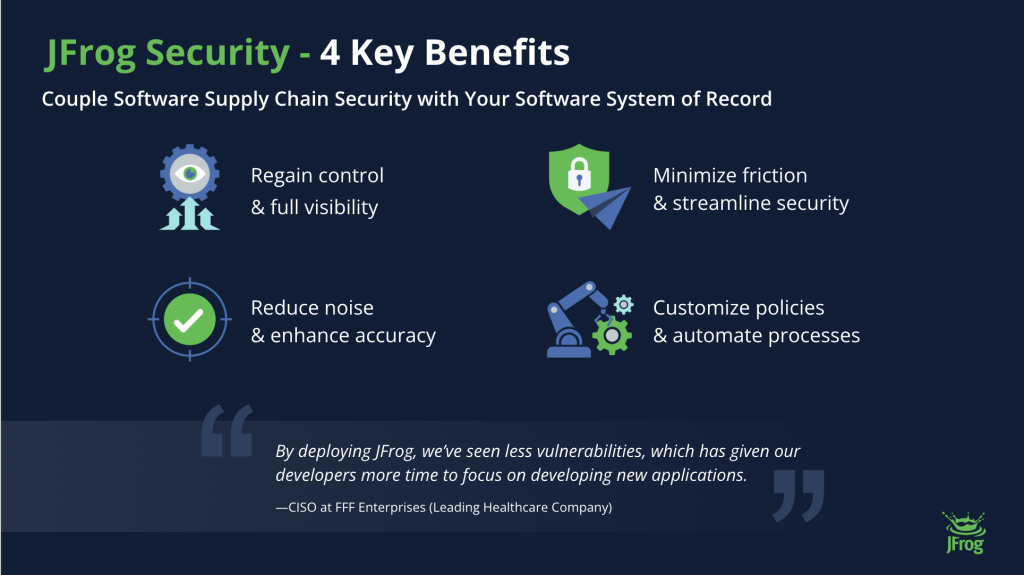
While vulnerabilities cannot be eliminated entirely, they can be managed effectively with the right tools and processes. JFrog Xray provides continuous scanning of binaries and dependencies to identify vulnerabilities before they are exploited. By integrating with the JFrog Platform, Xray enriches findings with metadata, usage context, and policies, allowing teams to prioritize remediation efforts that matter most.
With connections to SCA, vulnerability scanning, and full lifecycle management, JFrog ensures that vulnerabilities are detected, assessed, and remediated as part of an automated DevSecOps workflow. This reduces risk across the software supply chain and strengthens both compliance and resilience. With JFrog, software vulnerability