Definition
An MCP registry manages MCP servers and AI context services, including version control, access governance, lifecycle distribution, and policy enforcement. It provides a trusted framework for integrating AI-enabled tooling into development, automation, and operational workflows while enforcing organizational security, compliance, and software supply chain controls similar to those applied to traditional software artifacts. MCP registries are the essential connecting tissue of the ecosystem—transforming static models into active agents capable of executing real-world tasks.
Overview
Artificial intelligence is rapidly becoming embedded within modern software delivery pipelines. AI agents, developer copilots, automation assistants, and intelligent security tools are increasingly integrated into engineering workflows. While these integrations unlock productivity gains, they also introduce governance, security, and lifecycle management challenges.
MCP registries provide structured lifecycle management, discoverability, trust validation, and governance enforcement for AI context services. They help organizations adopt AI safely while preserving the integrity and transparency of the modern software supply chain.
Beyond improving discoverability, MCP registries provide visibility into how AI services are used across engineering ecosystems. This enables organizations to track adoption patterns, monitor usage risk, and enforce compliance requirements as AI becomes deeply embedded in development, deployment, and operational workflows.
As engineering environments become increasingly automated and AI-driven, registry-based governance helps organizations maintain consistency, enforce policy compliance, and reduce operational fragmentation across teams and environments—defining which servers are authorized for connection and providing the standardized schemas that dictate exactly how AI models interact with them.
Understanding MCP and MCP Registries
What MCP Means
MCP stands for Model Context Protocol, a standardized framework that enables artificial intelligence models to securely interact with enterprise tools, services, and data sources. MCP enables AI assistants to access contextual information, trigger automation workflows, and perform engineering tasks inside governed enterprise environments. Teams often pair registries with tools like an MCP inspector to test endpoints, validate permissions, and troubleshoot MCP client behavior during integration.
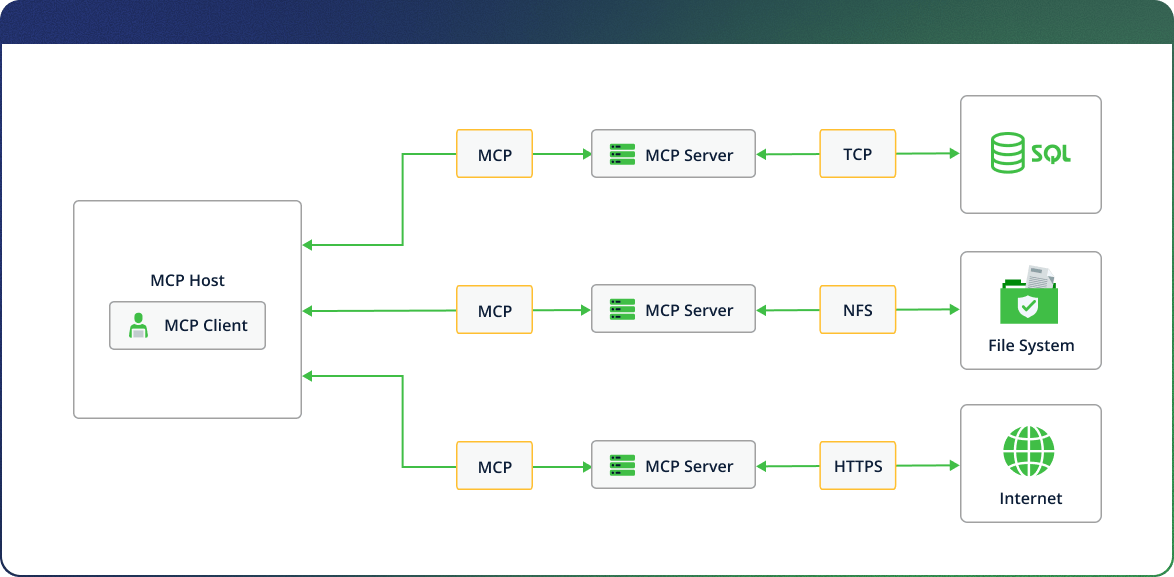
MCP General Architecture
Instead of operating in isolation, MCP-enabled AI systems effectively turn AI models into AI agents via the ability to:
- Retrieve data from code repositories and build systems
- Access infrastructure configuration and deployment environments
- Execute development and testing workflows
- Support security scanning and remediation automation
- Interact with monitoring and operational tooling
- Assist with dependency analysis and resolution
MCP servers act as integration endpoints that expose contextual capabilities to AI clients and AI applications. These servers provide secure interfaces that allow models to interact with enterprise systems while enforcing identity controls, authentication, and authorization policies.
By standardizing how AI systems interact with engineering environments, MCP reduces integration fragmentation and improves scalability across distributed teams and workflows.
What Does an MCP Registry Do?
An MCP registry provides centralized lifecycle governance for MCP servers and AI integration services, acting as the authoritative distribution and management layer for AI context services across an organization. Rather than allowing AI integrations to be deployed inconsistently across teams or environments, an MCP registry establishes a structured framework that ensures services remain discoverable, versioned, and governed throughout their lifecycle.
Through centralized discovery, development teams can locate approved MCP servers and reusable AI context capabilities without relying on ad hoc or unverified tooling. This improves consistency across development workflows and reduces duplication by enabling teams to build on validated integrations rather than creating new implementations independently. As organizations scale AI adoption, registries help maintain version compatibility across MCP services, ensuring that updates to AI integrations do not introduce breaking changes into production workflows.
Security and governance are also core functions of an MCP registry. By enforcing enterprise security standards and compliance policies, registries help organizations control which AI integrations developers and automation systems can access. Continuous monitoring capabilities provide visibility into how AI services are consumed across teams and environments, supporting operational oversight and reducing the risk of unauthorized or unapproved integrations. Audit trails and lifecycle traceability further strengthen governance by documenting how MCP servers evolve, who deploys them, and how they are used across development pipelines.
MCP registries also help standardize integration development practices by providing a single secure gateway to connect MCP servers. This standardization supports collaboration between platform engineering, security, and DevOps teams, enabling organizations to scale AI-enabled workflows while maintaining operational control. In many ways, MCP registries function similarly to centralized software artifact repository platforms that manage containers, packages, and binaries. However, MCP registries extend lifecycle governance into the AI integration layer, managing services that connect models to enterprise workflows, automation pipelines, and operational tooling.
Why MCP Registries Matter Now
The Transformation of Software Engineering
Software development is undergoing one of its most significant transformations since the rise of cloud computing and distributed architectures. Artificial intelligence is reshaping how software is designed, built, tested, deployed, and maintained, shifting engineering toward collaborative human-AI workflows. Modern teams are no longer solely writing code—they are coordinating intelligent systems that accelerate development, automate repetitive tasks, and generate actionable insights.
AI is now embedded across the software development lifecycle. Developers rely on AI-assisted coding tools that generate and optimize code, enabling faster iteration and reduced manual overhead. Testing and quality assurance are evolving through AI-driven automation that generates test cases, identifies edge conditions, and expands validation coverage. Security and compliance are also becoming more proactive as AI continuously evaluates code, dependencies, and infrastructure configurations to detect vulnerabilities earlier in development workflows.
Beyond task automation, AI is enabling autonomous automation agents capable of executing complex engineering workflows. These agents analyze dependencies, recommend remediation, automate build and deployment tasks, and support incident response. In operations environments, AI-driven monitoring platforms analyze telemetry data to detect anomalies, optimize resources, and predict failures, enabling highly automated and self-optimizing delivery pipelines.
At the same time, engineering environments are becoming more interconnected with open source ecosystems, third-party services, and external automation platforms. While these integrations accelerate innovation, they expand software supply chain complexity. AI services often require privileged access to repositories, databases, artifact registries, and infrastructure. Without centralized lifecycle governance, these integrations can introduce supply chain risk, expose sensitive data, and create inconsistencies across development environments, increasing the need for structured governance and trusted AI supply chains.
MCP Registries as Foundational AI Infrastructure
MCP registries provide structured governance that enables organizations to safely scale AI adoption across engineering workflows. They establish trust frameworks that ensure AI services are approved, versioned, monitored, and controlled throughout their lifecycle.
As AI becomes embedded in software delivery pipelines, MCP registries are emerging as foundational infrastructure that supports AI-enabled software ecosystems. They provide centralized governance and lifecycle management while enabling teams to safely adopt AI-driven automation without compromising security or compliance.
MCP Registries and the Software Supply Chain
The Expanding Software Supply Chain
Modern software supply chains now extend far beyond source code repositories. Delivery pipelines depend on open-source libraries, third-party dependencies, container images, infrastructure-as-code templates, automation tooling, and validation services operating across development, security, and operations environments. These interconnected components create complex dependency networks that require governance, validation, and continuous monitoring to maintain secure software delivery.
Open-source ecosystems accelerate innovation but introduce inherited risk. Vulnerabilities, licensing conflicts, or malicious code can propagate across applications if dependencies are not properly governed. Containerization and infrastructure-as-code further expand supply chain scope by converting infrastructure and deployment configurations into versioned artifacts that require lifecycle governance to ensure integrity, traceability, and compliance across environments.
CI/CD pipelines and automation tooling increase delivery velocity while adding additional supply chain complexity. Policy enforcement and validation services help maintain security and operational standards but require centralized oversight to preserve trust across distributed systems.
Artificial intelligence introduces a new category of supply chain dependencies through AI agents, automation services, and model-integrated tooling that interact directly with development pipelines and infrastructure platforms. Today, every developer leverages AI-assisted development to build software that integrates AI assets as core components. Without structured governance, these integrations can introduce risks such as unauthorized automation, data exposure, and unvalidated services.
Organizations have addressed similar complexity challenges through centralized artifact management platforms that govern binaries, packages, and containers throughout the software development lifecycle. MCP registries extend these governance models into AI integration layers by providing lifecycle management, policy enforcement, discoverability, and traceability for AI context services, supporting secure and compliant AI-enabled software delivery.
Governance and Trust for MCP Servers
MCP servers introduce new supply chain risks, including unauthorized plugins, malicious automation services, and uncontrolled data access. MCP registries mitigate these risks by enabling organizations to:
- Validate MCP server authenticity and source integrity
- Maintain version-controlled AI integration services
- Enforce enterprise governance policies with a 3-layered permissions structure:
- Which MCP servers are available?
- Who can access them?
- How can they be used?
- Track distribution and usage history across environments
- Provide transparency into integration dependencies and AI service interactions
By extending supply chain governance to AI context services, MCP registries transform AI integrations from unmanaged tooling into governed, traceable software components.
How MCP Registries Fit Into DevOps Workflows
MCP servers function similarly to software artifacts. As reusable, versioned services that integrate into development pipelines and automation workflows, they require lifecycle governance and security validation aligned with modern DevSecOps practices.
Development Workflows
Developers increasingly use AI models connected through MCP servers to accelerate development workflows. MCP registries provide centralized discovery for approved integrations, ensuring development teams use validated AI services aligned with enterprise policies and platform engineering standards.
Centralized registry management promotes consistent tooling across development teams. It reduces onboarding complexity and enables organizations to standardize development workflows across distributed engineering environments.
CI/CD Pipeline Integration
MCP-enabled services integrate into build, testing, and release pipelines. MCP registries provide version control, compatibility validation, and lifecycle governance, ensuring pipelines operate using trusted integrations that maintain predictable behavior across environments.
Integration with DevSecOps workflows enables AI services to undergo validation, scanning, and approval processes consistent with traditional software components. Registry governance supports automation by enabling policy-based validation before pipeline execution.
Production and Operational Workflows
AI agents increasingly support operational workflows such as monitoring, incident investigation, performance optimization, and automated remediation. MCP registries provide governance controls that ensure only trusted integrations operate in production environments.
Registry-based approval workflows, access controls, and version governance reduce the risk of unauthorized AI services interacting with operational systems. Registry audit logs also improve transparency and support regulatory compliance requirements.
How MCP Registries Address Security and Governance Challenges
Trust and Integrity Validation
AI services embedded within delivery pipelines require authenticity verification. MCP registries support signing, certification, and curation workflows that ensure MCP servers originate from trusted providers and meet enterprise security policies.
Policy Enforcement and Access Control
Organizations must control which MCP servers developers and automation agents can access. MCP registries enforce governance through:
- Role-based access policies
- MCP tools permissions
- Integration approval workflows
- Environment-specific deployment controls
- MCP authentication enforcement
- Identity and authorization controls across MCP clients and MCP apps
These governance capabilities ensure AI integrations align with enterprise security policies and regulatory frameworks.
Auditability and Compliance
Regulatory frameworks increasingly require visibility into automation workflows and AI service usage. MCP registries provide audit trails that track:
- MCP server deployment and usage patterns
- Authentication and access events
- Integration lifecycle and version changes
- AI agent activity across development and production workflows
This visibility helps organizations maintain accountability and demonstrate compliance with security and governance requirements.
Preventing AI Supply Chain Attacks
AI integrations introduce emerging attack vectors, including malicious plugins, shadow AI usage, and unauthorized automation tooling. MCP registries mitigate these risks by enforcing centralized governance, integration validation, and lifecycle monitoring across AI services.
MCP Registries and AI-Native Software Development
Artificial intelligence is evolving from assistive tooling into autonomous workflow agents capable of executing complex engineering and operational tasks.
Expanding AI Responsibilities
AI systems increasingly support:
- Automated build and deployment assistance
- Security remediation and vulnerability analysis
- Dependency resolution and automated upgrades
- Operational monitoring and predictive incident response
- Intelligent automation across distributed DevOps pipelines
These capabilities require standardized integration infrastructure. MCP registries provide governance frameworks required to scale AI adoption while maintaining operational oversight, acting as a verification layer that enables systemic trust.
Standardization and Oversight
Without centralized registry management, AI integrations can proliferate across organizations without consistent governance, creating a vacuum where “rogue agents” become a liability. In such unmanaged environments, an AI agent could execute unauthorized or destructive commands that compromise the company environment or result in significant operational harm.
MCP registries mitigate these risks by enabling enterprises to standardize AI integrations and enforce strict policy and permission controls. This ensures consistent behavior across teams and workflows while providing visibility into MCP client usage and application integrations essential to maintaining a secure, trusted ecosystem.
Benefits of MCP Registries for Enterprise DevSecOps Teams
MCP registries offer the following benefits:
Benefit #1: Single Source of Truth
MCP registries provide a unified discovery platform that allows organizations to identify and adopt approved AI integrations while reducing duplication across engineering teams.
Benefit #2: Accelerated AI Adoption
By centralizing access to validated MCP servers, organizations can accelerate AI adoption and ensure developers are using consistent, trusted integrations across workflows.
Benefit #3: Strengthened Supply Chain Security
Registry governance strengthens software supply chain security by extending established artifact governance practices to AI integrations. MCP registries help ensure services are validated, versioned, and monitored throughout their lifecycle, reducing the risk of introducing vulnerable or untrusted automation services into development and operational environments.
Benefit #4: Improved Visibility and Compliance
Unmanaged AI tooling can introduce significant compliance and security risks, particularly when teams independently adopt integrations without oversight. MCP registries improve visibility into AI usage across the organization and help reduce unauthorized or unapproved integrations by enforcing centralized governance and access controls.
Benefit #5: Standardized Infrastructure
Standardized registry infrastructure also accelerates AI service integration across CI/CD pipelines and operational workflows. By providing version-controlled, reusable MCP services, registries simplify deployment and allow teams to incorporate AI-assisted tooling more quickly while maintaining consistency across environments.
Benefit #6: Enhanced Team Collaboration
MCP registries support collaboration between platform engineering, security, and development teams by establishing shared governance standards. This alignment enables organizations to scale AI adoption while maintaining security, consistency, and operational control across distributed software delivery environments.
Best Practices for Managing MCP Registries Securely
Organizations should manage MCP servers using lifecycle governance practices similar to those applied to traditional software components. Implementing these practices offers several key benefits:
- Treating AI assets as governed artifacts improves traceability, version control, and risk management across AI-enabled integrations.
- Applying transparency frameworks such as Software Bills of Materials (SBOMs) strengthens dependency visibility and helps organizations maintain stronger supply chain governance.
- Restricting access to MCP servers through least-privilege principles reduces the risk of compromised AI tools or unauthorized automation workflows gaining entry to sensitive systems, repositories, or infrastructure environments.
- Enforcing governance by embedding it directly into CI/CD pipelines ensures MCP servers undergo automated validation before reaching production. By enforcing policy checks during build and deployment stages, organizations can detect vulnerabilities, misconfigurations, or unauthorized integrations early in the software delivery lifecycle.
- Continuous monitoring of registry usage further strengthens governance by providing visibility into how MCP services are consumed across teams and environments. Monitoring activity helps identify outdated integrations, unauthorized usage patterns, and emerging security risks before they impact operational systems.
- Aligning registry practices with established software supply chain security frameworks such as Supply-chain Levels for Software Artifacts (SLSA) and SBOM initiatives improves traceability, auditability, and regulatory readiness across AI-enabled development ecosystems.
Finally, it’s important to mention that an MCP registry provides limited value in isolation, functioning merely as a directory for traffic management between models and enterprise systems. To be truly effective, the registry must be deeply integrated into a broader software development lifecycle (SDLC) platform. This integration provides the essential context—such as project ownership, environment variables, and deployment stages—required to build and orchestrate agents properly. By tethering the MCP registry to the SDLC, organizations move from simple connectivity to context-aware governance that understands which agent is calling which tool, and for what specific purpose.
The Future of MCP Registries in the Software Supply Chain
Artifact registries fundamentally transformed DevOps by enabling centralized lifecycle management for packages, containers, and infrastructure artifacts. MCP registries represent the next evolution of this model by extending governance into AI integration layers, where AI services, automation workflows, and contextual tooling become part of the software delivery ecosystem.
As AI agents begin executing increasingly autonomous development and operational workflows, organizations require governance infrastructure capable of managing AI context services across development pipelines. MCP registries support these evolving requirements by providing traceability, policy enforcement, and lifecycle oversight across AI integrations, helping organizations adopt AI-driven development practices while maintaining governance, auditability, and operational trust. Software supply chain platforms are uniquely positioned to extend registry governance into the AI era, enabling organizations to safely scale AI-native development practices.
MCP Registries and the JFrog Platform
As AI integrations become embedded across development pipelines, organizations require governance models that extend beyond traditional artifacts. MCP servers introduce a new layer to the software supply chain that must be versioned, secured, and monitored with the same rigor applied to packages, containers, and infrastructure components.
The JFrog Software Supply Chain Platform provides a unified software supply chain solution designed to manage artifacts, dependencies, and security policies across the entire development lifecycle. By extending trusted artifact management and governance capabilities, the platform helps organizations store, secure, and distribute MCP servers alongside other software components while maintaining visibility, traceability, and compliance across environments.
With integrated vulnerability analysis, policy enforcement, and lifecycle governance, JFrog enables teams to safely incorporate AI-driven services into DevSecOps workflows. By correlating artifact intelligence, runtime visibility, and supply chain metadata, organizations gain deeper insight into how AI integrations interact with production systems and development pipelines.
As AI-native development continues to evolve, platforms capable of unifying software artifacts, automation services, and AI context integrations will play a critical role in enabling trusted, scalable software delivery.
For more information, please visit our website, take a virtual tour, or set up a one-on-one demo at your convenience.