NVIDIA
  Cursor
  GitHub


 Docker
  Maven
Maven  Financial Services
  Public Sector
  Technology
  Healthcare
  Gaming
  Automotive
  Enterprise


JFrog VS. Snyk:
AppSec Solution Comparison
JFrog is a full software supply chain security platform, while Snyk primarily focuses on source code scanning, which leaves critical gaps across binaries, containers, and runtime artifacts. JFrog secures everything you build, ship, and run- going beyond bolted-on, single-purpose AppSec tools that flood developers with alerts while creating blind spots. With native, full-featured application security for code, packages, binaries, containers, and runtime images, teams can move fast without sacrificing trust.
By deploying JFrog, we’ve seen less vulnerabilities, which has given our developers more time to focus on developing new applications. And with the different development teams all being on the same platform, it has centralized and streamlined the process.
See how JFrog Compares to Snyk
Please note that the following research findings reflect information that is available to the public and is to our best understanding.
JFrog

Snyk
Single System of Record for Software Supply Chain


Comprehensive Software Composition Analysis (SCA)
Binary Scanning (Secrets included)
Intelligent Prioritization with CVE Contextual Analysis
Partial
(source reachability only)
Preemptive Blocking of Risky/Malicious 3rd-party Components
End-to-end Release Integrity
Deciding between JFrog and Snyk?
See JFrog's unique advantages
JFrog is a holistic software supply chain security platform chosen by leading security, DevOps and development experts and practitioners around the globe
Protection beyond source code - It’s a binary difference
Unlike code-only approaches, JFrog secures everything from the first lines of code, to binaries, packages, containers and their dependencies. We make sure nothing risky enters your SDLC and, in addition to table-stakes (yet top-notch) AppSec scanners, offer advanced AI capabilities for the models you create, and the AI you use.
AppSec that is integrated in the pipelines, not bolted on
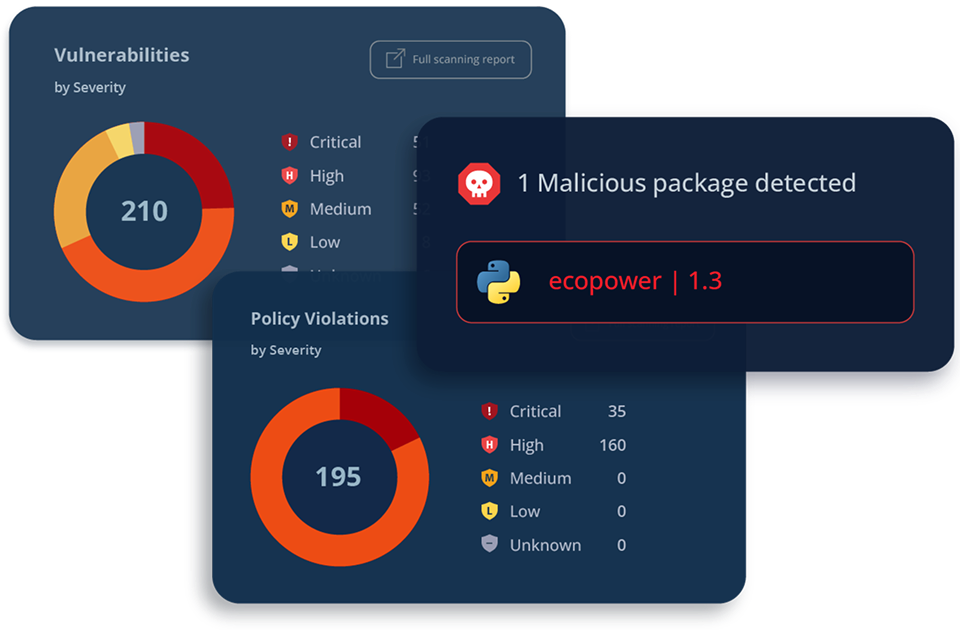
JFrog’s security solutions are an integral part of our Software Supply Chain Platform. With Artifactory acting as the single source of truth for managing all your organization’s software artifacts, models, containers, and more, JFrog’s security solutions integrate seamlessly into your existing DevOps pipelines and best practices. Say goodbye to silos and friction.
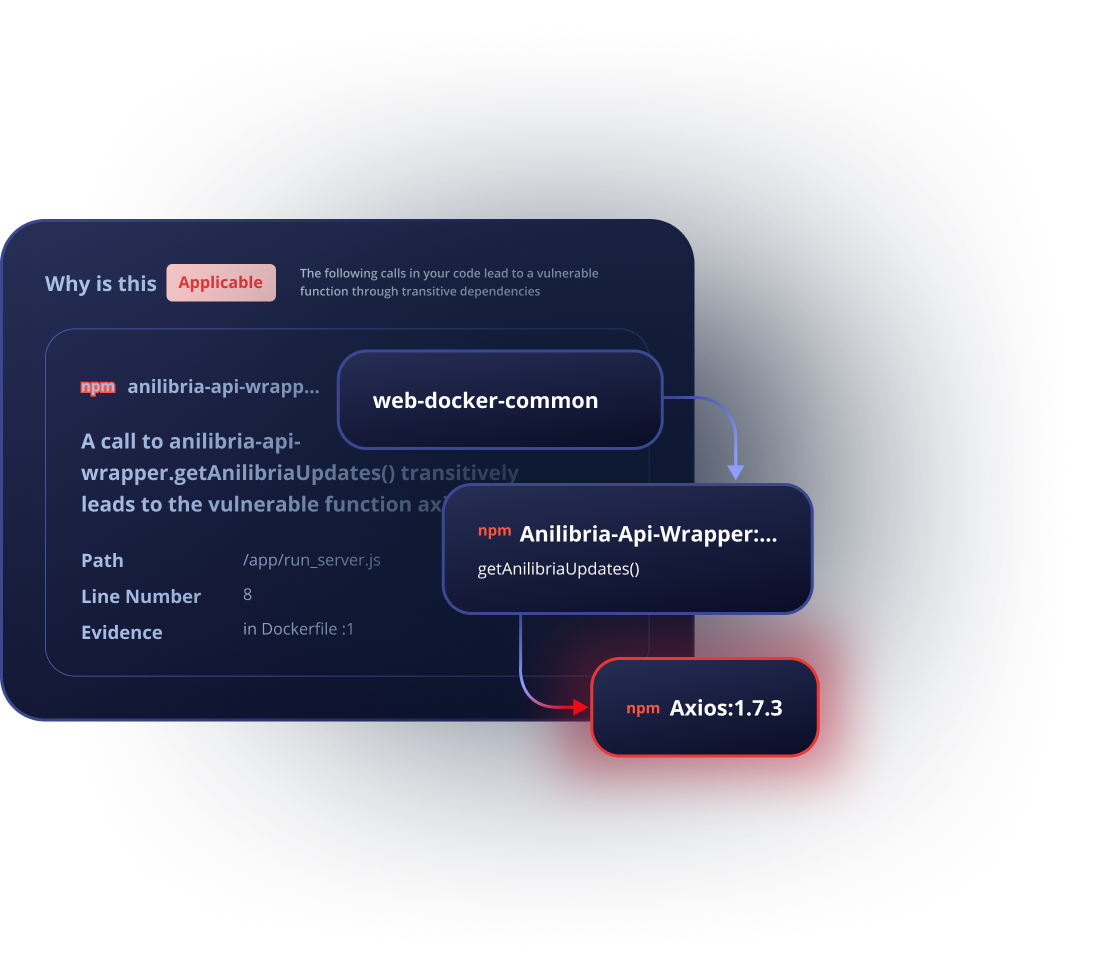
Remediation with JFrog Compared to Snyk
Rather than prioritizing vulnerabilities based solely on code-level analysis, JFrog prioritizes risk using application and artifact-aware context, analyzing code, binaries and container images with transitive contextual analysis. We highlight the vulnerabilities that are actually applicable, and offer remediation guidance.
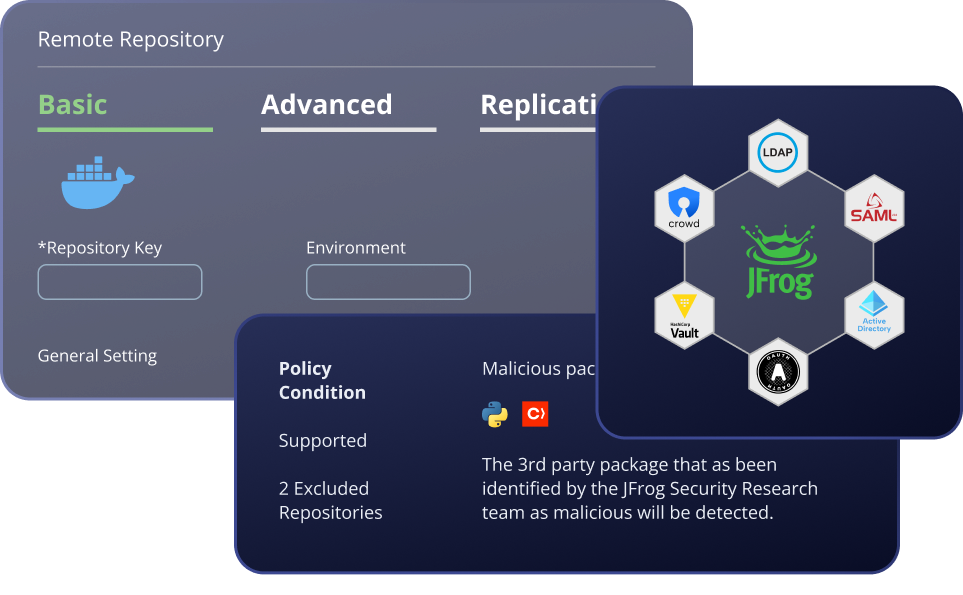
How JFrog Delivers AppSec Across the Software Supply Chain
Modern application security requires an integrated platform, not point solutions. In an era of AI-driven development, JFrog unifies artifact management, security scanning, governance, and runtime security into a single platform

Security Built for Developers
Secure your software from code to production with JFrog’s SAST, SCA, IaC, Secrets scanners and Runtime security – powering governance and control across the SDLC, both source code and binary. All that while working with developers and their tools of choice

Prevent Risk Before it Hits Your SDLC
Block malicious or risky third party software from entering your SDLC and ensure developers are building with only vetted third-party components: Packages, models, IDE extensions and more are all curated by JFrog.

The Binary difference in AppSec
Scan your binaries, as they represent the final product and its actual attack surface. JFrog ensures your applications have no hidden vulnerabilities, addressing the same binary-level security concerns attackers target.

AI/ML Security
Secure the AI you build, use AI securely. JFrog helps you do both by managing, scanning and governing your models, uncovering shadow AI, providing an AI security catalog and offering advanced AI capabilities that simplify and expedite your AppSec.
Research powered AppSec
JFrog’s Security research team is a CVE Numbering Authority (CNA). Our security products and cutting-edge innovation stem from extensive technological and community-driven research. We’re constantly on the lookout for the most recent threats and the best technological advancements to combat them.
Why Leading Companies Choose JFrog
Security
Developers
Leaders
DevOps
AI/MLOps
IoT
I follow the basic principles for AppSec -- Prevent, Detect, Remediate. And when I look at the offerings from JFrog, they're checking those boxes for me.
James Carter, Distinguished Engineer, Deloitte
We wanted to figure out what can we really use instead of having five, or six different applications. Is there anything we can use as a single solution? And Artifactory came to the rescue. It turned out to be a one-stop shop for us. It provided everything that we need.
Keith Kreissl, Principal Developer, Cars.com

By deploying JFrog, we’ve seen less vulnerabilities, which has given our developers more time to focus on developing new applications. And with the different development teams all being on the same platform, it has centralized and streamlined the process.
Billy Norwood, CISO, FFF Enterprises
Since moving to Artifactory, our team has been able to cut down our maintenance burden significantly…we’re able to move on and be a more in depth DevOps organization.
Stefan Kraus, Software Engineer, Workiva
Before… delivering a new AI model took weeks... Now the research team can work independently and deliver while keeping the engineering and product teams happy. We had 5 new models running in production within 4 weeks.
Idan Schwartz, Head of Research, Spot (by NetApp)
As our business grew, JFrog Connect helped us enhance our operations. Being able to automate and push software updates across multiple devices at once saves us time and resources with each version we deployed. When you consider the cost of an engineer’s time, it was an easy call.
Senior Manager, DevOps, Telehealth
-
How does JFrog compare to Snyk?
JFrog offers a significant advantage over Snyk in terms of vulnerability detection. JFrog Xray is a software composition analysis (SCA) engine that scans an artifact’s binaries, which is effective at uncovering vulnerabilities that source code scanning alone won’t detect. Snyk’s vulnerability detection relies on SBOM metadata obtained from package managers. However, in reality, not all packages are installed through package managers or contain such metadata, causing these tools to overlook critical vulnerabilities. Most importantly, JFrog offers an AppSec solution suite that is seamlessly built into the software system of record. Snyk requires an integration with the underlying devops platform.
-
Can I migrate from Snyk to JFrog?
It is possible and straightforward to migrate from Snyk to JFrog. Migration would involve re-scanning software artifacts in Artifactory using Xray and generating updated results, along with new SBOMs for each artifact.
-
Why choose a platform-based AppSec solution over point tools?
A platform-based application security approach enhances both protection effectiveness and developer productivity when compared to juggling separate security tools with limited visibility and function. Teams relying on disconnected point solutions frequently face challenges including fragmented workflows, significant overhead from managing multiple integrations, and gaps in security visibility throughout the development process. Conversely, AppSec capabilities—such as static code analysis, dependency scanning, secrets detection, and vulnerability management—natively embedded in the development platform yields meaningful advantages. Security and engineering teams work from consolidated interfaces and cohesive workflows, eliminating the drag of switching contexts across isolated systems. Most significantly, this native platform methodology ensures complete security observability across the entire software delivery chain, removing the coverage gaps inherent in piecemeal tool deployments.
-
Does JFrog do source code scanning like Snyk?
JFrog provides source code scanning (alongside artifact scanning) through Xray’s advanced dependency security features. Additionally, JFrog Advanced Security (JAS) includes a proprietary static code analysis engine that examines application source code to detect CVEs.
-
What is binary scanning and why does it matter?
The software supply chain has one core asset that is delivered into production: the software binary (or software package). Therefore, today’s attackers try to reverse-engineer, break, or entice the shipment of compromised binaries, as they contain more information than source code alone. JFrog’s security tools and research focus on the binary level, revealing issues that are not visible in source code alone, providing a full picture of any impact or point of exploitation. Binaries can contain keys, configurations, and more that may expose a business.