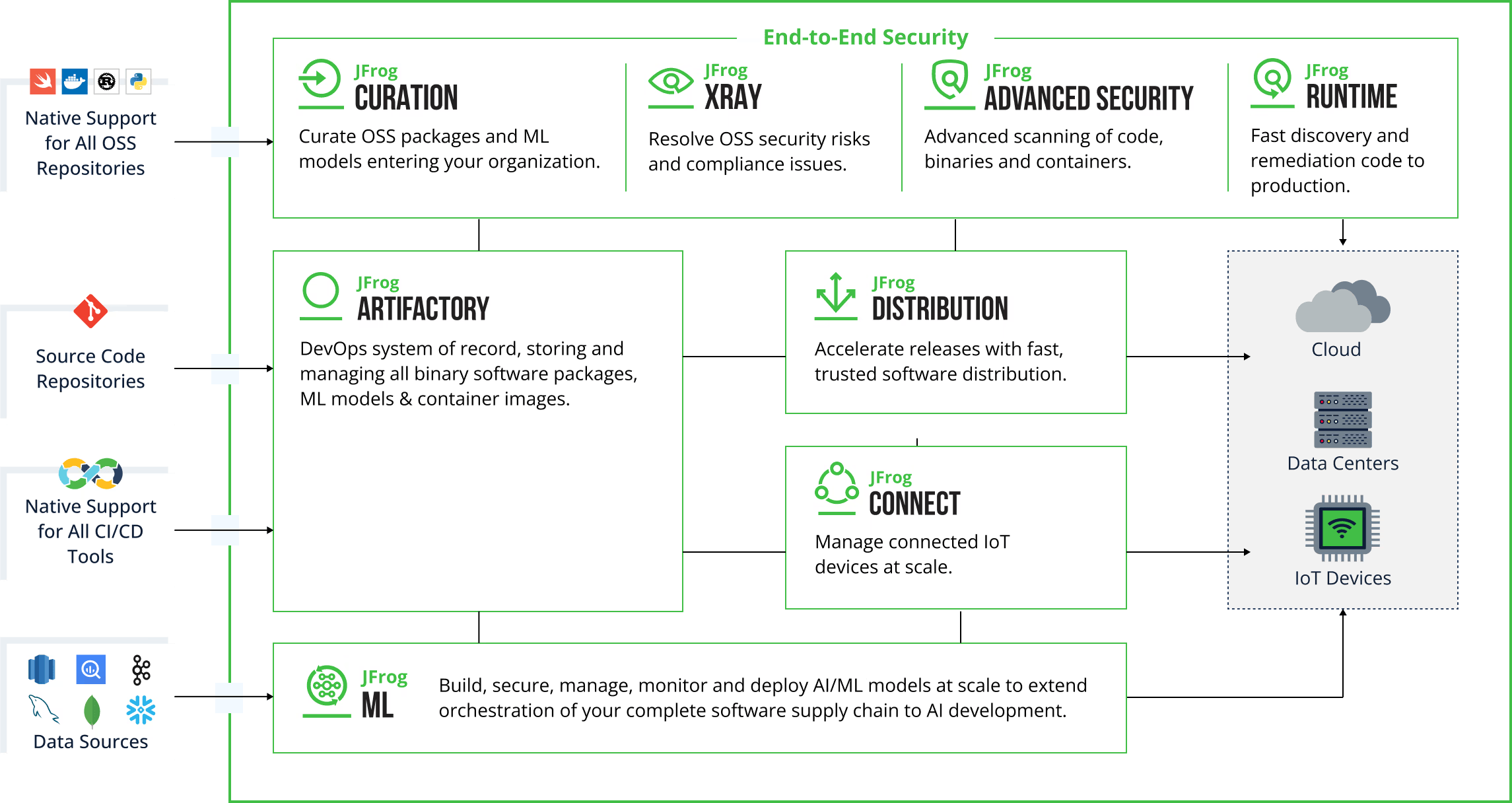
JFrog immunizes what agents consume and controls how they build and deploy — every AI model, agent skill, plugin, MCP server, package, and AI-generated artifact, governed in a single source of truth.
A trusted agentic workforce.
This is AgentSecOps.
La fiabilité de vos agents dépend entièrement de ce qu’ils ingèrent, produisent et diffusent. JFrog gouverne chaque modèle d’IA, compétence d’agent, serveur MCP, code généré par l’IA et artefact assemblé dans une source unique de vérité. Sécurisez l’ensemble de votre chaîne d’approvisionnement logicielle agentique afin de pouvoir livrer des logiciels fiables à votre nouvelle vitesse.
The universal and adaptable JFrog Platform solves essential cross-industry agentic software supply chain challenges.
Accelerate software delivery while meeting strict regulatory standards like HIPAA and FedRAMP
platform for container orchestration, enables organizations to deploy, manage, and scale applications easily. Read Less >
In a typical scenario, a development team might build a microservice and create a Docker image using a CI/CD tool integrated with JFrog Artifactory. Once the Docker image is built, it can be pushed to Artifactory, where it is stored alongside its specific version. When deploying to OpenShift, the platform fetches the required image from Artifactory, ensuring that the exact version is used in production.
The integration between JFrog and OpenShift effectively enhances the management of containerized applications by providing a unified platform for artifact management, continuous integration, and security scanning. This combination streamlines the development and deployment processes, improving operational efficiency and ensuring the consistency and reliability of software releases.
Yes, the integration between JFrog and OpenShift facilitates the automation of CI/CD pipelines. By using JFrog’s tools, such as JFrog Pipelines or integration with CI/CD servers like Jenkins, teams can automatically build container images, push them to Artifactory, and trigger deployments in OpenShift. This ensures a seamless workflow from code commit to deployment in a containerized environment.
Using JFrog Artifactory as a proxy for remote container registries in OpenShift offers several benefits, including faster and more reliable builds. Artifactory caches images from remote registries, reducing the need for external calls during builds and improving build times. It also provides a centralized management solution for all container images, allowing teams to enforce versioning, access control, and security scanning. Additionally, this setup ensures that teams can maintain a consistent and controlled environment by managing all dependencies and artifacts in one place.
JFrog Xray enhances security in OpenShift deployments by scanning container images and their dependencies for known vulnerabilities and license compliance issues. When integrated with OpenShift, Xray automatically analyzes images stored in JFrog Artifactory. This proactive approach allows teams to identify and mitigate potential security risks before deploying applications to production environments.
Yes, JFrog Artifactory can manage Helm charts used in OpenShift deployments. By storing Helm charts in Artifactory, teams benefit from version control and easy distribution of application packages. OpenShift can pull these Helm charts directly from Artifactory during deployments, ensuring that the correct versions are used and simplifying the management of Kubernetes applications.
Votre action a été une réussite
Veuillez réessayer plus tard
Message modal