Subsidiaries and Vendors
Overview
Organizations working with subsidiaries or vendors isolate each group’s work on dedicated JFrog Platform sites, separate from the main organization. Each site may be JFrog SaaS or self-managed.
Why
- External and semi-autonomous parties stay off the parent organization’s full platform site
- The parent scopes each relationship, including permissions and compliance boundaries
- The main site stays simpler to operate and remains the system of record, with selective outward sharing
How
- Run a main JFrog Platform site for the parent organization only
- Run one or more dedicated sites for subsidiary and vendor work, separate from the main site. Each dedicated site may be JFrog SaaS or self-managed
- A dedicated site is not necessarily one per entity. Choose per site when a hard boundary is required, or per project on a shared dedicated site. Each entity then gets its own project for users, repositories, and permissions
- Keep subsidiary and vendor work off the main site unless the sites are explicitly connected. Approved artifacts can flow with repository federation, release bundles, or a similar pattern. This is close to CI/CD Separation, driven by organizational boundaries
Considerations
- Choose site-level or project-level separation per relationship. Federation is subject to multi-site limitations
- Platform Federation syncs every project and access entity across its member sites, so it fits when those sites share one access model. When each site needs its own users or permissions, use Access Federation with filters. Selective artifact sharing stays on repository federation
- Not every repository on a dedicated site needs to connect to the main site
Architecture
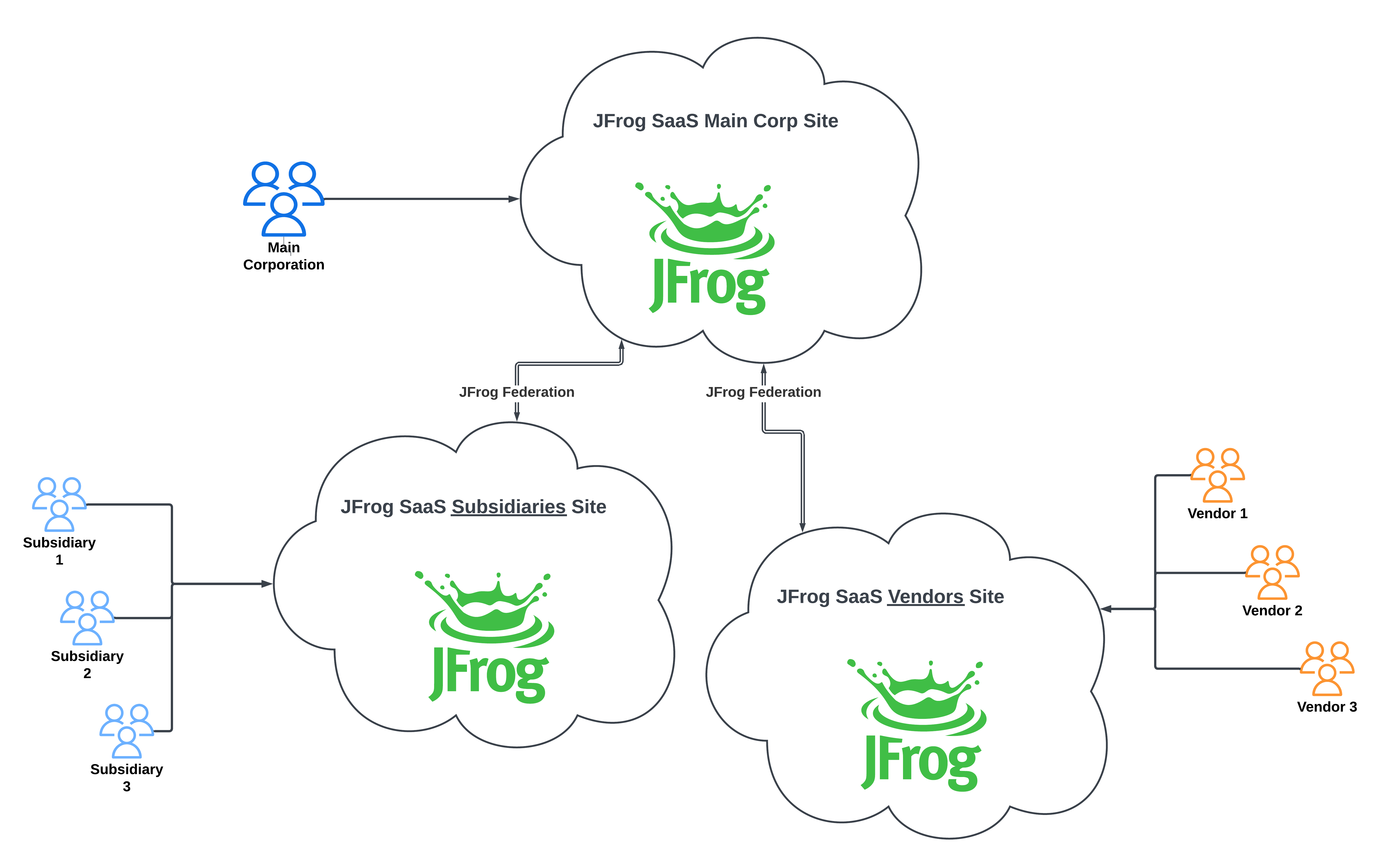
The following is a schematic high-level architecture of this topology.
The diagram shows the SaaS form. A self-managed deployment uses the same split between a main site and dedicated sites.