Archiving
Smart Archiving
JFrog Smart Archiving is a solution designed to manage the lifecycle of development artifacts that are no longer in active use but must be retained for compliance, audit, or historical purposes.
It provides organizations with the flexibility to define granular policies that determine which packages to archive and when. This process is fully automated and ensures that all essential metadata, security attestations, and compliance data are preserved and remain fully accessible for restores if and when needed.
Why Smart Archiving? The Cost of “Digital Dust”
As development repositories grow, they accumulate “Digital Dust”—a build-up of obsolete releases, end-of-life artifacts, and orphaned dependencies. This unmanaged data, a lot of which cannot be simply deleted, creates significant and escalating business friction.
The “cost” of this dust is not just financial; it impacts the entire organization:
- Productivity Drain: Developers face slowdowns as CI/CD pipelines lag. Locating current, trusted artifacts becomes a “needle in a haystack” problem, wasting valuable engineering time.
- Performance Brake: Bloated repositories slow down release cycles, degrade overall system performance, and can increase failure rates in production.
- Security & Compliance Holes: Every unmanaged artifact expands the potential attack surface. This “dust” creates a significant, unmonitored risk of failed audits and security vulnerabilities.
- Financial Tax: The direct cost of storing and transferring this ever-growing, inactive data is a continuous and unnecessary financial drain.
The Solution: Three Pillars of Trust
Smart Archiving is designed to turn this “Digital Dust” into a managed, compliant, and trusted archive.
The solution is built on three core pillars:
- Ensure Bulletproof Compliance & Security
- Full Traceability: Generates detailed reports (e.g., “what would be archived?” and “what was archived?”) to provide a clear audit trail.
- Dry Run Capability: Allows teams to test and validate policies without moving any data, ensuring policy accuracy before execution.
- Seamless Retrieval: All metadata and evidence are preserved and remain available, ensuring you can prove compliance instantly.
- Improve Operational Efficiency
- Optimized Repositories: By moving inactive data, active repositories remain lean, fast, and responsive.
- Performance Gains: Directly reduces CI/CD pipeline friction and improves overall developer velocity.
- Global Compatibility: Fully compatible with federated repository setups, ensuring a consistent policy framework everywhere.
- Unlock Scale Barriers
- Fully Automated: A “set-it-and-forget-it” policy engine that runs automatically, requiring no manual intervention.
- Granular Control: Policies are project-scoped, allowing different teams and services to set archiving rules that make sense for their specific compliance and operational needs.
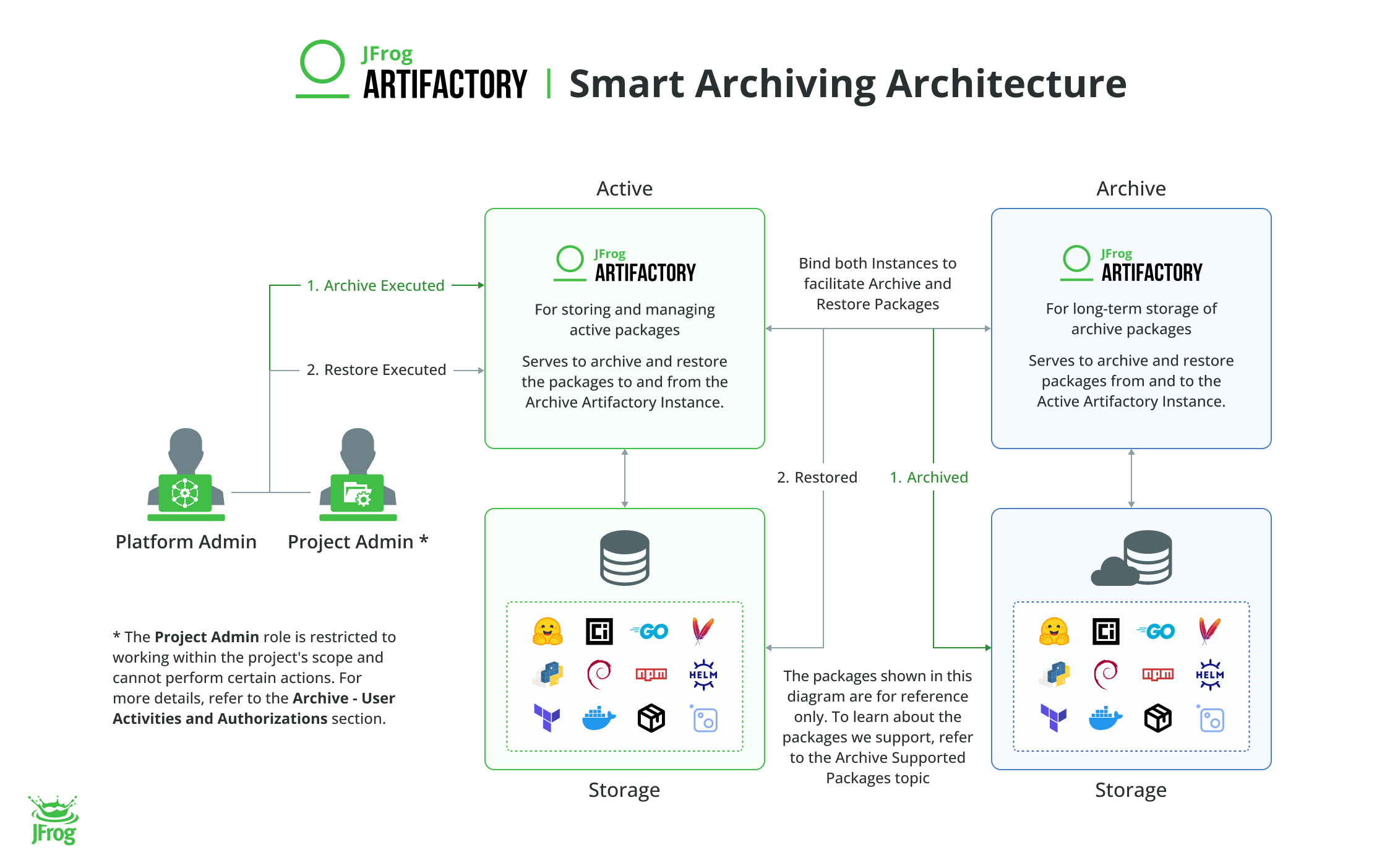
Architecture
The following is a schematic high level architecture of such a deployment.