Claude
  Cursor
  Codex
Codex  Hugging Face
  NVIDIA
  Visual Studio Code
  Devin
Devin  Kiro
Kiro  Open Code
  NanoClaw
 Docker
  npm
npm  PyPy
PyPy  Wiz
Wiz 
 金融サービス
  ゲーム・エンタメ
  公共部門
公共部門  自動車
自動車  テクノロジー
  ヘルスケア
ヘルスケア 


Definition
AI Trust, Risk, and Security Management (AI TRiSM) is a governance framework designed to evaluate, secure, and monitor artificial intelligence systems throughout their operational lifecycle. It combines risk assessments, data protection controls, and runtime guardrails to address unique failure modes like hallucinations, algorithmic bias, and prompt injection attacks. By enforcing traceability and continuous compliance across development pipelines, organizations minimize security vulnerabilities while maintaining regulatory alignment and stakeholder trust.
Overview of AI TriSM
AI TRiSM (AI Trust, Risk, and Security Management) is a framework created by Gartner that provides AI governance, security, and risk assessment. AI TRiSM works by combining the controls that are used to secure and govern AI into a single model.
AI TRiSM plays a key role in DevSecOps, specifically with traditional machine learning (ML) models, GenAI/LLMs, and agentic systems. TRiSM also plays a role throughout the lifecycle of an agent, from data to development to deployment to runtime to operations to retirement.
Trust, risk, and security in AI
- Trust: An AI model is considered trustworthy based on the reliability, robustness, explainability, and fairness of its outputs.
- Risk: Governance, accountability, validation, and monitoring help prevent threats such as data leakage, algorithmic bias, and model hallucinations.
- Security: Data protection, access control, and adversarial resilience are key parts of preventing unauthorized access and attacks, including data poisoning.
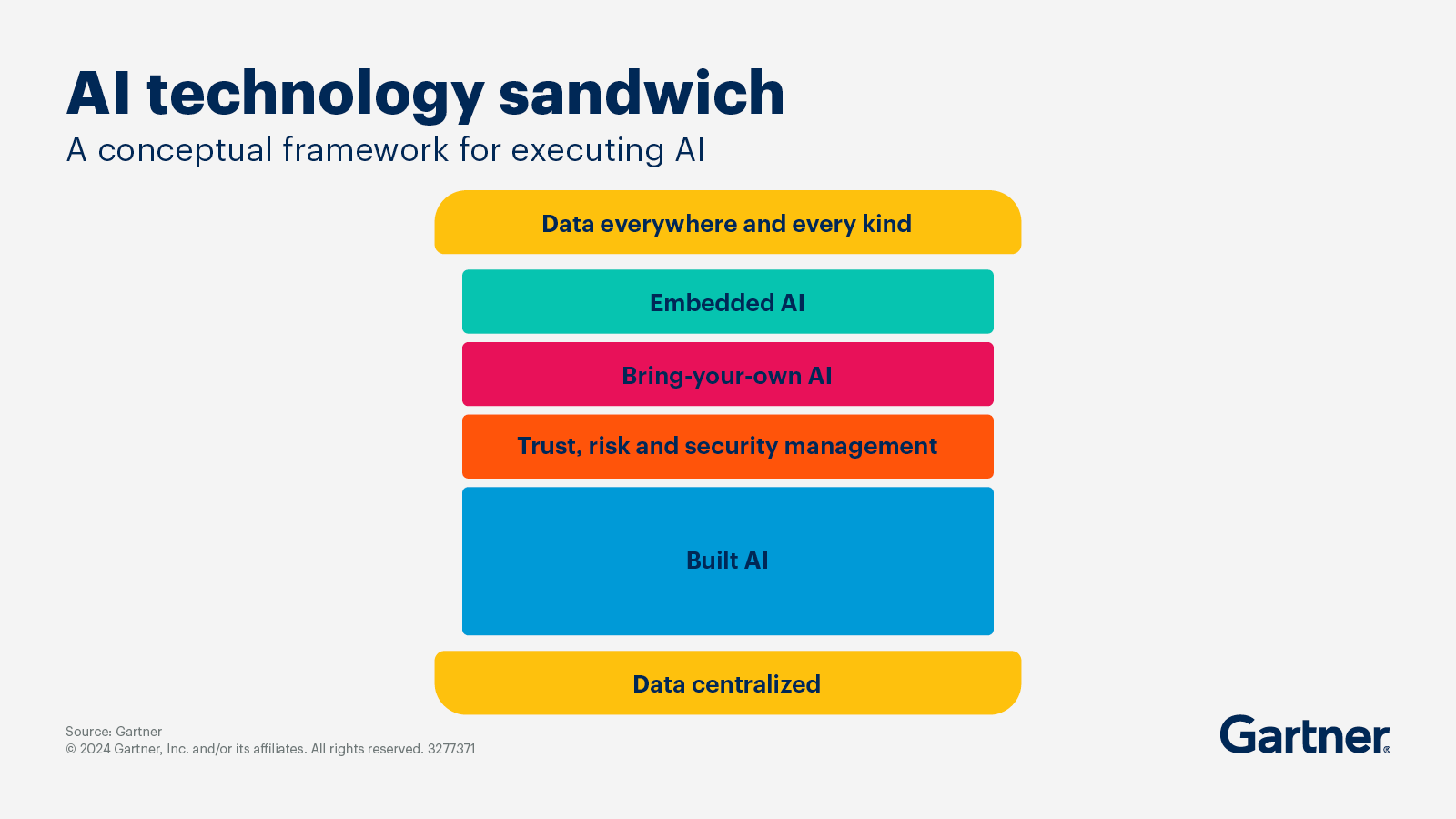
Diagram of an AI technology sandwich, by Gartner
Importance of managing AI frameworks
Effectively managing AI frameworks offers many benefits. Having guardrails in place results in faster scaling from pilot to production, resulting in faster scaling from pilot to production to save time and money. Managing AI frameworks also helps you stay prepared for audits with evidence capture as a built-in capability, so you’re not scrambling to respond to an audit. Plus, continuous controls lead to better reliability and lower incident rates, so you’re less likely to encounter issues integrating AI into software development.
Why is AI TRiSM Important?
From reducing shadow AI usage to regulatory compliance, there are countless reasons the AI TRiSM framework is important to your organization.
Impact of AI risks on businesses and society
AI risks can impact businesses and society in a number of ways, including:
- Business risks: Customer harm, brand and reputation damage, downtime, fraud, incorrect decisions, cost blowouts
- Societal risks: Discrimination, misinformation, privacy violations, safety impacts
When you couple these risks with the fact that failure modes like hallucinations and emergent behavior are AI-specific, AI TRiSM tools become even more important.
Regulatory compliance and ethical considerations
Because AI is relatively new, legal expectations are evolving rapidly across global and regional markets—such as the EU Cyber Resilience Act 2026 reporting obligations, as well as various U.S. federal and state frameworks. AI TRiSM makes it easier to comply with these expanding regulations, whether they relate to risk tiering, documentation, transparency, accountability, or safety. Aligning with internal ethics principles such as fairness, privacy, and human oversight is also an important aspect of maintaining societal trust with AI. Measurable controls and retained evidence play a key role in proving due diligence.
What is the role of AI TRiSM in building consumer trust?
With the potential for hallucinations and misinformation with AI, building consumer trust can be a challenge. AI TRiSM helps you build consumer trust by making AI behavior more predictable and explainable, which in turn makes outputs more trustworthy. Demonstrating safeguards like monitoring, escalation, and incident response can also aid in building consumer trust. “Surprise” failures can also erode customer trust, and these failures can be reduced through effective AI trust and risk security management.
What are the Principles and Practices of AI TRiSM?
Looking at the principles and practices of AI TRiSM can help you better understand how it works and fits alongside the software supply chain.
Key principles of trust, risk, and security
There are a handful of key principles that make AI TRiSM work:
- AI systems are “secure by design” and “governed by default.”
- Proportional controls mean there are stricter requirements in place for higher-impact use cases.
- Everything is traceable, from data sources and training to outputs and decisions.
- Continuing assurance is provided through ongoing evaluation, monitoring, and improvement.
What are Best Practices for Implementing AI TRiSM?
Following simple best practices when implementing AI TRiSM makes it easier to effectively use the framework:
- Establish governance: Ownership, policies, approval gates, and exception handling
- Standardize documentation: Asset cards (models, datasets, prompts, agents, MCP servers), data sheets, risk register entries
- Build evaluation pipelines: Continuous quality, robustness, fairness, and security tests across all AI assets
- Implement runtime guardrails: Monitoring, alerting, rate limiting, content controls
- Operationalize incident response: Playbooks for responding to leakage, hallucination spikes, and other harmful outputs
- Align with SDLC: Integrate checks across all AI assets into CI/CD pipelines and change management workflows
What Technologies Support AI TRiSM?
Using the right supporting technologies and AI TRiSM tools can simplify the implementation of AI TRiSM. From artifact management to MCP registry, a wide range of technologies play a role in the AI TRiSM framework.
Technological tools and frameworks for AI governance
AI model and dataset versioning are key aspects when it comes to ensuring AI governance and traceability. AI data lineage and provenance tracking also help document and track the entire lifecycle of data and models. Policy workflows like approvals, attestations, risk scoring, and audit reporting help verify the compliance of AI data, models, and agents. Test suites, benchmarking harnesses, and red teaming frameworks are important parts of the evaluation process to ensure agents execute actions reliably. Logs and traces allow you to track agentic behavior, execution flows, and overall system performance using key metrics.
Role of automation and machine learning in AI TRiSM
Automation and machine learning also play vital roles in AI TRiSM in the form of:
- Automated evaluation pipelines (pre-release and continuous)
- Automated policy enforcement (policy-as-code concepts applied to AI)
- Automated detection for harmful content, PII, prompt injection patterns (GenAI)
Integration of AI TRiSM with existing IT infrastructure
One of the biggest benefits of the AI TRiSM framework is its ability to integrate with your existing IT infrastructure. AI TRiSM integrates with CI/CD for gated releases and reproducible deployments, ensuring model quality, security, and compliance before moving on to the next stage in the CI/CD pipeline.
Identity and Access Management (IAM) and Security Information and Event Management (SIEM) software are essential when it comes to security alignment. Data Loss Prevention (DLP) software helps secure sensitive information while secrets management tools store API keys and passwords securely.
What are Mandatory Features for AI TRiSM Solutions?
While a simple SBOM can help enhance the security of AI models and other software, there are key features to look for in AI TRiSM tools that provide more robust security and governance.
Essential functionalities of AI TRiSM tools:
- Governance workflows: Approvals, ownership, risk tiering, and exception handling
- Evidence generation: Audit logs, lineage, documentation artifacts, evaluation reports
- Evaluation and validation: Configurable test suites across trust/safety/fairness/robustness
- Monitoring and response: Drift, performance, safety signals, alerting, rollback support
- Security controls: Access, secrets, encryption, redaction, abuse prevention
Importance of scalability and adaptability in AI TRiSM technologies
While you might start with one model, scalability is important because it allows your AI TRiSM solution to grow if you eventually have dozens or hundreds of models and environments.
AI TRiSM tools should also support frequent iteration, such as prompt changes, model swaps, and dataset updates. When regulations change or internal policies are updated, TRiSM technologies should adapt without a rework. Multi-cloud or hybrid readiness is essential for models deployed across different platforms, but even more important is consistent governance across deployments.
Future of AI TRiSM
As AI continues to grow and the AI TRiSM framework evolves with it, the future of AI TRiSM is likely to experience many changes.
Emerging trends in AI trust, risk, and security
While AI agents introduce dynamic execution paths, governance isn’t about tracking emergent behavioral states in flight. Instead, true security requires versioning, scanning, and controlling the concrete underlying assets that drive agent execution—including all AI assets (MCP server packages, skills, plugins), prompt definitions, and tool configurations—before they ever reach production.
- Declarative configuration over runtime state: Rather than attempting to govern unpredictable in-flight memory, agent governance focuses on securing the versioned configurations, system prompts, and tool manifests that define how an agent is permitted to behave.
- Standardizing agent TRiSM assets: Managing complex agent workflows requires securing the concrete building blocks of Trust, Risk, and Security Management (TRiSM); auditing model versions, prompt templates, and tool integrations as verifiable, traceable software artifacts.
- Pre-execution permissions & tool gating: Implementing granular access controls and supply chain permissions on the MCP servers, APIs, and action capabilities an agent is authorized to call before deployment.
- Securing runtime guardrails as assets: Ensuring the safety systems, such as prompt injection filters and hallucination guardrails, are deployed as versioned, tested components within the build pipeline.
- Automated compliance evidence: Capturing immutable build logs, artifact signatures, and configuration provenance across the software supply chain to maintain audit readiness automatically.
AI TRiSM with JFrog
A detailed SBOM and software artifact repository can only do so much in terms of security and provenance. As AI becomes an increasingly important branch of so many organizations, AI TRiSM is becoming a key part of maintaining security, compliance, and consumer trust.
JFrog makes everything from software supply chain to AI security simple. JFrog AI Security (formerly AI Catalog) makes it easy to keep records of your AI supply chain, detect and eliminate shadow AI usage, and govern every AI workload.
Visit our website to learn more about the JFrog AI Security, or book a demo to see JFrog’s AI TRiSM tools in action.